Webhook Pricing Explained: What Startups Need to Know
A transparent guide to webhook service pricing models. Learn about per-message fees, tiered subscriptions, hidden costs, and how to estimate your true webhook infrastructure spend.
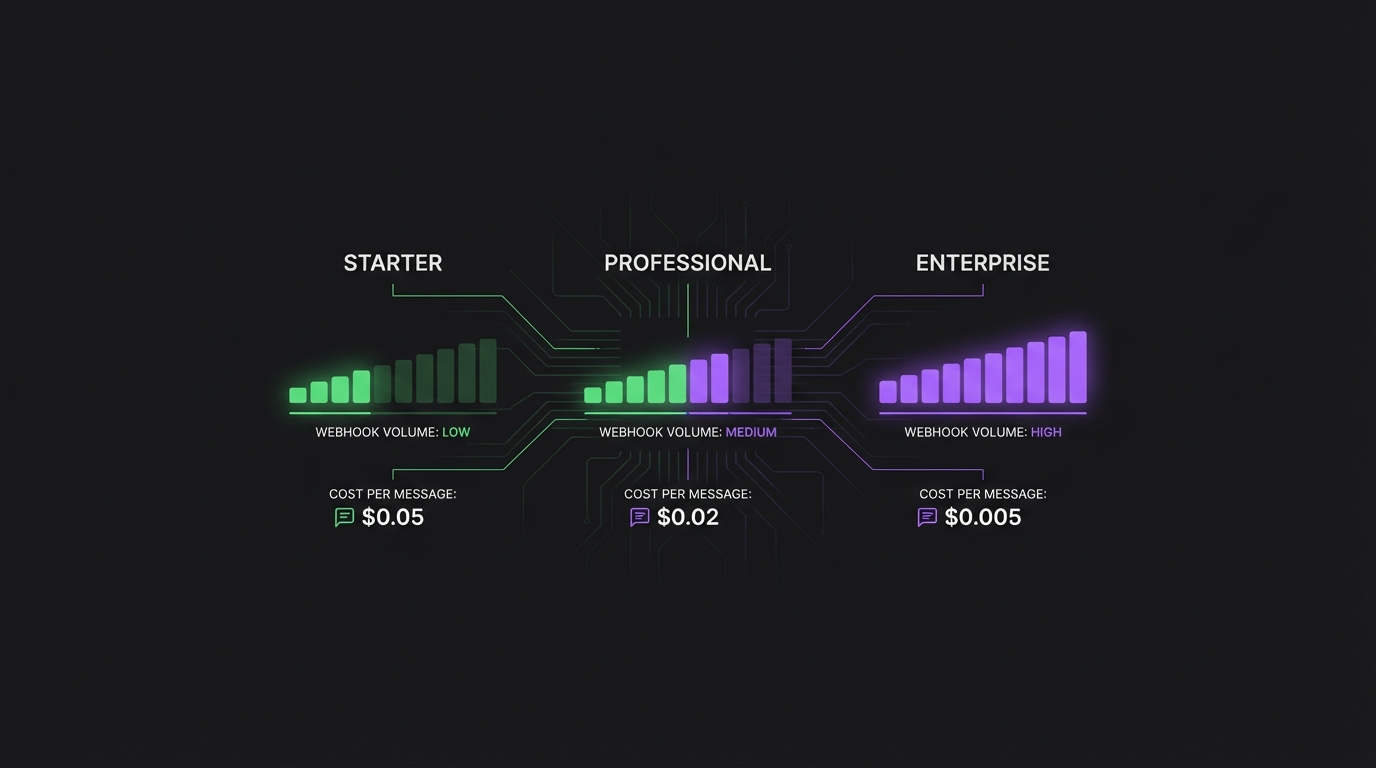
Webhook Pricing Explained: What Startups Need to Know
Webhook pricing is opaque. Pages have asterisks, "contact sales" buttons block real numbers, and true costs remain hidden until your first invoice.
This guide breaks down how webhook services price offerings, what hidden costs lurk, and how to estimate real spend before committing. If you're deciding whether to build or buy, see our build vs buy guide first.
The Three Common Pricing Models
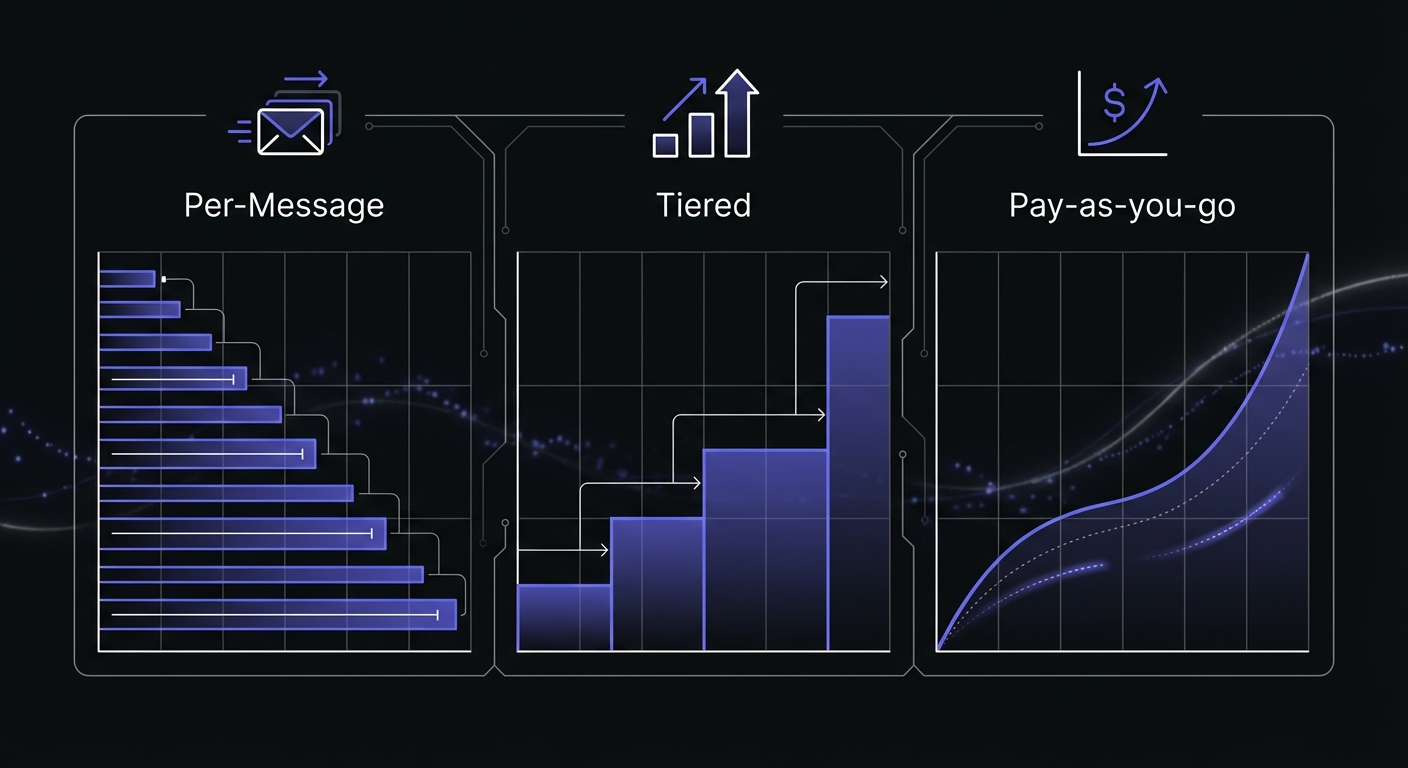
Per-Message Pricing
You pay a fixed rate per webhook delivered: send 100,000, pay for 100,000.
Pros:
- Predictable unit economics
- Pay only for what you use
- Easy to calculate costs from usage projections
Cons: Costs spike during traffic bursts. May not include retries. Often lacks volume discounts at lower tiers.
Typical range: $0.0001-0.001 per message depending on volume and provider.
Tiered Subscription Pricing
Bundle messages per month with features at each level.
Pros: Predictable bills, feature unlocks, support improvements.
Cons: Wasted spend if you don't use allocation, expensive overages, feature gating forces upgrades.
Most common model in webhook space.
Usage-Based (Pay-As-You-Go) Pricing
Charges based on actual consumption with no upfront commitment. Bills fluctuate monthly.
Pros: Zero waste, smooth scaling, low barrier to entry.
Cons: Unpredictable spend, expensive at scale without volume discounts, may lack support SLAs.
Works well for variable workloads but makes budgeting difficult.
What's Included (and What's Not)
Retries: Free or Extra?
Some providers count each retry as a separate message. If your average webhook requires 1.3 attempts, your effective cost is 30% higher.
Ask: "Are retries counted against my quota?"
Hook Mesh: Unlimited retries in all plans. One message count, regardless of delivery attempts.
Per-Endpoint Fees
Some providers charge per endpoint (destination URL). For B2B SaaS with 500 customers, this can exceed message costs.
Ask: "Is there an endpoint limit and overage cost?"
Hook Mesh: No per-endpoint fees. Pay by messages, not destinations.
Overage Costs
Exceed your allocation and overage rates kick in—often 2-5x your base cost.
Ask: "What's the overage rate and is there a cap?"
Hook Mesh: Overages at the same effective rate. Alerts at 80% and 90% usage.
Message Size Limits
Most providers set max payload sizes (64KB-1MB). Verify limits match your needs if sending large payloads.
Provider Pricing Comparison
Let's compare actual pricing across major webhook infrastructure providers as of early 2026.
| Provider | Entry Price | Mid-Tier | Business/Enterprise | Free Tier |
|---|---|---|---|---|
| Svix | $490/mo | Custom | Custom | Self-hosted only |
| Hookdeck | $39/mo | $99/mo | $499/mo | Yes (limited) |
| Convoy | $99/mo | Custom | Custom | Yes (limited) |
| Hook Mesh | $39/mo | $99/mo | $249/mo | Yes (10K messages) |
Svix ($490/month)
Enterprise standard with SOC 2 Type II and HIPAA. $490 Pro plan includes 1M messages.
Best for: Companies with compliance requirements. Hook Mesh vs Svix comparison.
Caveat: No affordable entry point for startups. Large jump from free to $490.
Hookdeck ($39-499/month)
Flexible tiers from $39 (100K messages) to $499 (higher volumes).
Best for: Middle-ground pricing between budget and enterprise. Hook Mesh vs Hookdeck comparison.
Caveat: Higher tiers required for custom retry policies and transformations.
Convoy ($99/month)
Open-source webhook gateway with managed cloud offering starting at $99.
Best for: Teams valuing open-source and potential self-hosting.
Caveat: Managed pricing jumps quickly; self-hosting requires operational investment.
Hook Mesh ($0-249/month)
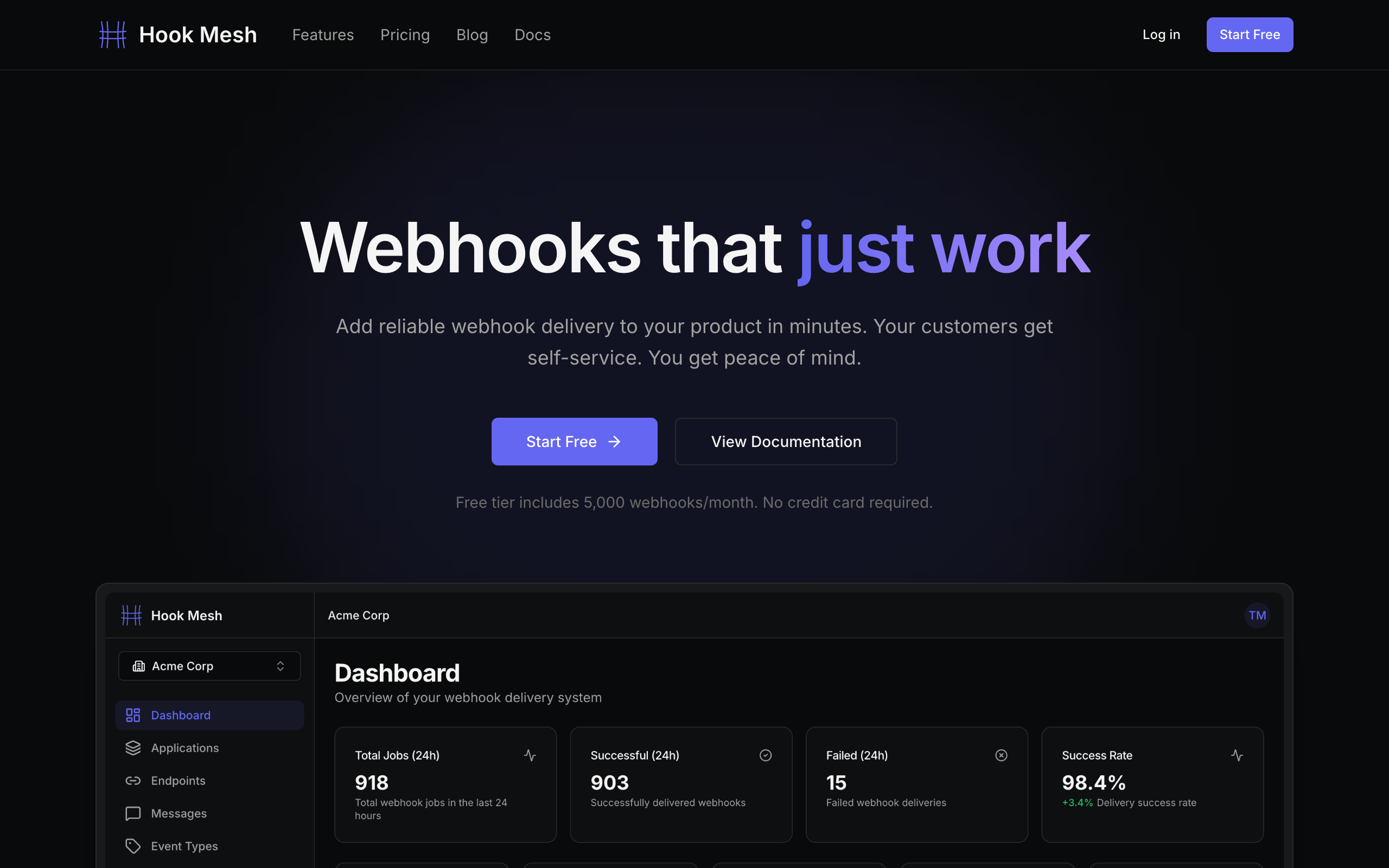
- Free: 10K messages/month, 3-day retention, community support
- Starter ($39/mo): 100K messages/month, 7-day retention, email support
- Growth ($99/mo): 500K messages/month, 14-day retention, priority support
- Business ($249/mo): 2M messages/month, 30-day retention, dedicated support, SLA
Best for: Startups and SMBs needing production-grade webhooks. Webhooks for startups.
Limitation: No SOC 2 Type II (in progress) or HIPAA yet. Use Svix if required today.
Hidden Costs to Watch For
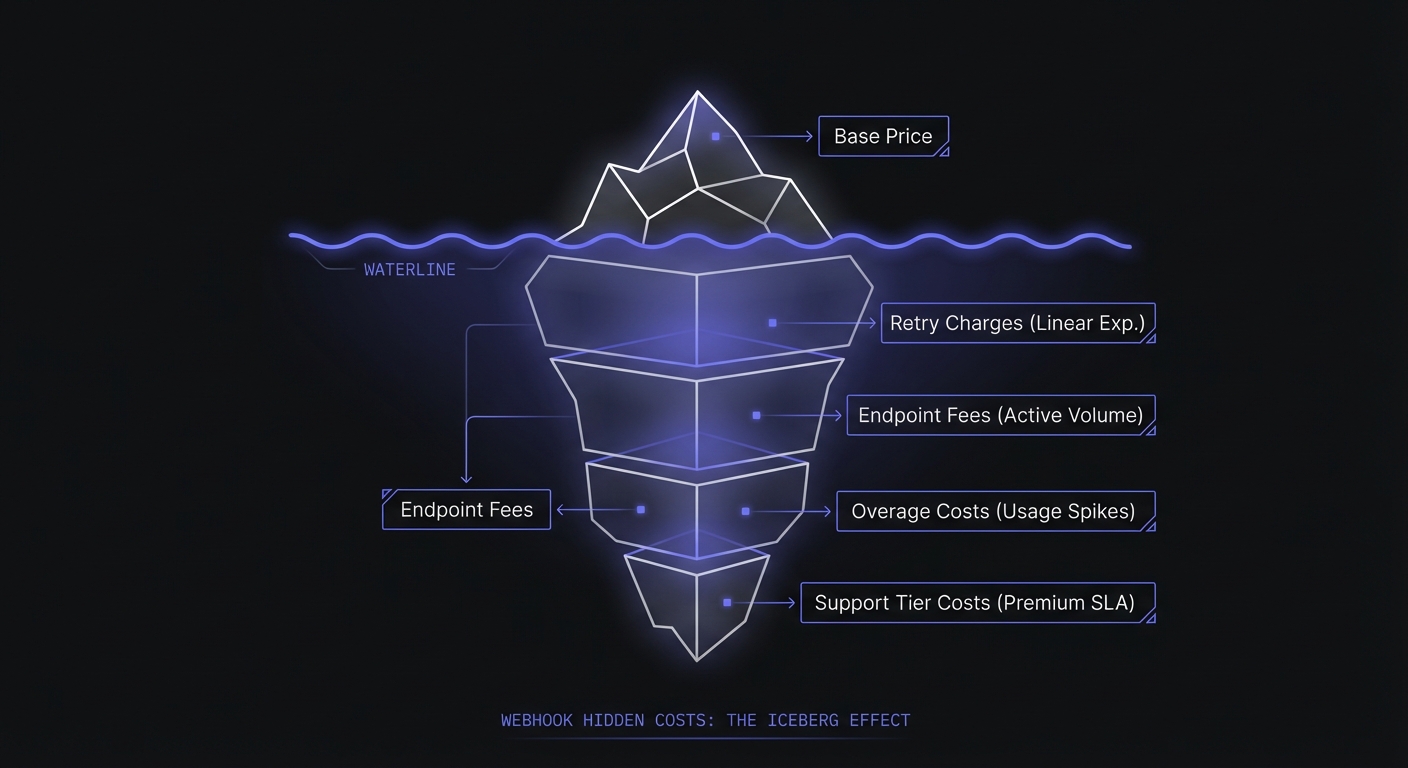
Beyond the pricing page, several less-obvious costs can impact your total spend.
Support Tier Gating
Lower tiers often have email-only support. Faster response and dedicated support require upgrades.
Ask:
- Response time SLA at my tier?
- Emergency support for production incidents?
- Phone/video support costs?
Feature Gates
Essential features often locked behind higher tiers:
- Custom retry schedules
- Webhook transformations
- Advanced filtering
- Multiple environments
Review feature matrix carefully. $39/month might become $249/month once you need required features.
Compliance Add-Ons
Enterprise compliance features (SOC 2 reports, HIPAA BAAs, custom retention, dedicated infrastructure) carry premium pricing. Can force you to enterprise pricing sooner than expected.
Integration and Migration Costs
Switching providers requires engineering time for SDKs, testing, customer communication, and parallel running. Use choosing a webhook provider checklist to evaluate systematically and choose one you can grow with.
How to Estimate Your Webhook Costs
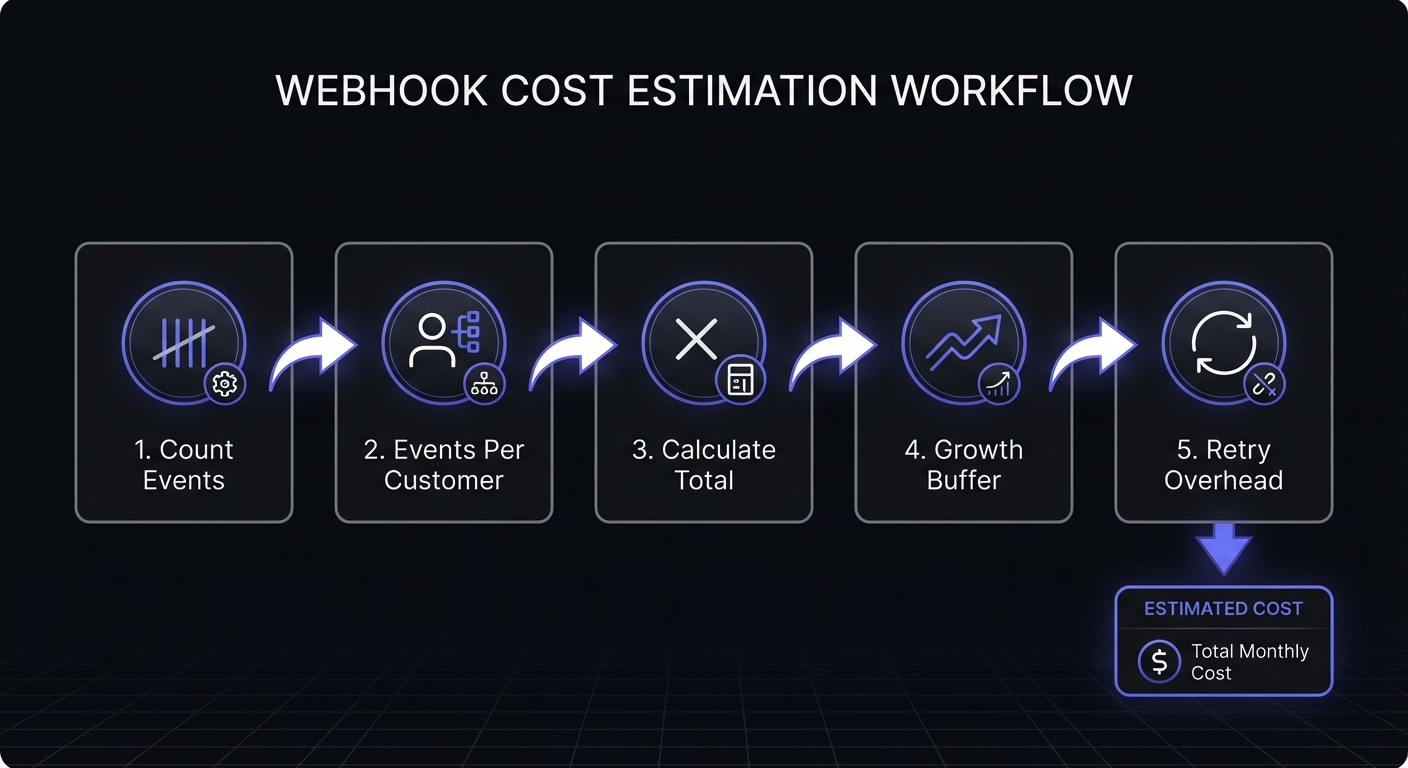
Before committing to a provider, estimate your monthly message volume:
Step 1: Count Your Webhook Event Types
List every event type your application sends via webhooks. Common examples:
- User created/updated/deleted
- Order placed/shipped/delivered
- Payment succeeded/failed
- Subscription started/cancelled
Step 2: Estimate Events Per Customer
For each event type, estimate how often it fires per customer per month. A typical B2B SaaS might see:
- User events: 5-10 per customer/month
- Transaction events: 20-100 per customer/month
- Activity events: 100-1000 per customer/month
Step 3: Calculate Total Monthly Messages
Monthly Messages = (Events per Customer) x (Number of Customers with Webhooks)
If 30% of your 1,000 customers use webhooks and average 200 events each:
Monthly Messages = 200 x 300 = 60,000 messages
Step 4: Add Growth Buffer
Add 50-100% buffer for next 12 months growth when choosing your plan.
Step 5: Factor in Retry Overhead
If the provider charges for retries, multiply by your expected retry rate (typically 1.1-1.3x for well-behaved endpoints).
Why Hook Mesh Has Transparent Pricing
We built Hook Mesh after experiencing webhook pricing frustration firsthand. As startup operators, we needed reliable webhooks but couldn't justify $500+/month for non-core infrastructure.
Our philosophy:
- Free tier that works: 10K messages to build and validate
- Honest feature access: Retries, signatures, logging, customer portal on all plans
- Predictable scaling: Linear tiers, no sudden 5x cliffs
- No endpoint taxes: Pay for messages, not destinations
- Retries included: One count regardless of delivery attempts
Not right for everyone. Need HIPAA? Use Svix. Need self-hosting? Use Convoy. Need reliable, affordable webhooks? Hook Mesh.
Making Your Decision
Calculate true total cost:
- Base tier price for your volume
- Expected overages based on traffic variability
- Add-ons for features you need
- Support tier required
- Future compliance requirements
Cheapest today might be most expensive in 18 months. Choose a provider whose pricing scales with your trajectory.
Ready for transparent webhook pricing? Start with Hook Mesh's free tier—10,000 messages/month with no credit card required. Get started in 5 minutes
Have questions about pricing? We publish our complete pricing with no hidden fees. View pricing details or book a call to discuss your specific use case.
Related Posts
Build vs Buy: Webhook Infrastructure Decision Guide
A practical guide for engineering teams deciding whether to build webhook delivery infrastructure from scratch or use a managed service. Covers engineering costs, timelines, and when each approach makes sense.
Choosing a Webhook Provider: A Checklist for Startup CTOs
A comprehensive evaluation checklist for technical leaders choosing a webhook provider. Covers reliability, security, developer experience, pricing, and the red flags to avoid.
The True Cost of Building Webhooks In-House
A detailed breakdown of what it really costs to build, maintain, and scale webhook infrastructure internally. Engineering time, infrastructure expenses, hidden costs, and opportunity cost compared to using a managed service.
Hook Mesh vs Svix: Which Webhook Service is Right for You?
An honest comparison of Hook Mesh and Svix webhook delivery services. Learn about pricing, features, and which solution fits your startup or SMB best.
Webhooks for Startups: A Practical Guide
A comprehensive guide for startup founders and engineers on implementing webhooks - when to add them, what to build first, and how to scale without over-engineering.