Choosing a Webhook Provider: A Checklist for Startup CTOs
A comprehensive evaluation checklist for technical leaders choosing a webhook provider. Covers reliability, security, developer experience, pricing, and the red flags to avoid.
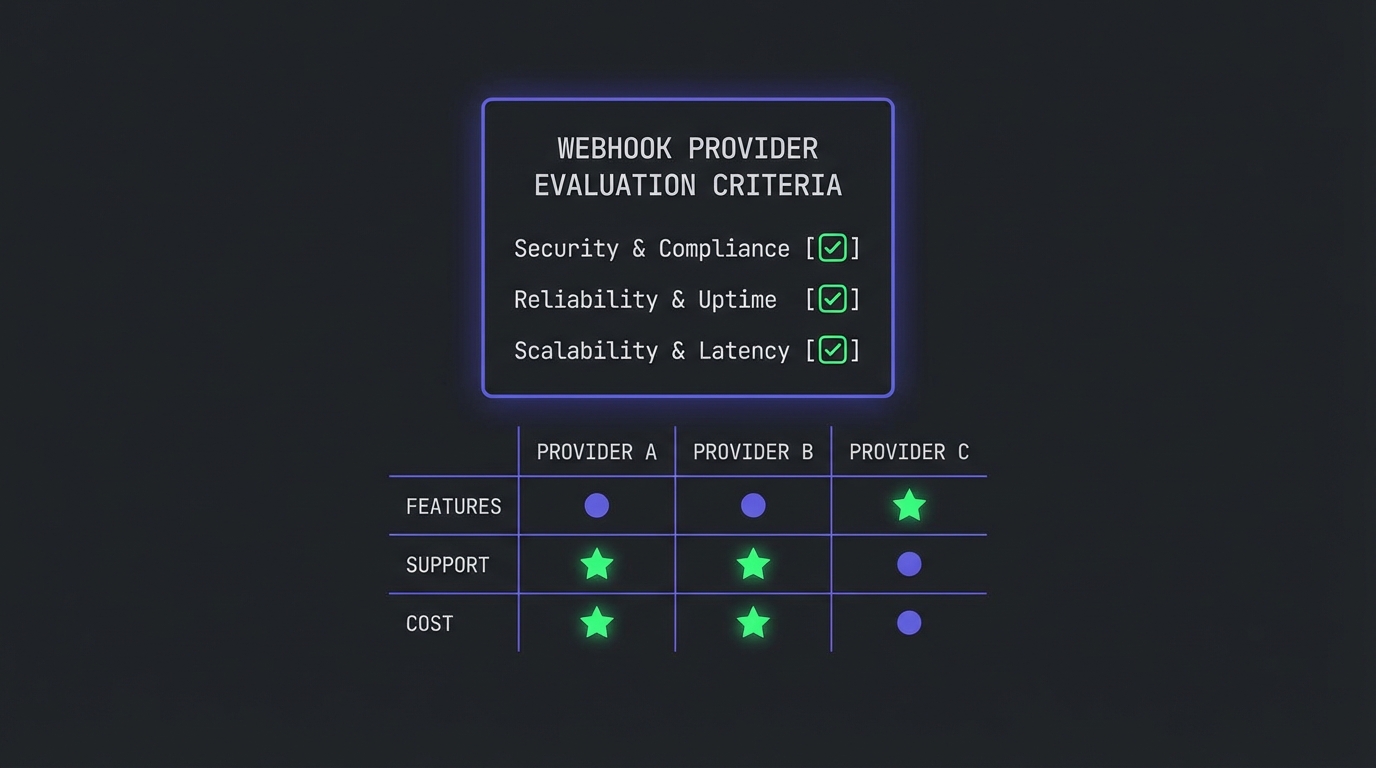
Choosing a Webhook Provider: A Checklist for Startup CTOs
At scale, webhooks become your integration backbone—from payment notifications to CRM syncs to automation. Choosing wrong means lost events, frustrated customers, and wasted engineering time.
This guide gives you a framework to choose a provider that scales with your startup—without hidden gotchas.
A webhook failure isn't just a technical issue. No delivery = customer loses revenue. Silent failure = wrong orders. Your infrastructure impacts customer trust directly.
Building in-house reveals complexity: retry logic, failure handling, debugging tools, signing, rate limiting, 99.99% uptime operations. See build vs buy decision and true cost analysis for why buying often makes sense.
Most startups reach breaking point at Series A or their first enterprise customer demanding SLAs. Choose wisely.
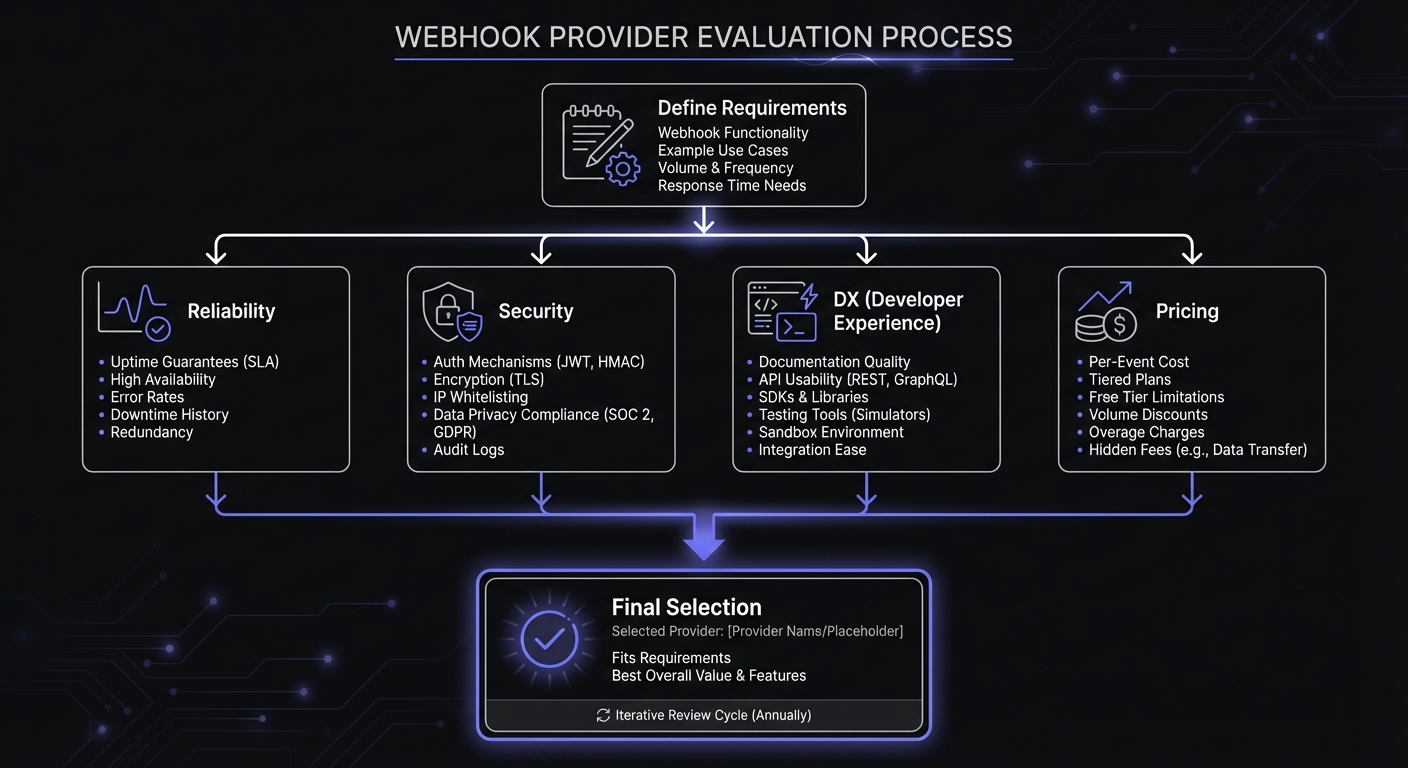
The Complete Evaluation Checklist
Reliability and Infrastructure
Must-have features:
- Published SLA with financial backing (target: 99.95%+ uptime)
- Automatic retries with configurable exponential backoff
- Circuit breaker patterns to protect failing endpoints
- Multi-region redundancy and failover
- Event persistence and replay capability
- Real-time system status page with incident history
Questions to ask:
- What's your retry policy, and can customers customize it?
- How long do you persist events for replay?
- What happens during a provider outage—are events queued or lost?
- Can you share post-mortems from recent incidents?
Red flag: Providers who can't share uptime metrics or incident history. If they're not transparent about reliability, assume the worst.
Security and Compliance
Must-have features:
- HMAC signature verification on all webhooks
- HTTPS-only delivery (no HTTP fallback)
- SOC 2 Type II certification
- GDPR compliance with data processing agreements
- IP allowlisting options for enterprise customers
- Timestamp validation to prevent replay attacks
- Secret rotation without downtime
Questions to ask:
- How are signing secrets stored and rotated?
- What's your data retention policy, and where is data stored geographically?
- Can we get a copy of your SOC 2 report?
- Do you support customer-managed encryption keys?
Red flag: Providers without SOC 2 certification. Enterprise customers will ask, and you'll lose deals.
Developer Experience
Must-have features:
- Well-documented REST API with OpenAPI spec
- SDKs for major languages (Node.js, Python, Go, Ruby at minimum)
- Interactive webhook testing playground
- Local development tools or CLI
- Comprehensive code examples and tutorials
- Webhook payload builder and validator
- Clear versioning and migration guides
Questions to ask:
- How do you handle breaking API changes?
- What's the typical integration time for a new customer?
- Can I try the product in a sandbox before committing?
Red flag: Documentation that's outdated, incomplete, or requires contacting sales to access. If they can't document their product well, they can't build it well either.
Customer-Facing Experience
Must-have features:
- Customer portal for endpoint management
- Searchable delivery logs with full payload visibility
- Manual retry functionality for customers
- Delivery status and failure notifications
- White-label or embedded options
- Endpoint health monitoring and alerts
- Customer-accessible webhook history
Questions to ask:
- Can our customers access logs without going through our support team?
- How far back can customers search delivery history?
- Can we customize the portal branding to match our product?
Red flag: No customer-facing portal or logging. You'll become the middleman for every debugging session.
Pricing and Cost Predictability
Must-have features:
- Transparent, published pricing (no "contact sales" for basic tiers)
- Event-based pricing that scales predictably
- Free tier or trial for evaluation
- No charges for retries or failed deliveries
- Volume discounts at scale
- Clear overage policies
Questions to ask:
- What counts as a billable event?
- Are retries counted toward our event quota?
- What happens if we exceed our plan limits?
- Can you model our costs at 10x and 100x current volume?
Red flag: Pricing per retry or endpoint. Creates perverse incentives and unpredictable bills. See webhook pricing explained for details.
Support and Partnership
Must-have features:
- Published support SLAs by tier
- Multiple support channels (email, chat, and phone for critical issues)
- Dedicated account management for growth-stage companies
- Technical onboarding assistance
- Regular product updates and roadmap visibility
- Active community or developer forum
Questions to ask:
- What's your average response time for critical issues?
- Will we have a dedicated point of contact?
- How do you gather and prioritize customer feedback?
Red flag: Support only available through email with 48+ hour response times. Webhook issues are time-sensitive by nature.
Red Flags Summary: Walk Away If You See These
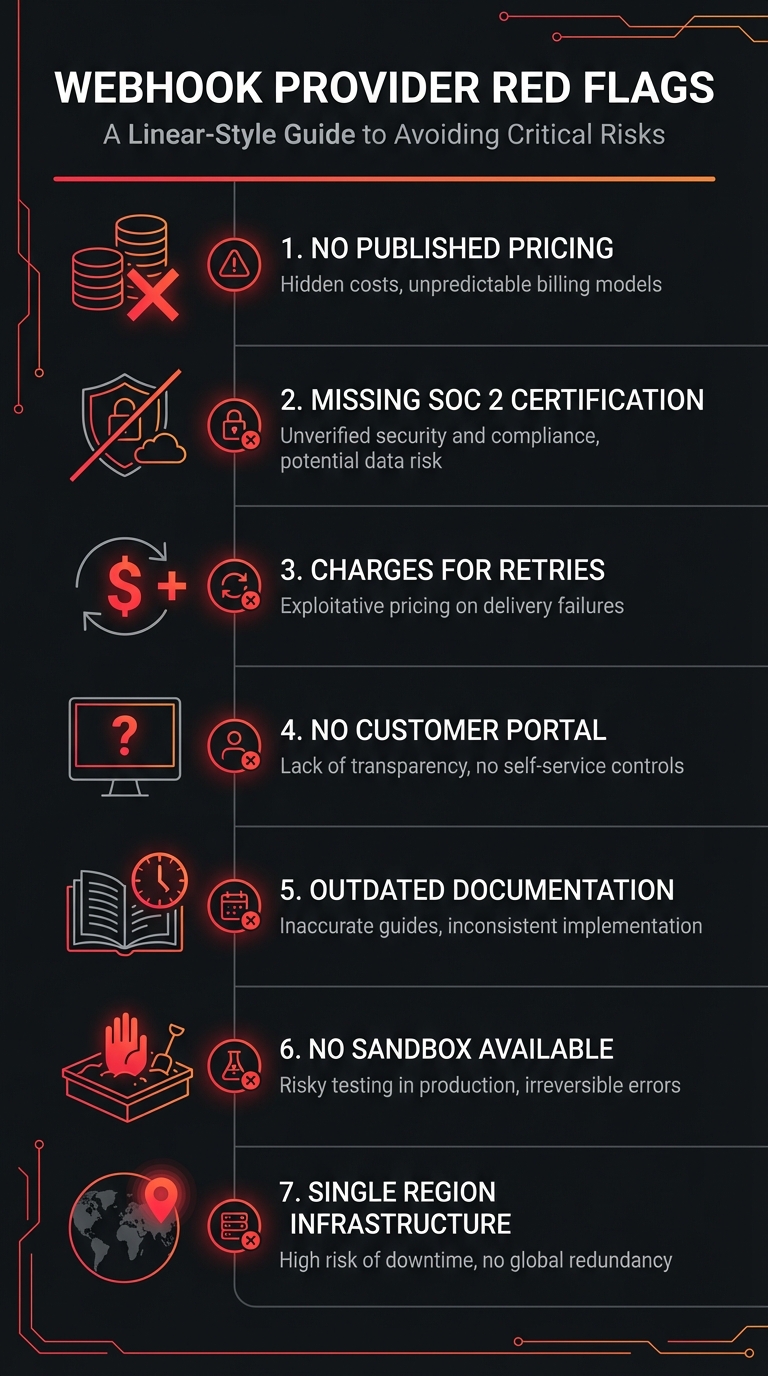
Not every provider will meet every checkbox, but some signals indicate fundamental problems:
- No published pricing — They'll charge what they think you'll pay
- Missing SOC 2 certification — Security isn't a priority
- Charging for retries — Misaligned incentives that punish reliability
- No customer-facing portal — Your support team becomes their support team
- Outdated documentation — The product is likely neglected too
- No sandbox or trial — They know the product won't sell itself
- Single-region infrastructure — One outage takes down all your webhooks
The Vendor Evaluation Questions
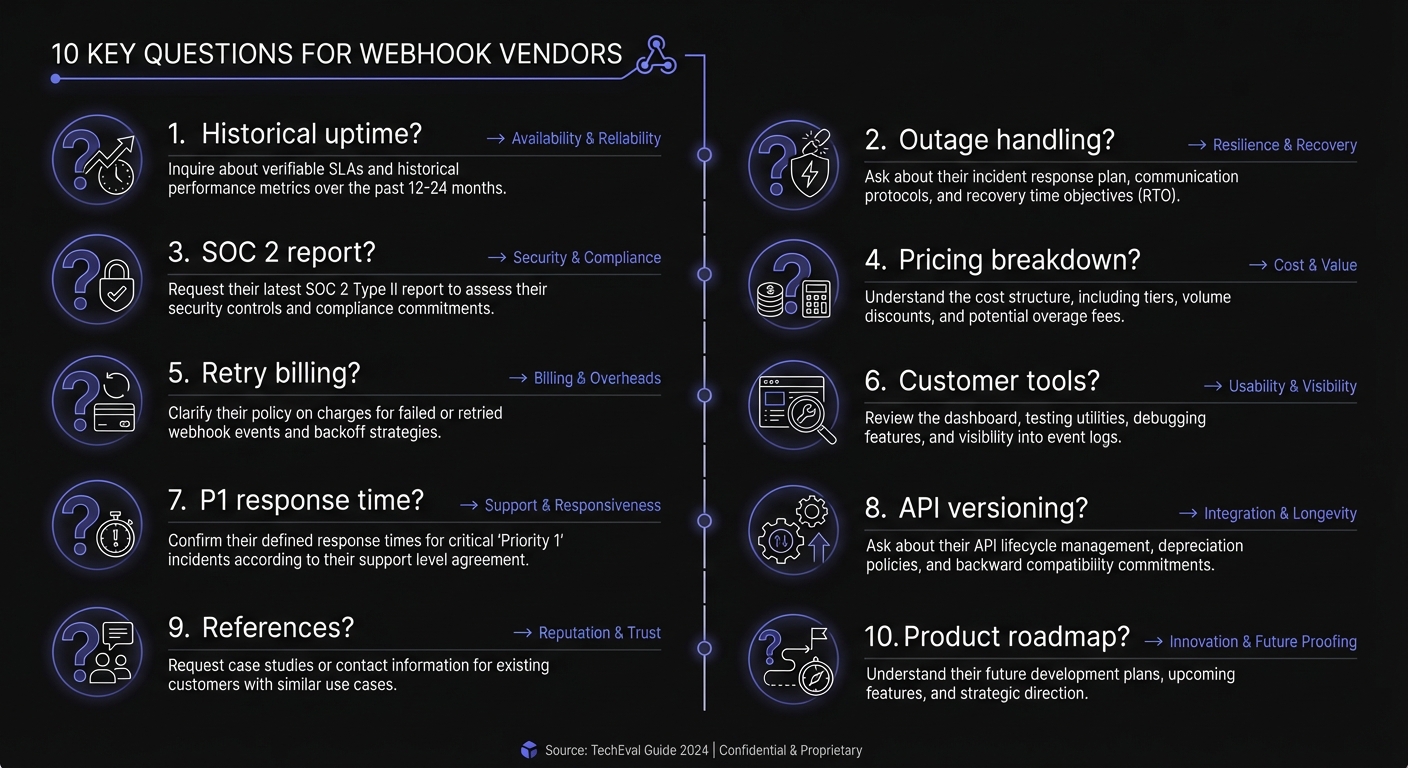
Before signing, get answers to these ten questions:
- What's your historical uptime over the past 12 months?
- How do you handle events during an outage?
- Can I see your SOC 2 Type II report?
- What's included in your base pricing vs. add-ons?
- How do retries affect my billing?
- What customer-facing tools are included?
- What's your typical response time for P1 issues?
- How do you handle API versioning and breaking changes?
- Can you share references from companies at our stage?
- What's on your product roadmap for the next 12 months?
Why Startups Choose Hook Mesh
Built specifically for startups and SMBs needing enterprise-grade infrastructure without enterprise complexity.
What we get right:
- Reliability: 99.99% uptime SLA, automatic retries, circuit breakers, multi-region redundancy
- Security: SOC 2 Type II certified, HMAC signatures, HTTPS-only delivery
- Developer experience: SDKs in 7 languages, interactive playground, documentation engineers enjoy
- Customer experience: Full-featured portal with searchable logs and self-service retries
- Pricing: Transparent event-based, no retry charges, free for early-stage startups
- Support: Humans responding in hours, dedicated support for growing teams
Printable Checklist
Save this checklist for your evaluation process:
WEBHOOK PROVIDER EVALUATION CHECKLIST

RELIABILITY
[ ] 99.95%+ uptime SLA
[ ] Automatic retries with backoff
[ ] Circuit breaker patterns
[ ] Multi-region redundancy
[ ] Event replay capability

SECURITY
[ ] HMAC signature verification
[ ] HTTPS-only delivery
[ ] SOC 2 Type II certified
[ ] GDPR compliant

DEVELOPER EXPERIENCE
[ ] Documented REST API
[ ] SDKs for major languages
[ ] Testing playground
[ ] Local dev tools

CUSTOMER EXPERIENCE
[ ] Self-service portal
[ ] Searchable delivery logs
[ ] Manual retry functionality
[ ] Endpoint health monitoring

PRICING
[ ] Transparent pricing
[ ] No retry charges
[ ] Free tier available
[ ] Predictable scaling costs

SUPPORT
[ ] Published SLAs
[ ] Multiple channels
[ ] Reasonable response times

RED FLAGS (walk away if present)
[ ] No published pricing
[ ] Missing SOC 2
[ ] Charges for retries
[ ] No customer portal
[ ] Single-region only
Make the Right Choice
Choosing a provider is a decision for years. Wrong choice = technical debt, frustration, distraction. Right choice = reliable infrastructure that scales.
Use this checklist. Ask hard questions. See Hook Mesh vs Svix and Hook Mesh vs Hookdeck for comparisons. When ready, see how Hook Mesh compares.
Related Posts
Build vs Buy: Webhook Infrastructure Decision Guide
A practical guide for engineering teams deciding whether to build webhook delivery infrastructure from scratch or use a managed service. Covers engineering costs, timelines, and when each approach makes sense.
Webhook Pricing Explained: What Startups Need to Know
A transparent guide to webhook service pricing models. Learn about per-message fees, tiered subscriptions, hidden costs, and how to estimate your true webhook infrastructure spend.
Hook Mesh vs Svix: Which Webhook Service is Right for You?
An honest comparison of Hook Mesh and Svix webhook delivery services. Learn about pricing, features, and which solution fits your startup or SMB best.
Hook Mesh vs Hookdeck: A Startup-Focused Comparison
An honest comparison between Hook Mesh and Hookdeck for webhook delivery. Learn which solution fits your startup's needs, budget, and technical requirements.
Webhooks for Startups: From MVP to Scale
The definitive guide for startup founders and engineers on implementing webhooks - from your first integration to handling millions of events. Learn when to add webhooks, how to scope your MVP, avoid common pitfalls, and scale confidently.