Webhooks for Startups: A Practical Guide
A comprehensive guide for startup founders and engineers on implementing webhooks - when to add them, what to build first, and how to scale without over-engineering.

Webhooks for Startups: A Practical Guide
You've shipped your MVP. Users are signing up. And now your first enterprise prospect asks: "Do you have webhooks?"
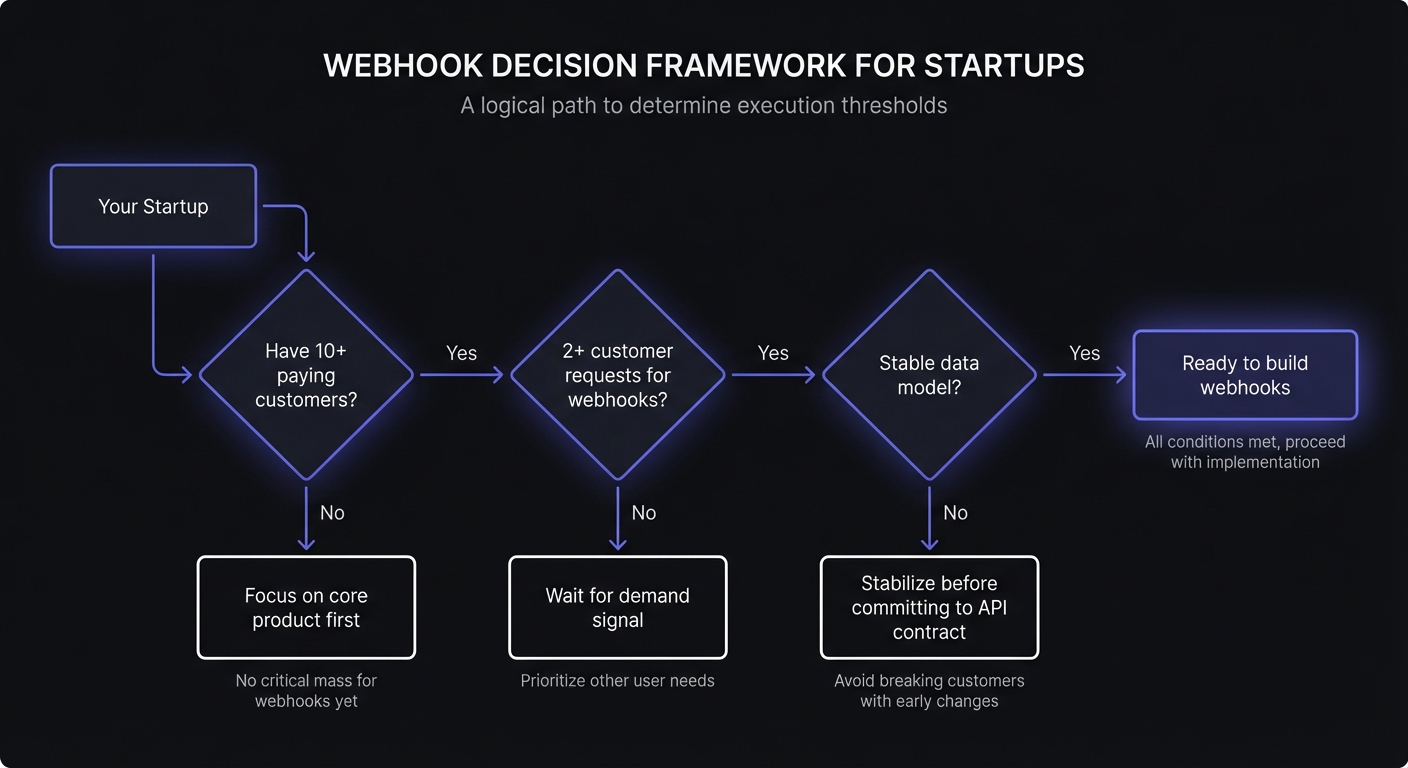
If you're an early-stage startup founder or engineer, this question can feel like a fork in the road. Build webhooks now and delay other features? Or punt and risk losing the deal?
This guide will help you make that decision - and if you choose to build, show you exactly how to do it without over-engineering or burning precious runway.
Why Webhooks Matter for Startups
Let's be direct: webhooks aren't just a nice-to-have feature. For many startups, they're a strategic inflection point.
The Integration Imperative
Your customers don't use your product in isolation. They use Slack, Salesforce, HubSpot, their own internal tools, and dozens of other services. When something happens in your app, they need that information elsewhere - immediately.
Without webhooks, your customers resort to:
- Manually copying data between systems
- Building polling scripts that hammer your API
- Hiring developers to create brittle workarounds
- Eventually churning to competitors who offer integrations
With webhooks, you give them real-time data flow. When a user signs up, their CRM knows instantly. When a payment fails, their alerting system fires. When a task completes, their dashboard updates.
The Platform Play
Here's what experienced founders understand: webhooks transform your product from a tool into a platform.
Stripe didn't become a $95B company just by processing payments. They became the infrastructure layer that thousands of businesses build on top of. Webhooks are central to that - they're what enable the ecosystem.
When you offer webhooks, you're telling customers: "Build on us. Integrate us into your workflows. Make us indispensable."
For startups, this creates compounding advantages:
- Stickier customers - deeply integrated products are harder to replace
- Word-of-mouth growth - developers recommend tools that play well with others
- Partnership opportunities - integration partners bring distribution
- Higher contract values - platform products command premium pricing
Real Startup Scenarios
Let's ground this in examples you'll actually encounter:
Payment notifications: You're building a SaaS product. When a subscription renews, fails, or gets cancelled, your customer's finance team needs to know. They want those events in their accounting software, their Slack channel, and their internal dashboards. Without webhooks, you're fielding support tickets. With them, you're invisible infrastructure.
User lifecycle events: A customer wants to sync new user signups to their email marketing platform, update their analytics when users complete onboarding, and alert sales when high-value actions occur. Webhooks make you the source of truth they build around.
Integration triggers: Your customer uses Zapier or Make to connect hundreds of tools. Your webhooks become the starting point for workflows you never anticipated - automations that make your product exponentially more valuable without you writing a line of code.
When to Add Webhooks: Timing in Your Product Lifecycle
Not every startup needs webhooks on day one. Here's how to think about timing. For a deeper dive on this decision, see our guide on when your startup should add webhooks.
Signs You're Ready
Customer demand is real, not hypothetical. You have actual customers asking for webhooks, not just a theoretical future need. Better yet, you've lost a deal or two because you didn't have them.
Your core product is stable. Webhooks expose your internal events to the outside world. If your data model is still shifting weekly, you'll create a maintenance nightmare. Wait until your core entities and events are reasonably settled.
You have the bandwidth to do it right. A broken webhook implementation is worse than none. Failed deliveries, missing retries, and unclear documentation will generate more support burden than value. Make sure you can invest in reliability.
Integration is part of your value proposition. If your product inherently needs to connect with other tools (B2B SaaS, developer tools, data platforms), webhooks should be earlier on your roadmap.
Signs It's Too Early
You're still searching for product-market fit. If you're pivoting every few weeks, don't lock yourself into a webhook contract with customers. Focus on finding what works first.
No one has actually asked. Building webhooks because "we might need them someday" is a classic over-engineering trap. Your time is better spent on features with proven demand.
Your team is underwater. Webhooks require ongoing maintenance - handling edge cases, scaling infrastructure, updating documentation. If you're already drowning, adding more surface area won't help.
The Timing Sweet Spot
For most startups, the right time is when you have:
- 10+ paying customers
- At least 2-3 explicit requests for webhooks or integrations
- A reasonably stable core data model
- 1-2 weeks of engineering time you can dedicate to the initial build
What to Build First: Your Minimum Viable Webhook System
Here's where many startups go wrong: they either over-engineer a complex eventing system, or they hack together something so fragile it becomes a support nightmare. We've documented the most common webhook mistakes startups make to help you avoid these pitfalls.
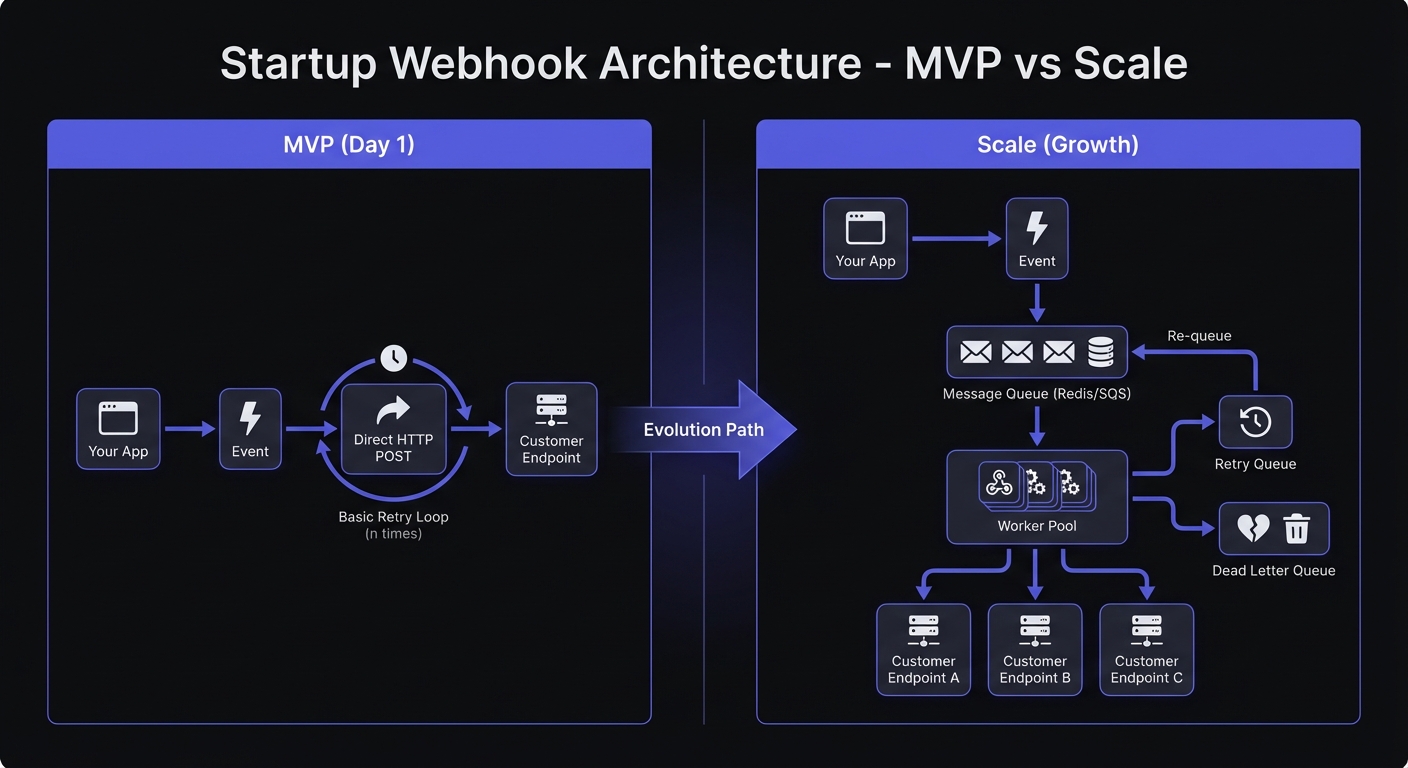
Let's walk through what a minimum viable webhook system actually looks like. For the complete technical blueprint, check out our MVP webhook architecture guide.
Start With One Event
Don't try to webhook-enable your entire application at once. Pick the single most valuable event - usually the one customers are explicitly asking for.
Common starting points:
payment.completedfor fintech or billing productsuser.createdfor B2B SaaSorder.placedfor e-commercetask.completedfor productivity tools
Ship one event. Get feedback. Iterate.
The Minimum Feature Set
Your V1 needs exactly these capabilities:
Endpoint registration: Let customers specify a URL to receive events. Start with one endpoint per customer. Multiple endpoints can come later.
Payload delivery: When the event occurs, POST a JSON payload to their URL. Include a timestamp, event type, and the relevant data.
Basic retry logic: If delivery fails, retry a few times with backoff. Three retries over an hour is fine for V1.
Delivery logging: Show customers whether their webhooks were delivered successfully. This saves you hours of "did you send it?" support conversations.
Endpoint verification: Before accepting a customer's webhook URL, verify they own it. Send a test event and require them to acknowledge receipt - either by returning a 200 or echoing back a challenge token. This prevents customers from accidentally (or maliciously) pointing webhooks at URLs they don't control.
That's it. No complex filtering, no transformation layers, no fan-out to multiple endpoints. Those can come in V2.
The Build vs. Buy Decision
Here's an honest assessment of your options. For a comprehensive analysis, see our build vs buy webhook infrastructure guide:
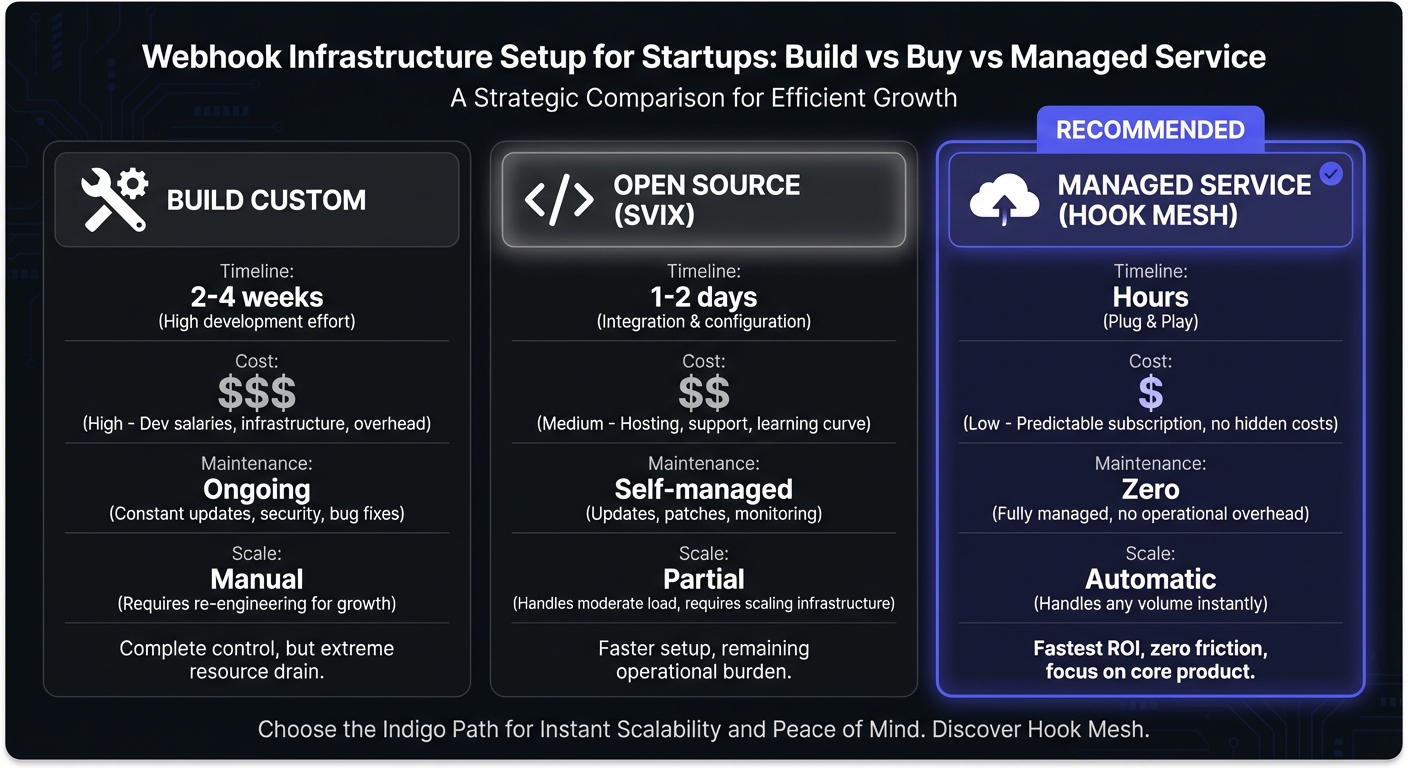
Building from scratch works if:
- You have strong infrastructure engineering skills on the team
- Your scale is modest (hundreds of customers, not thousands)
- You have time to handle edge cases as they emerge
- You're okay maintaining this system indefinitely
Using a webhook service makes sense if:
- You want to ship in days, not weeks
- Reliability and scale matter (enterprise customers, high event volume)
- Your engineering team should focus on core product, not infrastructure
- You need features like signature verification, detailed analytics, or compliance
For most startups, the calculus favors using a service. Your time is your scarcest resource. Every week spent building and maintaining webhook infrastructure is a week not spent on features that differentiate your product.
Practical Advice: Start Simple, Iterate, Don't Over-Engineer
After watching hundreds of startups implement webhooks, here's what separates success from struggle:
Do This
Document early. Even for V1, write clear docs explaining your event format, authentication method, and retry behavior. Future-you will thank present-you.
Use standard patterns. Include a signature header so customers can verify payloads came from you. Follow conventions from well-documented APIs like Stripe or GitHub. Learn more about HMAC-SHA256 signature verification for implementation details.
Make debugging easy. Provide a way to see recent delivery attempts and their outcomes. A simple table showing timestamp, status code, and response time saves hours of back-and-forth.
Set expectations. Tell customers your retry policy, expected latency, and any delivery guarantees. Under-promise and over-deliver.
Avoid This
Don't build a generic event bus. You're not building Kafka. You're building a feature. Resist the urge to create elaborate internal pub/sub systems.
Don't promise ordering guarantees you can't keep. Distributed systems are hard. If you can't guarantee exactly-once ordered delivery, don't claim to.
Don't forget about failure modes. Customers will configure broken endpoints. They'll let SSL certificates expire. They'll return 500 errors. Handle these gracefully.
Don't treat it as "done." Webhooks are a contract with your customers. Once you ship, you're committed to maintaining compatibility and reliability.
Scaling: From MVP to Growth
Your V1 architecture won't survive 10x growth. Plan for these transitions:
Asynchronous Processing
The biggest architectural leap: stop processing webhooks inline. Your initial implementation probably looks like:
// V1: Inline processing (works at low scale)
app.post('/api/events', async (req, res) => {
  await sendWebhook(event);  // Blocks until delivered
  res.json({ success: true });
});
At scale, switch to queue-based processing:
// V2: Async processing (scales)
app.post('/api/events', async (req, res) => {
  await queue.add('webhook-delivery', event);  // Returns immediately
  res.json({ success: true });  // 2xx in <100ms
});

// Separate worker process
queue.process('webhook-delivery', async (job) => {
  await sendWebhook(job.data);
});
This pattern keeps your API responsive even when customer endpoints are slow or failing. Use Redis + Bull, AWS SQS, or Google Cloud Pub/Sub depending on your stack.
Handling Retry Storms
When a customer's endpoint goes down, your retry logic kicks in. If you have 100 customers and one goes down for an hour, you might queue thousands of retry attempts. Without backpressure handling, this can overwhelm your delivery workers and delay webhooks to healthy endpoints.
Mitigation strategies:
- Per-endpoint rate limits: Cap retries per customer (e.g., 10/minute)
- Circuit breakers: After N consecutive failures, pause deliveries and alert
- Separate queues: Isolate failing endpoints from healthy ones
- Exponential backoff: Space retries at 1min, 5min, 30min, 2hr intervals
Don't Rely Solely on Webhooks
Webhook delivery isn't guaranteed. Networks fail, endpoints go down, and payloads get lost. Build your system assuming some webhooks won't arrive.
Recommendations:
- Implement reconciliation jobs: Periodically poll for missed events or offer a "sync" API
- Provide a webhook history API: Let customers fetch recent events they may have missed
- Consider a "replay" button: Let customers manually trigger re-delivery of specific events
This isn't just good architecture - it's good UX. Customers will thank you when they can recover from their own endpoint failures.
Resource Constraints: The Startup Reality
Let's acknowledge the elephant in the room: you have limited time, limited people, and a thousand competing priorities.
Building a reliable webhook system from scratch takes 2-4 weeks of focused engineering time for V1, plus ongoing maintenance. That's time not spent on features, sales, or customer success.
The hidden costs are real:
- Scaling infrastructure as you grow
- Debugging delivery failures at 2 AM
- Building monitoring and alerting
- Handling compliance requirements for enterprise deals
- Maintaining documentation as you add events
This is exactly why we built Hook Mesh. We handle the infrastructure so you can focus on your product.
Why Hook Mesh for Startups
Hook Mesh was built specifically for teams like yours - startups and SMBs who need enterprise-grade webhook delivery without enterprise-grade complexity or cost.
Ship in hours, not weeks. Our SDK integrates in a single afternoon. Define your events, point to our API, and you're delivering webhooks.
Reliability you don't have to build. Automatic retries, failure alerting, and detailed delivery logs - out of the box.
Scale without surprises. Pay for what you use, with pricing that makes sense for early-stage companies. No enterprise minimums, no surprise bills.
Focus on what matters. Every hour you're not debugging webhook infrastructure is an hour you can spend on your core product.
Your customers are asking for webhooks. Your competitors are offering them. The question isn't whether to add webhook support - it's how to do it without derailing your roadmap.
The answer is simpler than you think. Start with one event. Use the right tools. Ship this week.
Related Posts
When Should Your Startup Add Webhooks?
A practical decision guide for startup founders and product managers on the right time to invest in webhook infrastructure, what signs to watch for, and how to avoid common timing mistakes.
MVP Webhook Architecture: Start Simple, Scale Later
A practical guide for startups building their first webhook system. Learn what you need on day one versus later, avoid common over-engineering mistakes, and understand when to build versus buy.
5 Webhook Mistakes Early-Stage Startups Make
Learn the most common webhook mistakes that plague early-stage startups—from missing retry logic to over-engineering—and how to avoid them before they cost you customers.
Build vs Buy: Webhook Infrastructure Decision Guide
A practical guide for engineering teams deciding whether to build webhook delivery infrastructure from scratch or use a managed service. Covers engineering costs, timelines, and when each approach makes sense.
Webhooks for Startups: From MVP to Scale
The definitive guide for startup founders and engineers on implementing webhooks - from your first integration to handling millions of events. Learn when to add webhooks, how to scope your MVP, avoid common pitfalls, and scale confidently.