Building Webhooks with Django and Hook Mesh
A complete tutorial for Django developers on implementing webhooks—sending events from views and signals, receiving webhooks securely, signature verification, and integrating with Hook Mesh for reliable delivery.
Building Webhooks with Django and Hook Mesh
Django powers thousands of SaaS apps. This tutorial covers sending webhooks when events occur and receiving webhooks from external services securely. For more Python-specific patterns, see sending webhooks with Python and receiving and verifying webhooks in Python.
Understanding Webhooks in Django
Webhooks are HTTP callbacks—when something happens, send a POST request to a subscriber's URL. Django lets you trigger them from views or use the signal system to decouple webhook logic. The challenge is handling failures, implementing retries, and managing multiple subscribers. See our webhook implementation guides for patterns across languages.
Sending Webhooks from Django Views
# views.py
import json
import requests
from django.http import JsonResponse
from django.views.decorators.http import require_POST
from django.contrib.auth.decorators import login_required
from .models import Order

@login_required
@require_POST
def complete_order(request, order_id):
    order = Order.objects.get(id=order_id, user=request.user)
    order.status = 'completed'
    order.save()

    # Send webhook notification
    webhook_payload = {
        'event': 'order.completed',
        'data': {
            'order_id': str(order.id),
            'user_id': str(order.user.id),
            'total': str(order.total),
            'completed_at': order.updated_at.isoformat()
        }
    }

    # Direct webhook call (not recommended for production)
    try:
        requests.post(
            'https://subscriber.example.com/webhooks',
            json=webhook_payload,
            timeout=5
        )
    except requests.RequestException:
        pass  # Webhook delivery failed silently

    return JsonResponse({'status': 'completed'})
This has limitations: blocking requests, silent failures, no retries. For production, use Django signals.
Using Django Signals for Webhook Events
Signals decouple webhook sending from business logic—trigger actions on events without modifying original code.
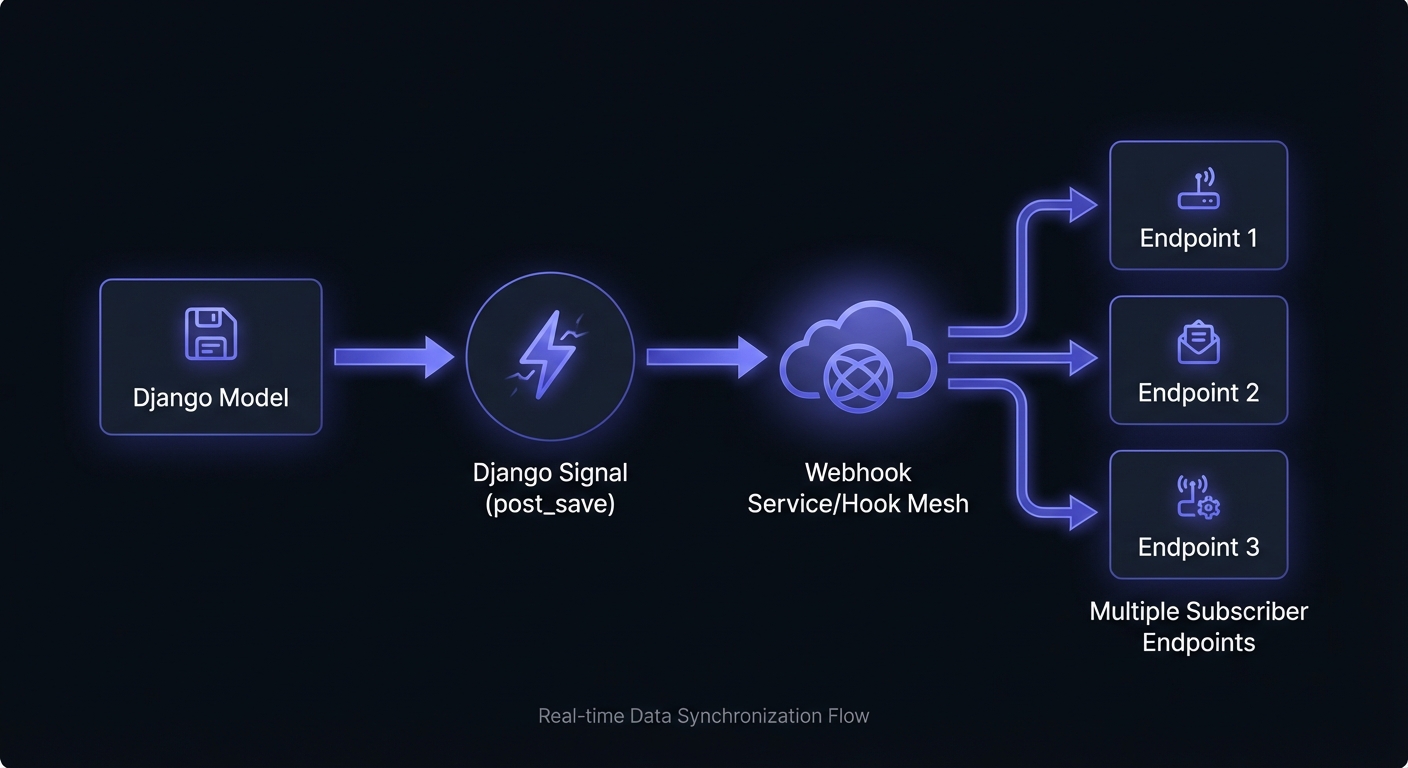
# signals.py
from django.db.models.signals import post_save
from django.dispatch import receiver
from .models import Order, Subscription

@receiver(post_save, sender=Order)
def order_saved_handler(sender, instance, created, **kwargs):
    if instance.status == 'completed':
        send_webhook_event('order.completed', {
            'order_id': str(instance.id),
            'user_id': str(instance.user.id),
            'total': str(instance.total),
            'completed_at': instance.updated_at.isoformat()
        })

@receiver(post_save, sender=Subscription)
def subscription_saved_handler(sender, instance, created, **kwargs):
    if created:
        event_type = 'subscription.created'
    else:
        event_type = 'subscription.updated'

    send_webhook_event(event_type, {
        'subscription_id': str(instance.id),
        'user_id': str(instance.user.id),
        'plan': instance.plan.name,
        'status': instance.status
    })
Don't forget to import your signals in your app's apps.py:
# apps.py
from django.apps import AppConfig

class CoreConfig(AppConfig):
    default_auto_field = 'django.db.models.BigAutoField'
    name = 'core'

    def ready(self):
        import core.signals  # noqa
Integrating Hook Mesh for Reliable Delivery
Let Hook Mesh handle delivery complexity. The Python SDK makes integration straightforward:
# webhook_service.py
from hookmesh import HookMesh
from django.conf import settings

hookmesh = HookMesh(settings.HOOKMESH_API_KEY)

def send_webhook_event(event_type: str, data: dict, customer_id: str = None):
    """Send a webhook event through Hook Mesh."""
    hookmesh.events.send(
        event_type=event_type,
        data=data,
        customer_id=customer_id  # Optional: for multi-tenant apps
    )
Update your signals to use this service:
# signals.py
from django.db.models.signals import post_save
from django.dispatch import receiver
from .models import Order
from .webhook_service import send_webhook_event

@receiver(post_save, sender=Order)
def order_saved_handler(sender, instance, created, **kwargs):
    if instance.status == 'completed':
        send_webhook_event(
            'order.completed',
            {
                'order_id': str(instance.id),
                'user_id': str(instance.user.id),
                'total': str(instance.total)
            },
            customer_id=str(instance.user.organization_id)
        )
Hook Mesh handles retries with exponential backoff, maintains delivery logs, and provides customer dashboards.
Async Webhook Sending with Celery
Celery pairs perfectly with Django for async webhook sending in high-throughput apps.
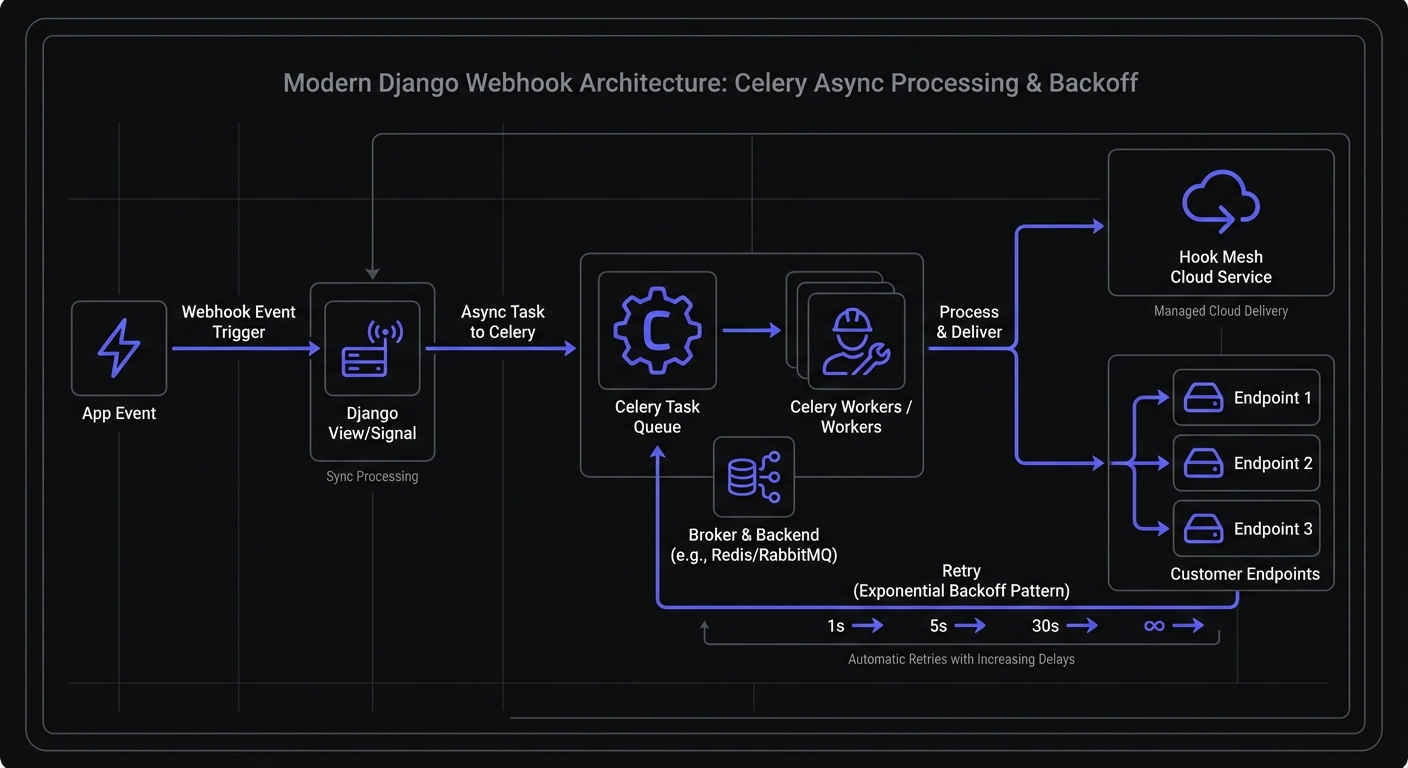
# tasks.py
from celery import shared_task
from .webhook_service import send_webhook_event

@shared_task(bind=True, max_retries=3)
def send_webhook_async(self, event_type: str, data: dict, customer_id: str = None):
    try:
        send_webhook_event(event_type, data, customer_id)
    except Exception as exc:
        self.retry(exc=exc, countdown=60 * (2 ** self.request.retries))
Then in your signals:
from .tasks import send_webhook_async

@receiver(post_save, sender=Order)
def order_saved_handler(sender, instance, created, **kwargs):
    if instance.status == 'completed':
        send_webhook_async.delay(
            'order.completed',
            {'order_id': str(instance.id), 'total': str(instance.total)},
            str(instance.user.organization_id)
        )
Django 4.1+ supports async views with httpx, but Celery is recommended for production.
Receiving Webhooks in Django
URL Configuration
Start by setting up a dedicated URL for incoming webhooks:
# urls.py
from django.urls import path
from . import views

urlpatterns = [
    path('webhooks/stripe/', views.stripe_webhook, name='stripe_webhook'),
    path('webhooks/github/', views.github_webhook, name='github_webhook'),
]
CSRF Exemption for Webhook Endpoints
Exempt webhook endpoints from Django's CSRF protection—external services don't have your CSRF token:
# views.py
import json
from django.http import JsonResponse, HttpResponse
from django.views.decorators.csrf import csrf_exempt
from django.views.decorators.http import require_POST

@csrf_exempt
@require_POST
def stripe_webhook(request):
    payload = request.body  # Raw bytes - important for signature verification
    signature = request.headers.get('Stripe-Signature', '')

    # Verify and process the webhook
    # ...

    return HttpResponse(status=200)
The @csrf_exempt decorator is critical. Without it, Django returns a 403 Forbidden response to all webhook requests.
Accessing Raw Request Body
Access the raw request body exactly as received via request.body:
@csrf_exempt
@require_POST
def incoming_webhook(request):
    # request.body returns bytes - the raw, unmodified payload
    raw_payload = request.body

    # For string operations, decode explicitly
    payload_string = raw_payload.decode('utf-8')

    # Parse JSON after verification
    try:
        data = json.loads(payload_string)
    except json.JSONDecodeError:
        return JsonResponse({'error': 'Invalid JSON'}, status=400)

    return JsonResponse({'received': True})
Never use request.POST or call json.loads() before signature verification—these can alter or reparse the data, causing signature mismatches.
Webhook Signature Verification
Signature verification ensures webhooks come from the claimed source. Most providers use HMAC-SHA256. See webhook security best practices for more authentication options.
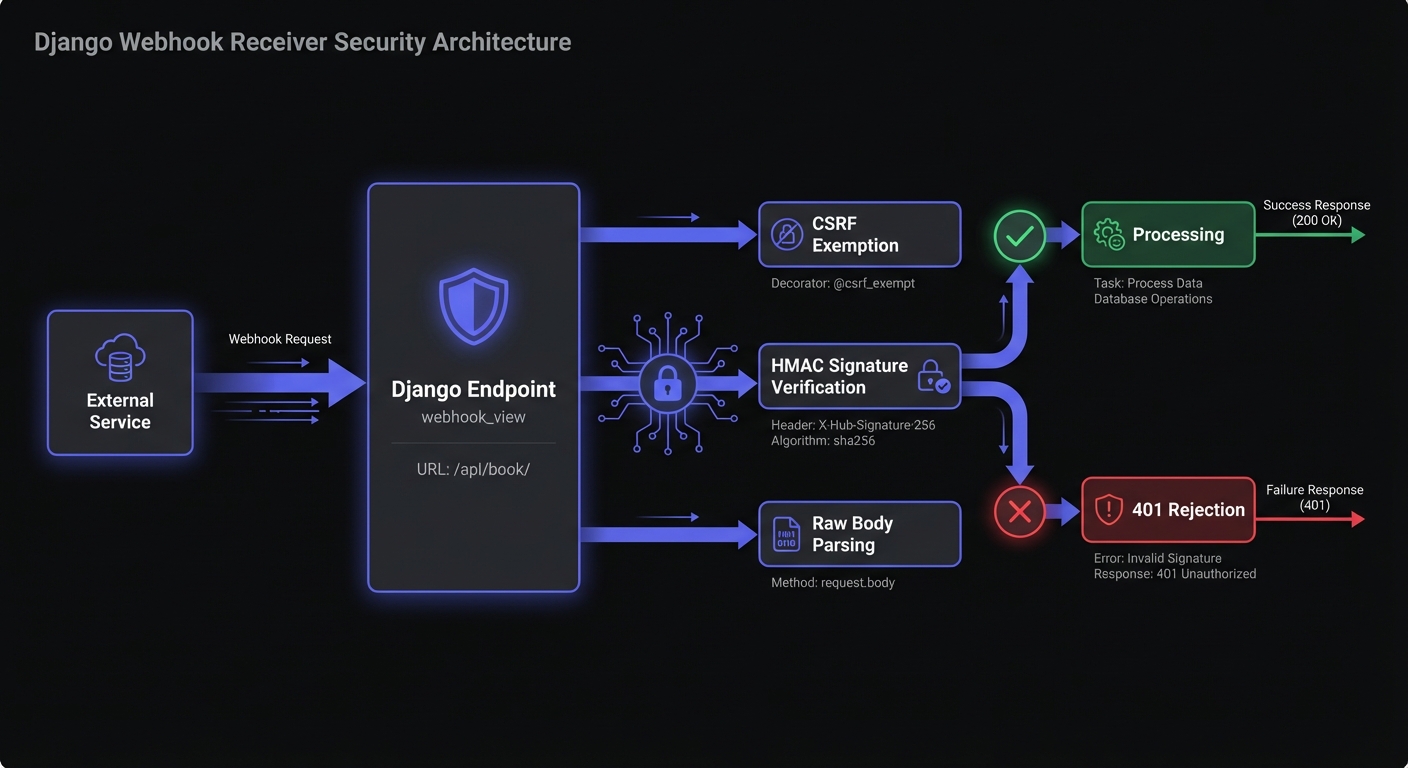
# webhook_verification.py
import hmac
import hashlib

def verify_webhook_signature(payload: bytes, signature: str, secret: str) -> bool:
    """Verify HMAC-SHA256 webhook signature."""
    expected_signature = hmac.new(
        secret.encode('utf-8'),
        payload,
        hashlib.sha256
    ).hexdigest()

    # Use compare_digest to prevent timing attacks
    return hmac.compare_digest(signature, expected_signature)
Now use it in your view:
# views.py
import json
import os
from django.http import JsonResponse, HttpResponse
from django.views.decorators.csrf import csrf_exempt
from django.views.decorators.http import require_POST
from .webhook_verification import verify_webhook_signature

@csrf_exempt
@require_POST
def payment_webhook(request):
    payload = request.body
    signature = request.headers.get('X-Webhook-Signature', '')
    secret = os.environ.get('WEBHOOK_SECRET')

    if not verify_webhook_signature(payload, signature, secret):
        return JsonResponse({'error': 'Invalid signature'}, status=401)

    # Signature valid - safe to process
    data = json.loads(payload)
    event_type = data.get('event')

    if event_type == 'payment.completed':
        handle_payment_completed(data['data'])
    elif event_type == 'payment.failed':
        handle_payment_failed(data['data'])

    return HttpResponse(status=200)

def handle_payment_completed(payment_data):
    # Process successful payment
    pass

def handle_payment_failed(payment_data):
    # Handle failed payment
    pass
Class-Based Views for Webhooks
For complex webhook handling, class-based views provide better organization:
# views.py
import json
from django.http import JsonResponse, HttpResponse
from django.views import View
from django.views.decorators.csrf import csrf_exempt
from django.utils.decorators import method_decorator
from .webhook_verification import verify_webhook_signature

@method_decorator(csrf_exempt, name='dispatch')
class WebhookView(View):
    webhook_secret_env = 'WEBHOOK_SECRET'

    def get_webhook_secret(self):
        return os.environ.get(self.webhook_secret_env)

    def verify_signature(self, request):
        signature = request.headers.get('X-Webhook-Signature', '')
        return verify_webhook_signature(
            request.body,
            signature,
            self.get_webhook_secret()
        )

    def post(self, request):
        if not self.verify_signature(request):
            return JsonResponse({'error': 'Invalid signature'}, status=401)

        data = json.loads(request.body)
        event_type = data.get('event')
        handler = getattr(self, f'handle_{event_type.replace(".", "_")}', None)

        if handler:
            handler(data['data'])

        return HttpResponse(status=200)

    def handle_order_completed(self, data):
        # Process order.completed event
        pass
Testing Your Webhook Endpoints
Use Django's test client to verify webhook implementations:
# tests.py
import json
import hmac
import hashlib
from django.test import TestCase, Client

class WebhookTests(TestCase):
    def setUp(self):
        self.client = Client()
        self.secret = 'test_secret'

    def sign_payload(self, payload: bytes) -> str:
        return hmac.new(
            self.secret.encode(),
            payload,
            hashlib.sha256
        ).hexdigest()

    def test_valid_webhook(self):
        payload = json.dumps({'event': 'order.completed', 'data': {}}).encode()
        signature = self.sign_payload(payload)

        response = self.client.post(
            '/webhooks/orders/',
            data=payload,
            content_type='application/json',
            HTTP_X_WEBHOOK_SIGNATURE=signature
        )

        self.assertEqual(response.status_code, 200)

    def test_invalid_signature_rejected(self):
        payload = json.dumps({'event': 'order.completed', 'data': {}}).encode()

        response = self.client.post(
            '/webhooks/orders/',
            data=payload,
            content_type='application/json',
            HTTP_X_WEBHOOK_SIGNATURE='invalid_signature'
        )

        self.assertEqual(response.status_code, 401)
Local Testing with ngrok
Test webhook endpoints locally before deploying to production. ngrok exposes your local Django server to the internet:
# Terminal 1: Start Django
python manage.py runserver

# Terminal 2: Start ngrok tunnel
ngrok http 8000
ngrok provides a public URL (e.g., https://abc123.ngrok.io) that forwards requests to localhost:8000. Register this URL with your webhook provider for testing.
For Stripe webhooks, use the Stripe CLI for faster local development:
# Forward Stripe events to your local endpoint
stripe listen --forward-to localhost:8000/webhooks/stripe/

# Trigger test events
stripe trigger payment_intent.succeeded
The Stripe CLI outputs a webhook signing secret for local verification.
Storing Webhooks for Debugging
Store incoming webhooks before processing to debug failures and audit event history:
# models.py
from django.db import models

class WebhookLog(models.Model):
    received_at = models.DateTimeField(auto_now_add=True, db_index=True)
    source = models.CharField(max_length=50, db_index=True)
    event_type = models.CharField(max_length=100, blank=True)
    payload = models.JSONField()
    signature = models.TextField(blank=True)
    verified = models.BooleanField(default=False)
    processed = models.BooleanField(default=False)
    error = models.TextField(blank=True)

    class Meta:
        indexes = [
            models.Index(fields=['source', 'received_at']),
        ]
Log before verifying or processing:
@csrf_exempt
@require_POST
def stripe_webhook(request):
    log = WebhookLog.objects.create(
        source='stripe',
        payload=json.loads(request.body),
        signature=request.headers.get('Stripe-Signature', '')
    )

    try:
        event = stripe.Webhook.construct_event(
            request.body,
            log.signature,
            settings.STRIPE_WEBHOOK_SECRET
        )
        log.verified = True
        log.event_type = event['type']
    except stripe.error.SignatureVerificationError:
        log.error = 'Invalid signature'
        log.save()
        return HttpResponse(status=401)

    # Process event...
    log.processed = True
    log.save()
    return HttpResponse(status=200)
Add a management command to clean old logs:
# management/commands/cleanup_webhook_logs.py
from django.core.management.base import BaseCommand
from django.utils import timezone
from datetime import timedelta
from myapp.models import WebhookLog

class Command(BaseCommand):
    def handle(self, *args, **options):
        cutoff = timezone.now() - timedelta(days=30)
        deleted, _ = WebhookLog.objects.filter(
            received_at__lt=cutoff,
            processed=True
        ).delete()
        self.stdout.write(f'Deleted {deleted} old webhook logs')
Production Considerations
Respond quickly: Return 200 immediately, queue heavy processing with Celery.
Idempotency: Store processed event IDs to detect duplicates. See webhook idempotency guide for patterns.
Logging: Log all incoming webhooks with signatures and verification results.
Timeouts: External services expect 5-30 second responses. Long-running handlers cause failures.
Background processing: Offload webhook processing to Celery tasks to avoid blocking the HTTP response and enable automatic retries on failure.
Conclusion
Django provides signals for clean architecture, views for secure receiving, and Celery for async processing. Hook Mesh removes the sending infrastructure burden—retries, subscriber management, and dashboards. Get started with Hook Mesh.
Related Posts
Receive and Verify Webhooks in Python: A Complete Guide
Learn how to securely receive and verify webhooks in Python using Flask and FastAPI. Covers HMAC signature verification, timestamp validation, and common security pitfalls to avoid.
Send Webhooks with Python: A Complete Tutorial
Learn how to send webhooks with Python using the requests library. This hands-on tutorial covers payload structure, HMAC signatures, error handling, retry logic with exponential backoff, and async options.
Webhook Security Best Practices: The Complete Guide
Learn how to secure your webhook implementations with HMAC signature verification, replay attack prevention, SSRF mitigation, and more. Includes code examples in Node.js and Python.
Webhook Idempotency: Why It Matters and How to Implement It
A comprehensive technical guide to implementing idempotency for webhooks. Learn about idempotency keys, deduplication strategies, and implementation patterns with Node.js and Python code examples.
How to Add Webhooks to Your SaaS Product in 2026
A complete guide for SaaS founders and engineers on implementing webhooks—from event design and payload structure to build vs buy decisions and customer experience best practices.