Webhook Security Best Practices: The Complete Guide
Learn how to secure your webhook implementations with HMAC signature verification, replay attack prevention, SSRF mitigation, and more. Includes code examples in Node.js and Python.

Webhook Security Best Practices: The Complete Guide
Webhooks power payment notifications, CI/CD pipelines, and real-time integrations—but compromised endpoints lead to data breaches, unauthorized actions, and financial fraud. This guide covers essential practices from authentication to replay protection to SSRF mitigation. For comprehensive coverage, see our complete webhook security guide.
Why Webhook Security Matters
Unlike traditional API calls where your application initiates requests to trusted endpoints, webhooks flip the model. External services push data to your servers, which creates unique security challenges:
- Trust verification: How do you know the request actually came from the claimed source?
- Data integrity: How can you be certain the payload wasn't tampered with in transit?
- Replay attacks: What prevents an attacker from capturing and resending legitimate requests?
- Server-side vulnerabilities: Could a malicious payload trick your server into attacking internal resources?
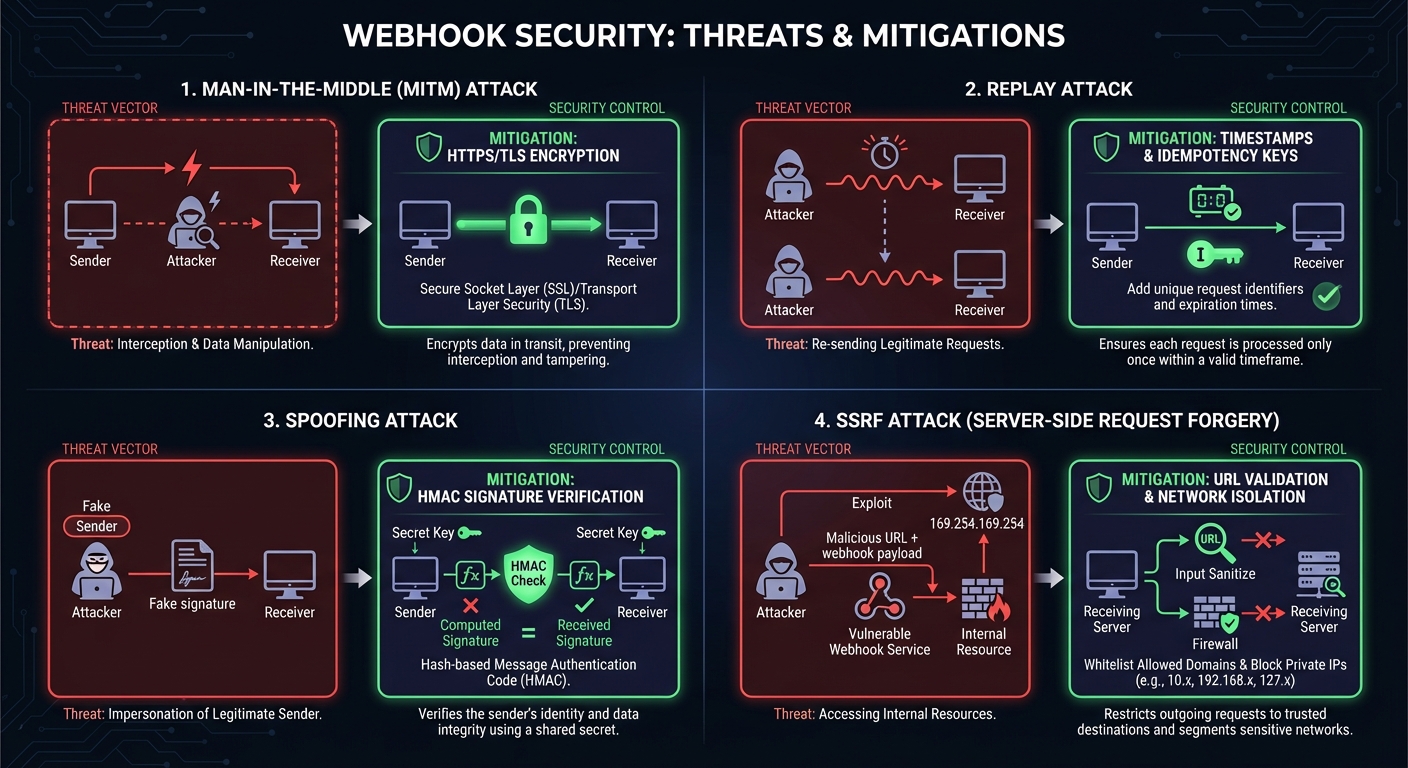
Let's address each of these challenges systematically.
HMAC Signature Verification
HMAC-SHA256 is the industry standard for webhook authentication, providing both sender authentication and message integrity. For cryptographic details, see our guide on HMAC-SHA256 webhook signatures.
How HMAC Verification Works
- Share a secret key between provider and consumer
- Provider creates a hash of the payload using the secret
- Signature is included in a request header
- Consumer recalculates the hash and compares it to the received signature
- A match confirms authenticity and integrity
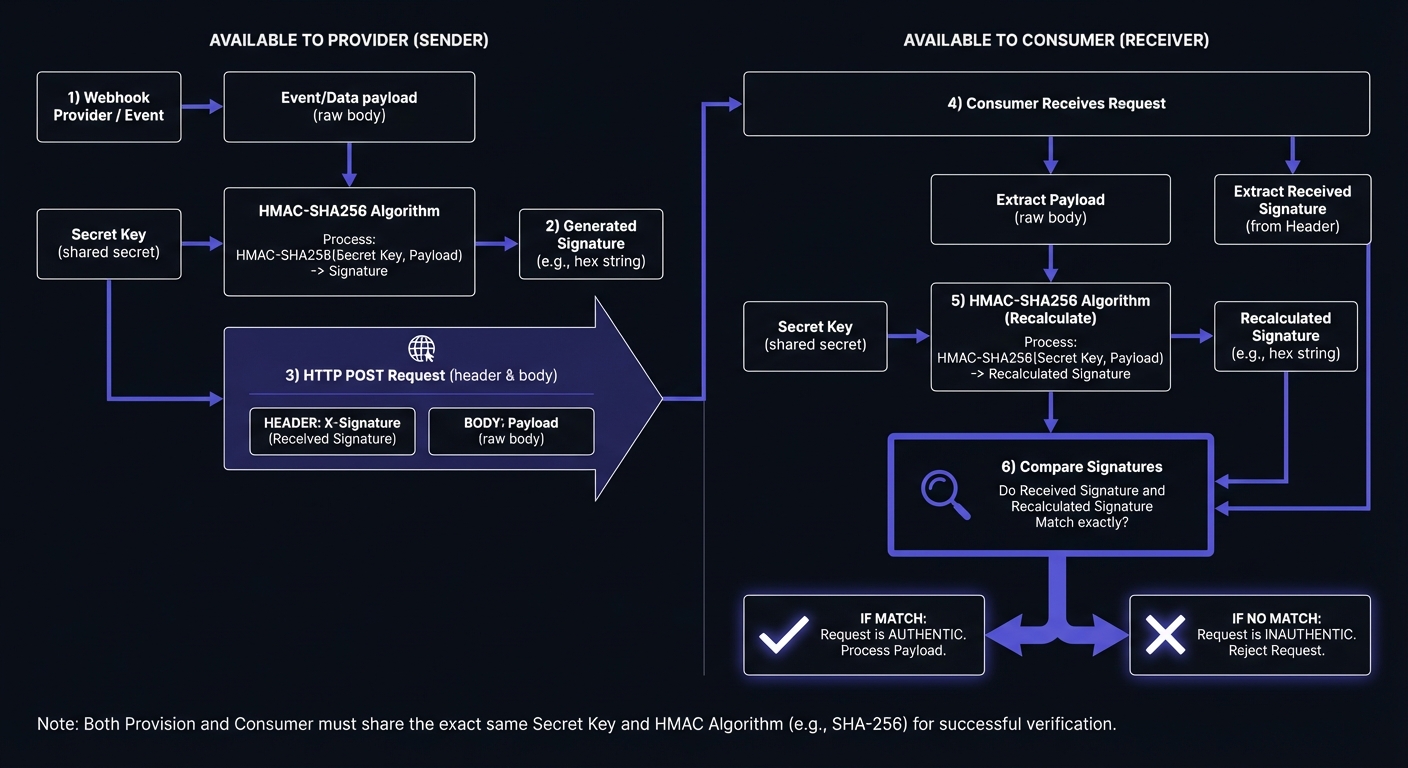
Node.js Implementation
const crypto = require('crypto');

function verifyWebhookSignature(payload, signature, secret) {
  const expectedSignature = crypto
    .createHmac('sha256', secret)
    .update(payload, 'utf8')
    .digest('hex');

  // Use timing-safe comparison to prevent timing attacks
  const signatureBuffer = Buffer.from(signature, 'hex');
  const expectedBuffer = Buffer.from(expectedSignature, 'hex');

  if (signatureBuffer.length !== expectedBuffer.length) {
    return false;
  }

  return crypto.timingSafeEqual(signatureBuffer, expectedBuffer);
}

// Express middleware example
app.post('/webhooks/incoming', express.raw({ type: 'application/json' }), (req, res) => {
  const signature = req.headers['x-webhook-signature'];
  const payload = req.body.toString();

  if (!verifyWebhookSignature(payload, signature, process.env.WEBHOOK_SECRET)) {
    return res.status(401).json({ error: 'Invalid signature' });
  }

  // Process the verified webhook
  const data = JSON.parse(payload);
  // ... handle the event

  res.status(200).json({ received: true });
});
Python Implementation
import hmac
import hashlib
from flask import Flask, request, jsonify

app = Flask(__name__)

def verify_webhook_signature(payload: bytes, signature: str, secret: str) -> bool:
    expected_signature = hmac.new(
        secret.encode('utf-8'),
        payload,
        hashlib.sha256
    ).hexdigest()

    # Use compare_digest for timing-safe comparison
    return hmac.compare_digest(signature, expected_signature)

@app.route('/webhooks/incoming', methods=['POST'])
def handle_webhook():
    signature = request.headers.get('X-Webhook-Signature', '')
    payload = request.get_data()

    if not verify_webhook_signature(payload, signature, os.environ['WEBHOOK_SECRET']):
        return jsonify({'error': 'Invalid signature'}), 401

    # Process the verified webhook
    data = request.get_json()
    # ... handle the event

    return jsonify({'received': True}), 200
Critical Note: Always use timing-safe comparison (crypto.timingSafeEqual in Node.js, hmac.compare_digest in Python). Standard comparison leaks timing information, enabling attackers to discover valid signatures. See our guides on receiving webhooks in Node.js and Python.
Enforce HTTPS Everywhere
Never accept webhooks over plain HTTP in production. HTTPS provides encryption in transit, server authentication, and integrity protection. Reject HTTP requests entirely—redirects still expose initial requests to interception.
# Nginx configuration to reject HTTP
server {
    listen 80;
    server_name webhooks.yourapp.com;
    return 444;  # Close connection without response
}
Hook Mesh enforces HTTPS for all webhook deliveries by default—we won't even let you register an HTTP endpoint URL for production environments.
Timestamp Validation and Replay Attack Prevention
Even with valid signatures, attackers can capture and replay legitimate requests. This is dangerous for webhooks triggering financial transactions or state changes.
Implementing Timestamp Validation
Include a timestamp in your webhook payload or headers, sign it along with the body, and reject requests outside an acceptable time window.
function verifyWebhookWithTimestamp(payload, signature, timestamp, secret) {
  // Reject requests older than 5 minutes
  const MAX_AGE_SECONDS = 300;
  const currentTime = Math.floor(Date.now() / 1000);
  const requestTime = parseInt(timestamp, 10);

  if (Math.abs(currentTime - requestTime) > MAX_AGE_SECONDS) {
    return { valid: false, reason: 'Request timestamp too old or too far in future' };
  }

  // Include timestamp in signature verification
  const signedPayload = `${timestamp}.${payload}`;
  const expectedSignature = crypto
    .createHmac('sha256', secret)
    .update(signedPayload, 'utf8')
    .digest('hex');

  const isValid = crypto.timingSafeEqual(
    Buffer.from(signature, 'hex'),
    Buffer.from(expectedSignature, 'hex')
  );

  return { valid: isValid, reason: isValid ? null : 'Invalid signature' };
}
Idempotency Keys for Deduplication
Timestamp validation alone doesn't prevent replays within the valid time window. Use unique event identifiers:
const processedEvents = new Set(); // Use Redis in production

async function handleWebhook(eventId, payload) {
  // Check if we've already processed this event
  if (await redis.sismember('processed_webhooks', eventId)) {
    console.log(`Duplicate webhook detected: ${eventId}`);
    return { status: 'duplicate', processed: false };
  }

  // Process the webhook
  await processPayload(payload);

  // Mark as processed with TTL (e.g., 24 hours)
  await redis.setex(`webhook:${eventId}`, 86400, 'processed');
  await redis.sadd('processed_webhooks', eventId);

  return { status: 'success', processed: true };
}
Hook Mesh automatically includes unique event IDs and timestamps with every webhook delivery, making it straightforward to implement replay protection on the receiving end.
IP Allowlisting
Restrict webhook endpoints to known provider IP addresses for additional security.
const ALLOWED_IPS = [
  '192.0.2.0/24',    // Example webhook provider range
  '198.51.100.0/24', // Another range
];

function isIPAllowed(clientIP) {
  return ALLOWED_IPS.some(range => ipRangeCheck(clientIP, range));
}

app.post('/webhooks/incoming', (req, res, next) => {
  const clientIP = req.ip || req.connection.remoteAddress;

  if (!isIPAllowed(clientIP)) {
    console.warn(`Webhook rejected from unauthorized IP: ${clientIP}`);
    return res.status(403).json({ error: 'Forbidden' });
  }

  next();
});Caveat: IP allowlisting should complement, not replace, signature verification. IP addresses can be spoofed in certain network configurations, and provider IP ranges may change.
Hook Mesh publishes our delivery IP ranges in our documentation and sends advance notice before any changes, giving you time to update your allowlists.
Mutual TLS (mTLS)
Standard TLS secures communication from the consumer's perspective, but mutual TLS authenticates both parties. With mTLS, the webhook provider and consumer exchange TLS certificates before any data transfers.
When to Use mTLS
mTLS adds operational complexity but provides stronger guarantees for high-security environments:
- Financial services handling transaction data
- Healthcare systems with HIPAA requirements
- B2B integrations between enterprise systems
- Any scenario where IP allowlisting alone is insufficient
Implementation Considerations
const https = require('https');
const fs = require('fs');

const options = {
  key: fs.readFileSync('client-key.pem'),
  cert: fs.readFileSync('client-cert.pem'),
  ca: fs.readFileSync('ca-cert.pem'),
  requestCert: true,
  rejectUnauthorized: true
};

const server = https.createServer(options, (req, res) => {
  // Client certificate is verified automatically
  const clientCert = req.socket.getPeerCertificate();

  if (!clientCert || !clientCert.subject) {
    res.writeHead(401);
    return res.end('Client certificate required');
  }

  // Verify expected client identity
  if (clientCert.subject.CN !== 'webhook-provider.example.com') {
    res.writeHead(403);
    return res.end('Unauthorized client');
  }

  // Process verified webhook
  res.writeHead(200);
  res.end('OK');
});Trade-offs: mTLS requires certificate management infrastructure, complicates certificate rotation, and may not be supported by all webhook providers. Use it when compliance requirements demand it or when signature verification alone doesn't meet your security posture.
SSRF Prevention and Mitigation
Server-Side Request Forgery (SSRF) allows attackers to trick your server into making requests to unintended destinations. Webhook systems are vulnerable because they make requests to user-specified URLs. See our SSRF attacks guide for details.
The SSRF Threat Model
An attacker registering a webhook service might specify:
http://169.254.169.254/latest/meta-data/(AWS metadata service)http://localhost:6379/(Internal Redis)http://internal-admin.corp/(Internal services)
Mitigation Strategies
1. URL Validation and Sanitization
from urllib.parse import urlparse
import ipaddress
import socket

BLOCKED_HOSTS = {'localhost', '127.0.0.1', '0.0.0.0', '169.254.169.254'}
BLOCKED_NETWORKS = [
    ipaddress.ip_network('10.0.0.0/8'),
    ipaddress.ip_network('172.16.0.0/12'),
    ipaddress.ip_network('192.168.0.0/16'),
    ipaddress.ip_network('169.254.0.0/16'),
    ipaddress.ip_network('127.0.0.0/8'),
]

def is_url_safe(url: str) -> bool:
    try:
        parsed = urlparse(url)

        # Require HTTPS
        if parsed.scheme != 'https':
            return False

        hostname = parsed.hostname
        if not hostname or hostname in BLOCKED_HOSTS:
            return False

        # Resolve DNS and check IP
        ip = socket.gethostbyname(hostname)
        ip_obj = ipaddress.ip_address(ip)

        for network in BLOCKED_NETWORKS:
            if ip_obj in network:
                return False

        return True
    except Exception:
        return False
2. DNS Rebinding Protection
Validate the resolved IP both before and after the request, or pin the DNS resolution:
import requests
from requests.adapters import HTTPAdapter

class SafeWebhookAdapter(HTTPAdapter):
    def send(self, request, **kwargs):
        # Re-resolve and validate IP at request time
        hostname = urlparse(request.url).hostname
        ip = socket.gethostbyname(hostname)

        if not is_ip_safe(ip):
            raise ValueError(f"DNS rebinding detected: {hostname} -> {ip}")

        return super().send(request, **kwargs)
3. Network Segmentation
Run webhook delivery workers in isolated network segments with no access to internal services. This provides defense in depth even if URL validation is bypassed.
At Hook Mesh, our delivery infrastructure runs in completely isolated network segments with egress-only internet access. We perform multi-layer URL validation including DNS rebinding protection, ensuring your webhooks are delivered safely without SSRF risks.
Secret Rotation
Rotate secrets periodically and immediately if compromised. Plan for rotation from the start:
Graceful Rotation Strategy
- Support multiple active secrets: Both old and new secrets valid during rotation
- Rotate every 90 days minimum: Establish a rotation schedule
- Automate the process: Manual rotation is error-prone
const WEBHOOK_SECRETS = [
  process.env.WEBHOOK_SECRET_CURRENT,
  process.env.WEBHOOK_SECRET_PREVIOUS, // Still valid during rotation window
].filter(Boolean);

function verifyWithRotation(payload, signature) {
  for (const secret of WEBHOOK_SECRETS) {
    if (verifyWebhookSignature(payload, signature, secret)) {
      return true;
    }
  }
  return false;
}
Hook Mesh provides automatic secret rotation with configurable schedules, supporting both secrets during transitions and notifying your team.
Additional Security Measures
Rate Limiting
Protect your webhook endpoints from abuse:
const rateLimit = require('express-rate-limit');

const webhookLimiter = rateLimit({
  windowMs: 60 * 1000, // 1 minute
  max: 100, // Limit each IP to 100 requests per minute
  message: { error: 'Too many requests' },
  standardHeaders: true,
});

app.use('/webhooks', webhookLimiter);
Payload Size Limits
Prevent denial-of-service through oversized payloads:
app.use('/webhooks', express.json({ limit: '1mb' }));Logging and Monitoring
Maintain detailed logs for security analysis and incident response:
- Log all webhook attempts (successful and failed)
- Track signature verification failures
- Monitor for unusual patterns (spikes in traffic, geographic anomalies)
- Set up alerts for repeated authentication failures
Defense-in-Depth Strategy
No single security control is foolproof. Layer multiple defenses so attackers must bypass several mechanisms to compromise your webhook endpoint.
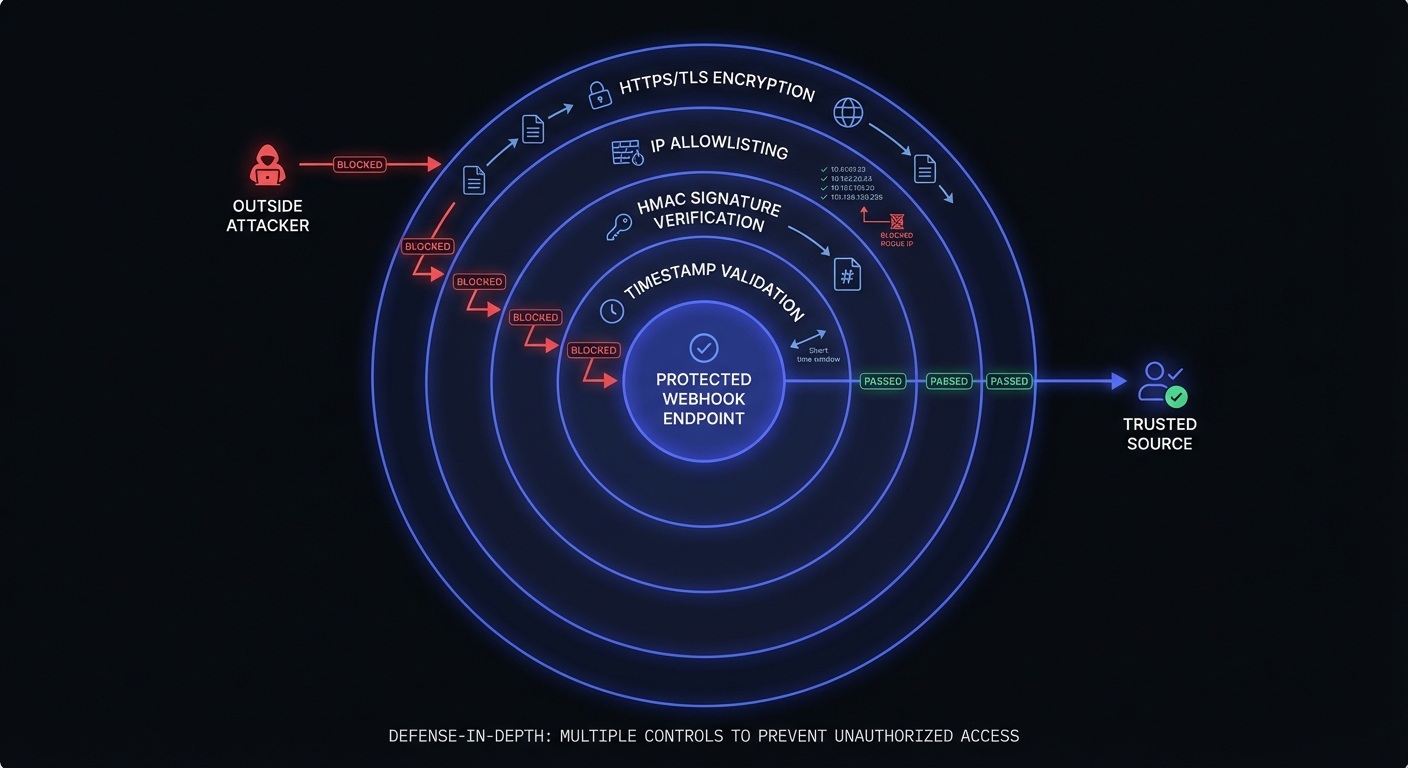
Each layer provides protection even if others fail:
| Layer | Protects Against | Failure Mode |
|---|---|---|
| HTTPS/TLS | Eavesdropping, MITM | Certificate compromise |
| IP Allowlisting | Unauthorized sources | IP spoofing, provider IP changes |
| HMAC Signatures | Spoofing, tampering | Secret key compromise |
| Timestamps | Replay attacks | Clock skew issues |
| Idempotency Keys | Duplicate processing | Storage failures |
Implement at minimum: HTTPS + HMAC signatures + timestamp validation. Add IP allowlisting and mTLS based on your threat model.
Compliance Considerations
Webhook security intersects with regulatory requirements:
- PCI DSS: Encrypt cardholder data in transit (TLS 1.2+), log access, implement access controls
- HIPAA: Protect PHI with encryption, audit logging, access verification
- GDPR/CCPA: Minimize data in webhook payloads, document data flows, enable deletion
- SOC 2: Demonstrate security controls through logging, monitoring, and incident response
For compliance-sensitive webhooks, consider sending minimal event data (IDs and types) and having recipients fetch full details via authenticated API calls.
Webhook Security Checklist
Use this checklist to audit your webhook implementations. For a more detailed, priority-ranked version with additional code examples, see our production webhook security checklist:
Authentication and Integrity
- HMAC-SHA256 signature verification implemented
- Timing-safe comparison used for signature validation
- Webhook secrets stored securely (environment variables, secrets manager)
- Secret rotation process documented and tested
Transport Security
- HTTPS enforced for all webhook endpoints
- HTTP requests rejected (not redirected)
- TLS 1.2 or higher required
- Certificate validation enabled
Replay Attack Prevention
- Timestamp validation implemented (5-minute window recommended)
- Idempotency keys tracked to prevent duplicate processing
- Processed event IDs stored with appropriate TTL
Network Security
- IP allowlisting configured (if provider publishes ranges)
- Rate limiting applied to webhook endpoints
- Payload size limits enforced
SSRF Protection (for webhook senders)
- URL validation blocks private IP ranges
- DNS rebinding protection implemented
- Webhook delivery isolated from internal networks
Operational Security
- Webhook authentication failures logged and monitored
- Alerts configured for security anomalies
- Incident response plan includes webhook compromise scenarios
Conclusion
Implement HMAC signature verification, enforce HTTPS, prevent replay attacks, and protect against SSRF to create a robust security posture. Hook Mesh handles these with built-in signature verification, automatic secret rotation, SSRF protection, and comprehensive logging. Get started with Hook Mesh for enterprise-grade webhook security without enterprise complexity.
Related Posts
HMAC-SHA256 Webhook Signatures: Implementation Guide
Learn how to implement secure webhook signature verification using HMAC-SHA256. Complete guide with code examples for signing and verifying webhook payloads in Node.js and Python.
Webhook Authentication: HMAC vs JWT vs mTLS Compared
A comprehensive comparison of webhook authentication methods including HMAC-SHA256, JWT, mTLS, Basic Auth, and API Keys. Learn when to use each method, with code examples and security recommendations.
SSRF Attacks via Webhooks: Protection Strategies
Learn how Server-Side Request Forgery (SSRF) attacks exploit webhook systems, discover real-world attack scenarios targeting cloud metadata and internal services, and implement proven protection strategies to secure your infrastructure.
Securing Webhook Endpoints: A Checklist for Production
A comprehensive, actionable security checklist for production webhook endpoints. Covers transport security, authentication, input validation, rate limiting, logging, and error handling with priority levels and code examples.