Serverless Webhooks: Lambda, Vercel, Cloudflare Workers
A comprehensive tutorial on implementing webhooks in serverless architectures. Learn how to send and receive webhooks on AWS Lambda, Vercel Functions, and Cloudflare Workers with practical code examples and best practices.
Webhooks in Serverless: Lambda, Vercel, and Cloudflare Workers
Serverless webhooks require handling cold starts, timeouts, and stateless environments. This tutorial covers AWS Lambda, Vercel Functions, and Cloudflare Workers with practical patterns and code examples. For framework-specific guidance, see Next.js webhooks and Express.js patterns.
Why Serverless for Webhooks?
Serverless is ideal for webhooks: automatic scaling for unpredictable traffic, pay-per-execution cost efficiency, no infrastructure maintenance, and edge deployment for low latency. Constraints include cold starts, execution timeouts, and stateless environments. See webhook implementation guides for language-specific patterns.
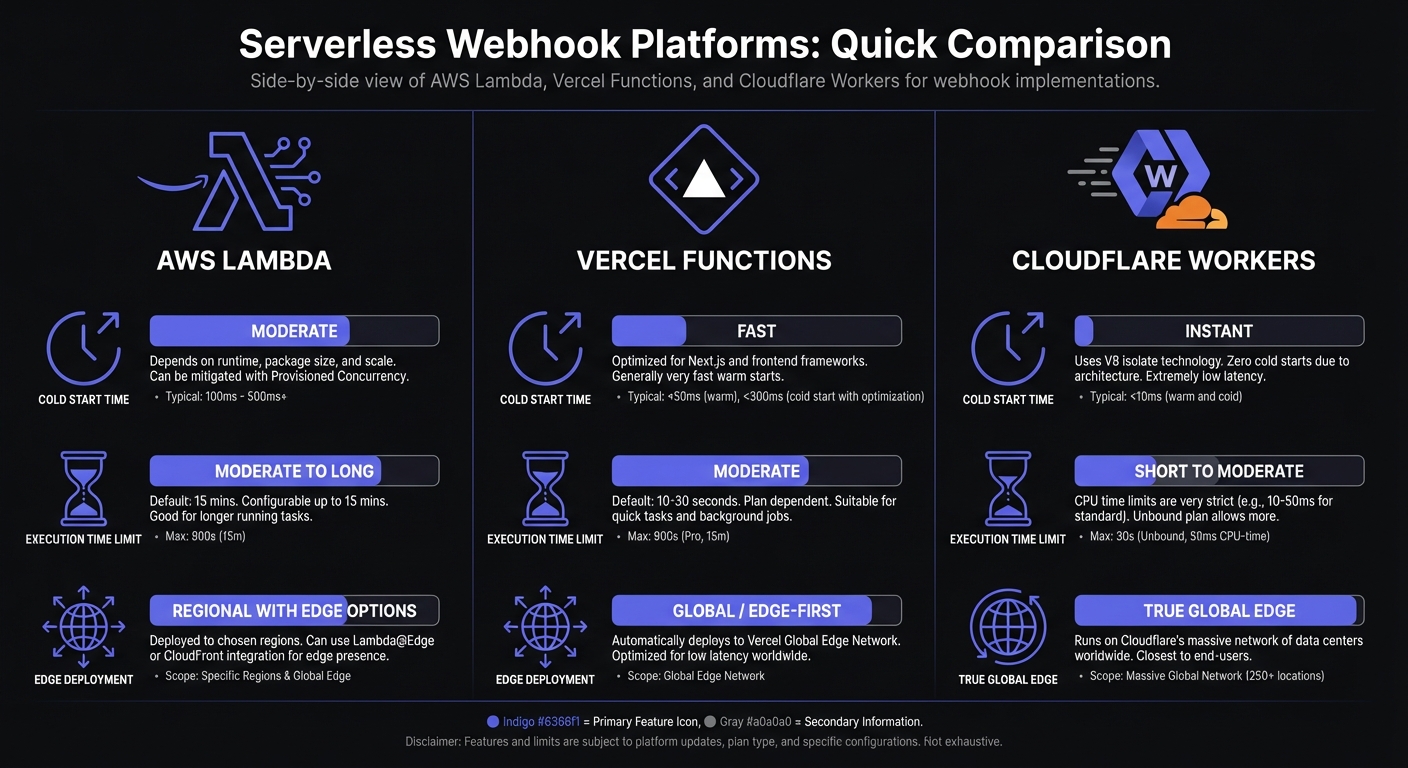
| Platform | Cold Start | Max Duration | Edge Deployment | Best For |
|---|---|---|---|---|
| AWS Lambda | 100ms-2s | 15 min | Via Lambda@Edge | Complex processing, AWS ecosystem |
| Vercel Functions | 50-300ms | 10-30s (plan-dependent) | Global edge network | Next.js apps, fast iteration |
| Cloudflare Workers | <10ms | 30s (Unbound) | 300+ data centers | Low latency, global reach |
AWS Lambda: The Serverless Pioneer
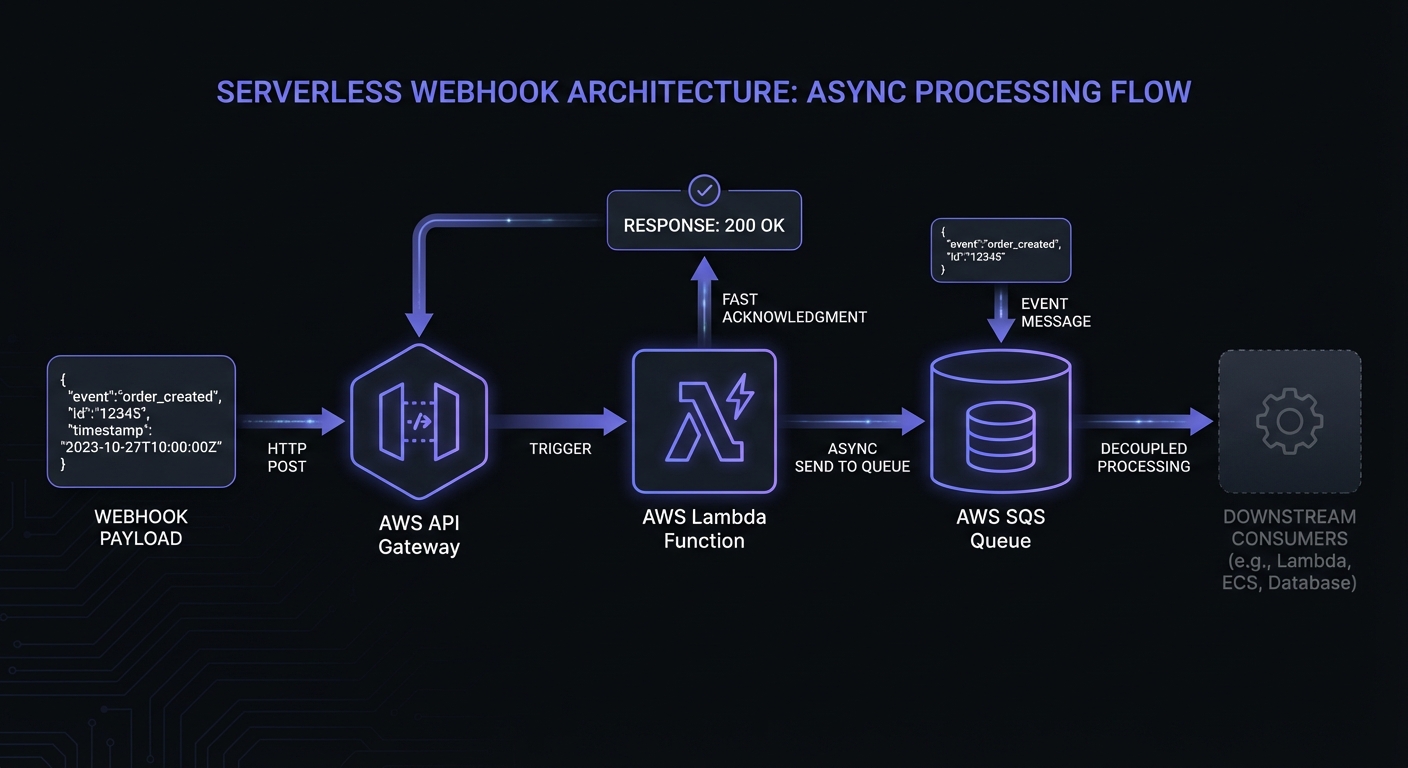
AWS Lambda combined with API Gateway provides a robust foundation for webhooks. The typical architecture pattern uses API Gateway as the public endpoint, Lambda for processing, and SQS for asynchronous handling.
Handler Structure
// handler.js
export const receiveWebhook = async (event, context) => {
  // Parse the incoming webhook payload
  const payload = JSON.parse(event.body);

  // Verify the webhook signature
  const signature = event.headers['x-webhook-signature'];
  if (!verifySignature(payload, signature, process.env.WEBHOOK_SECRET)) {
    return {
      statusCode: 401,
      body: JSON.stringify({ error: 'Invalid signature' })
    };
  }

  // Acknowledge receipt immediately
  // Process asynchronously to avoid timeouts
  await sendToQueue(payload);

  return {
    statusCode: 200,
    body: JSON.stringify({ received: true })
  };
};

function verifySignature(payload, signature, secret) {
  const crypto = require('crypto');
  const expected = crypto
    .createHmac('sha256', secret)
    .update(JSON.stringify(payload))
    .digest('hex');
  return signature === `sha256=${expected}`;
}
API Gateway Integration
To expose your Lambda as a webhook endpoint, configure API Gateway with the following CloudFormation or SAM template:
# template.yaml
AWSTemplateFormatVersion: '2010-09-09'
Transform: AWS::Serverless-2016-10-31

Resources:
  WebhookFunction:
    Type: AWS::Serverless::Function
    Properties:
      Handler: handler.receiveWebhook
      Runtime: nodejs18.x
      Timeout: 30
      MemorySize: 256
      Events:
        WebhookEndpoint:
          Type: Api
          Properties:
            Path: /webhooks
            Method: POST
Sending Webhooks from Lambda
When sending webhooks from Lambda, use a dedicated function triggered by events:
// sendWebhook.js
import https from 'https';

export const handler = async (event) => {
  const webhookUrl = event.targetUrl;
  const payload = event.payload;

  const response = await sendWithRetry(webhookUrl, payload, 3);

  return {
    statusCode: response.status,
    deliveryId: event.deliveryId
  };
};

async function sendWithRetry(url, payload, maxRetries) {
  for (let attempt = 1; attempt <= maxRetries; attempt++) {
    try {
      const response = await fetch(url, {
        method: 'POST',
        headers: {
          'Content-Type': 'application/json',
          'X-Webhook-Signature': generateSignature(payload)
        },
        body: JSON.stringify(payload)
      });

      if (response.ok) return response;

      if (attempt < maxRetries) {
        await delay(Math.pow(2, attempt) * 1000);
      }
    } catch (error) {
      if (attempt === maxRetries) throw error;
      await delay(Math.pow(2, attempt) * 1000);
    }
  }
}
Cold Start Considerations
Cold starts add 100ms-seconds of latency. Mitigate by:
- Using provisioned concurrency for critical webhook endpoints
- Keeping deployment packages small
- Choosing ARM64 architecture for faster initialization
- Using Lambda SnapStart for Java workloads
Vercel Functions: Developer Experience First
Vercel offers serverless functions and edge functions—both work well for webhooks with different trade-offs.
Serverless Functions with Next.js
// app/api/webhooks/route.ts
import { NextRequest, NextResponse } from 'next/server';
import crypto from 'crypto';

export async function POST(request: NextRequest) {
  const body = await request.text();
  const signature = request.headers.get('x-webhook-signature');

  // Verify signature
  const expectedSig = crypto
    .createHmac('sha256', process.env.WEBHOOK_SECRET!)
    .update(body)
    .digest('hex');

  if (signature !== `sha256=${expectedSig}`) {
    return NextResponse.json(
      { error: 'Invalid signature' },
      { status: 401 }
    );
  }

  const payload = JSON.parse(body);

  // Queue for async processing
  await fetch(process.env.QUEUE_URL!, {
    method: 'POST',
    body: JSON.stringify(payload)
  });

  return NextResponse.json({ received: true });
}

export const config = {
  maxDuration: 30, // Maximum execution time in seconds
};
Edge Functions for Low Latency
Edge Functions run on Cloudflare's network with sub-millisecond cold starts:
// app/api/webhooks/edge/route.ts
import { NextRequest, NextResponse } from 'next/server';

export const runtime = 'edge';

export async function POST(request: NextRequest) {
  const payload = await request.json();
  const signature = request.headers.get('x-webhook-signature');

  // Edge-compatible signature verification
  const encoder = new TextEncoder();
  const key = await crypto.subtle.importKey(
    'raw',
    encoder.encode(process.env.WEBHOOK_SECRET),
    { name: 'HMAC', hash: 'SHA-256' },
    false,
    ['sign']
  );

  const signatureBuffer = await crypto.subtle.sign(
    'HMAC',
    key,
    encoder.encode(JSON.stringify(payload))
  );

  const expectedSig = Array.from(new Uint8Array(signatureBuffer))
    .map(b => b.toString(16).padStart(2, '0'))
    .join('');

  if (signature !== `sha256=${expectedSig}`) {
    return NextResponse.json({ error: 'Unauthorized' }, { status: 401 });
  }

  // Forward to processing endpoint
  await fetch('https://your-api.com/process', {
    method: 'POST',
    body: JSON.stringify(payload)
  });

  return NextResponse.json({ success: true });
}
Sending Webhooks from Vercel
// app/api/send-webhook/route.ts
import { NextRequest, NextResponse } from 'next/server';

export async function POST(request: NextRequest) {
  const { targetUrl, eventType, data } = await request.json();

  const payload = {
    event: eventType,
    data,
    timestamp: new Date().toISOString()
  };

  const signature = await generateSignature(payload);

  const response = await fetch(targetUrl, {
    method: 'POST',
    headers: {
      'Content-Type': 'application/json',
      'X-Webhook-Signature': signature,
      'X-Webhook-Event': eventType
    },
    body: JSON.stringify(payload)
  });

  return NextResponse.json({
    delivered: response.ok,
    statusCode: response.status
  });
}
Cloudflare Workers: Edge-First Architecture
Cloudflare Workers run at the edge in 300+ data centers globally, ideal for low-latency webhook endpoints.
Basic Webhook Receiver
// src/index.js
export default {
  async fetch(request, env, ctx) {
    if (request.method !== 'POST') {
      return new Response('Method not allowed', { status: 405 });
    }

    const body = await request.text();
    const signature = request.headers.get('x-webhook-signature');

    // Verify signature using Web Crypto API
    const isValid = await verifySignature(body, signature, env.WEBHOOK_SECRET);
    if (!isValid) {
      return new Response('Unauthorized', { status: 401 });
    }

    const payload = JSON.parse(body);

    // Use waitUntil for async processing after response
    ctx.waitUntil(processWebhook(payload, env));

    return new Response(JSON.stringify({ received: true }), {
      headers: { 'Content-Type': 'application/json' }
    });
  }
};

async function verifySignature(body, signature, secret) {
  const encoder = new TextEncoder();
  const key = await crypto.subtle.importKey(
    'raw',
    encoder.encode(secret),
    { name: 'HMAC', hash: 'SHA-256' },
    false,
    ['sign']
  );

  const sig = await crypto.subtle.sign('HMAC', key, encoder.encode(body));
  const expected = 'sha256=' + [...new Uint8Array(sig)]
    .map(b => b.toString(16).padStart(2, '0'))
    .join('');

  return signature === expected;
}

async function processWebhook(payload, env) {
  // Store in Durable Objects or send to queue
  await env.WEBHOOK_QUEUE.send(payload);
}
Using Durable Objects for State
Durable Objects provide consistent state for stateless Workers:
// src/webhook-processor.js
export class WebhookProcessor {
  constructor(state, env) {
    this.state = state;
    this.env = env;
  }

  async fetch(request) {
    const payload = await request.json();

    // Track delivery attempts
    const attempts = await this.state.storage.get('attempts') || 0;
    await this.state.storage.put('attempts', attempts + 1);

    // Process with idempotency
    const processed = await this.state.storage.get(`processed:${payload.id}`);
    if (processed) {
      return new Response('Already processed', { status: 200 });
    }

    await this.processPayload(payload);
    await this.state.storage.put(`processed:${payload.id}`, true);

    return new Response('Processed', { status: 200 });
  }
}
Sending Webhooks with Queues
// src/queue-handler.js
export default {
  async queue(batch, env) {
    for (const message of batch.messages) {
      const { targetUrl, payload, retryCount = 0 } = message.body;

      try {
        const response = await fetch(targetUrl, {
          method: 'POST',
          headers: {
            'Content-Type': 'application/json',
            'X-Webhook-Signature': await sign(payload, env.SECRET)
          },
          body: JSON.stringify(payload)
        });

        if (!response.ok && retryCount < 5) {
          // Re-queue with exponential backoff
          message.retry({ delaySeconds: Math.pow(2, retryCount) * 60 });
        } else {
          message.ack();
        }
      } catch (error) {
        if (retryCount < 5) {
          message.retry({ delaySeconds: Math.pow(2, retryCount) * 60 });
        }
      }
    }
  }
};
Cost Considerations
Serverless pricing follows a pay-per-execution model ideal for webhook workloads with variable traffic:
| Platform | Free Tier | Cost Per Million Invocations |
|---|---|---|
| AWS Lambda | 1M requests/month | ~$0.20 + compute time |
| Vercel Functions | 100GB-hours/month | Plan-dependent |
| Cloudflare Workers | 100K requests/day | $0.50 per million |
Cost optimization tips:
- Keep function memory low (256MB handles most webhook payloads)
- Use ARM64 on Lambda for 20% cost reduction
- Minimize cold starts to reduce billable duration
- Process heavy workloads asynchronously in separate functions
Monitoring and Observability
Track these metrics for serverless webhooks:
- Invocation count: Webhook volume trends
- Error rate: Failed signature verifications, processing errors
- Duration: Identify slow handlers before timeouts
- Cold start frequency: Monitor initialization overhead
Platform-specific tools:
- Lambda: CloudWatch Logs, X-Ray tracing, CloudWatch Alarms
- Vercel: Built-in analytics, Log Drains to external services
- Workers: Workers Analytics, Logpush to S3/R2
For comprehensive monitoring patterns, see webhook observability and logging.
Common Challenges and Solutions
Cold Starts: Use edge functions, provisioned concurrency, and small bundles.
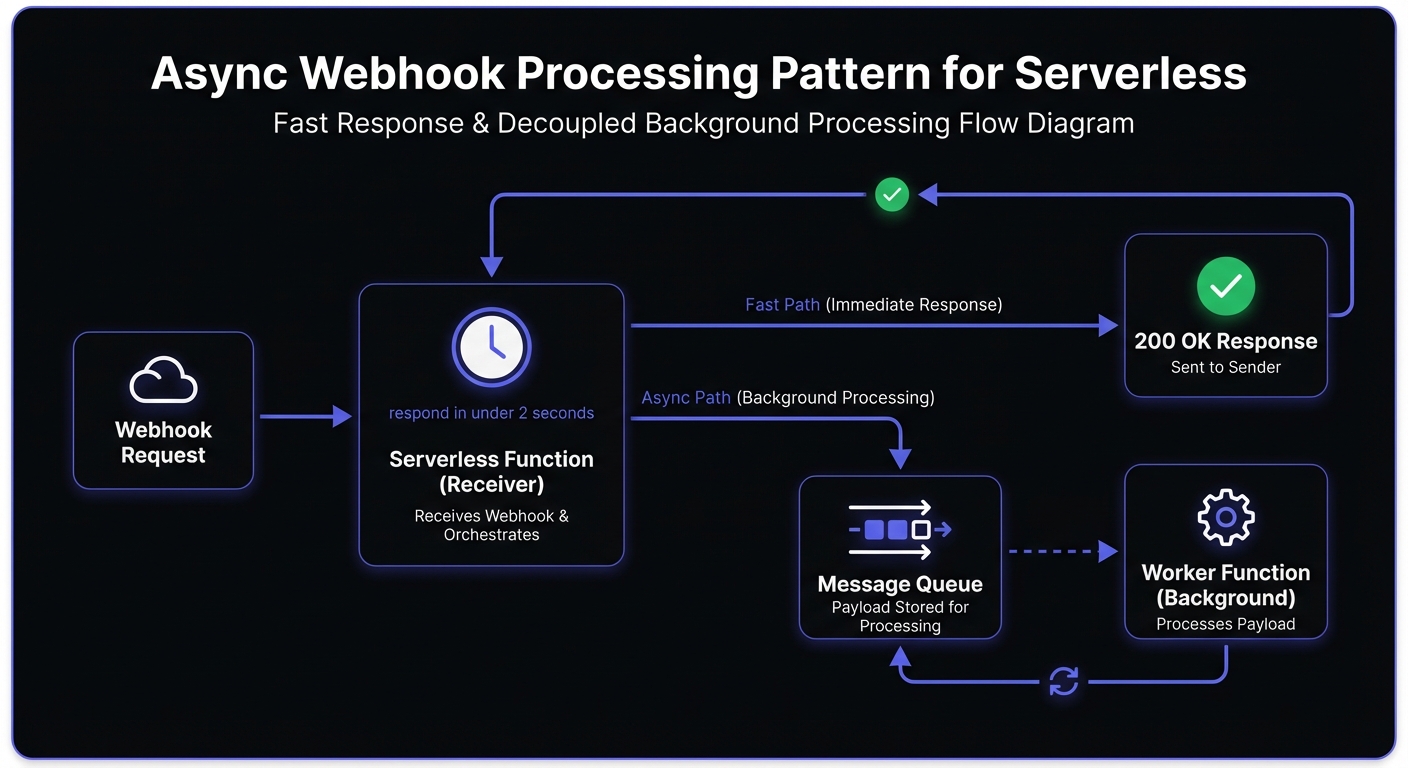
Timeouts: Acknowledge quickly (1-2s), process asynchronously:
- Lambda: SQS or EventBridge
- Vercel: Background functions or external queues
- Workers:
waitUntil()or Cloudflare Queues
Statelessness: Use external databases (DynamoDB, PlanetScale), platform solutions (Durable Objects, Vercel KV), or idempotency keys.
Payload Size Limits: Lambda supports up to 6MB for synchronous invocations. For larger payloads, use S3 pre-signed URLs or stream processing.
Dead Letter Queues: Capture failed webhook events for later analysis and replay. Configure DLQs on Lambda, use Vercel's retry mechanisms, or Cloudflare Queues with retry policies. See webhook dead letter queues for implementation patterns.
Best Practices for Serverless Webhooks
-
Respond fast, process later: Acknowledge within 1-2 seconds, process asynchronously.
-
Verify signatures: Always validate to prevent spoofing. See webhook security best practices.
-
Implement idempotency: Use idempotency keys to prevent duplicates. See webhook idempotency guide.
-
Use queues: Decouple receipt from processing.
-
Monitor and alert: Track delivery rates, latencies, and failures.
Simplify with Hook Mesh
Hook Mesh simplifies webhook infrastructure across all serverless platforms. Integrate with a single API call:
// Works on Lambda, Vercel, or Workers
const response = await fetch('https://api.hookmesh.com/v1/webhooks', {
  method: 'POST',
  headers: {
    'Authorization': `Bearer ${HOOKMESH_API_KEY}`,
    'Content-Type': 'application/json'
  },
  body: JSON.stringify({
    event: 'order.completed',
    destination: customerId,
    payload: orderData
  })
});
Hook Mesh manages retries, monitoring, and dashboards.
Conclusion
Serverless platforms excel for webhooks: automatic scaling, cost efficiency, and low operational overhead. Lambda offers maturity and AWS integration, Vercel offers developer experience, and Cloudflare Workers offer edge-first architecture. Success requires understanding constraints: acknowledge quickly, process asynchronously, and leverage platform features. See scaling webhooks 0-10K for growth guidance.
Related Posts
Building Webhooks with Next.js and Hook Mesh
Learn how to send and receive webhooks in Next.js 14+ using App Router conventions. Complete guide covering route handlers, signature verification, edge runtime, and Hook Mesh SDK integration.
Receive and Verify Webhooks in Node.js: A Complete Guide
Learn how to securely receive and verify webhooks in Node.js using Express.js. Covers HMAC signature verification, timestamp validation, replay attack prevention, and common mistakes to avoid.
Webhook Security Best Practices: The Complete Guide
Learn how to secure your webhook implementations with HMAC signature verification, replay attack prevention, SSRF mitigation, and more. Includes code examples in Node.js and Python.
From 0 to 10K Webhooks: Scaling Your First Implementation
A practical guide for startups on how to scale webhooks from your first implementation to handling 10,000+ events per hour. Learn what breaks at each growth phase and how to fix it before your customers notice.
Webhook Idempotency: Why It Matters and How to Implement It
A comprehensive technical guide to implementing idempotency for webhooks. Learn about idempotency keys, deduplication strategies, and implementation patterns with Node.js and Python code examples.