Webhook Landscape 2026: Trends, Tools, and Predictions
Explore the key webhook trends shaping 2026, from event-driven architecture adoption to AI/ML callbacks. Learn what these shifts mean for startups and how to future-proof your integration strategy.
The Webhook Landscape in 2026: Trends, Tools, and Predictions
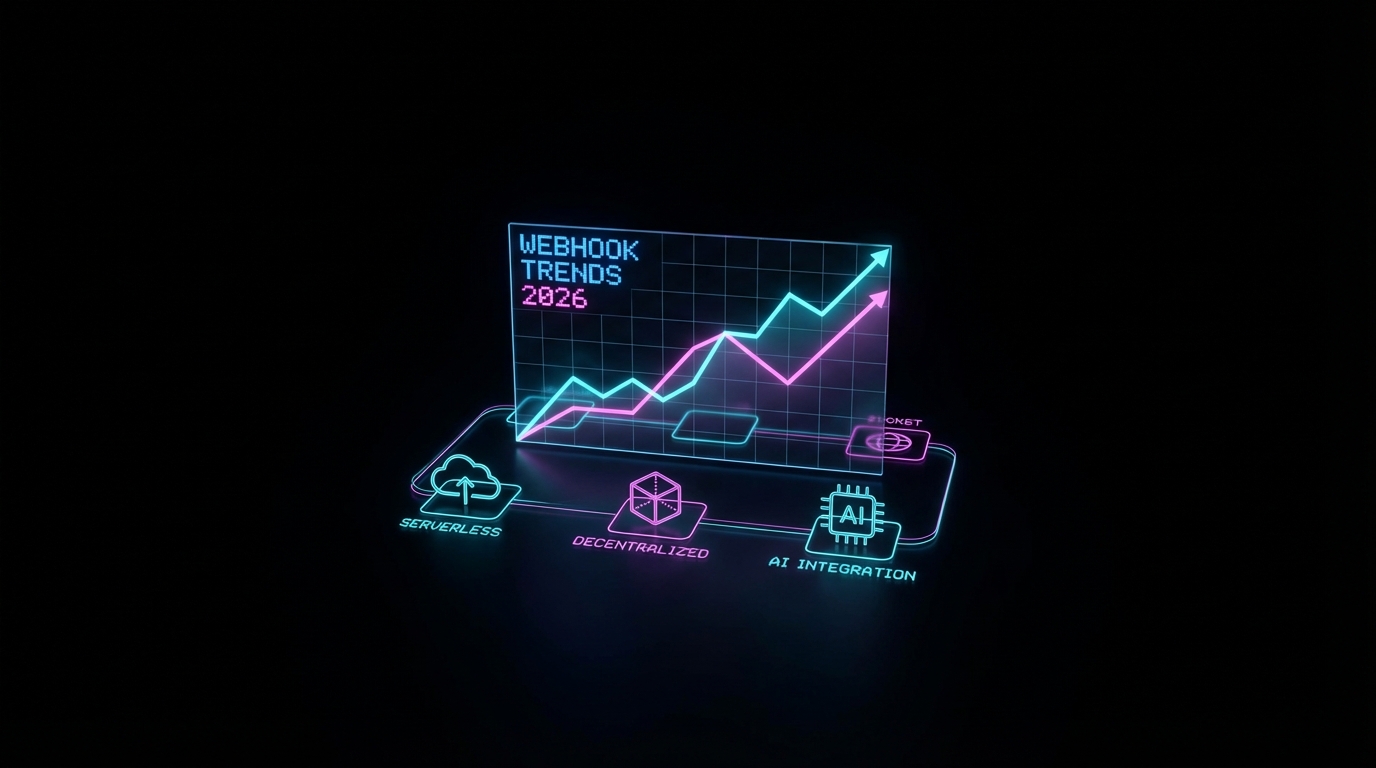
Webhooks have become the backbone of modern software integration—evolving from simple HTTP callbacks to mission-critical infrastructure for payment processing, CI/CD, and AI agent orchestration. This analysis breaks down the major trends shaping 2026 and offers infrastructure decisions for startups and SMBs.
The Rise of Event-Driven Architecture
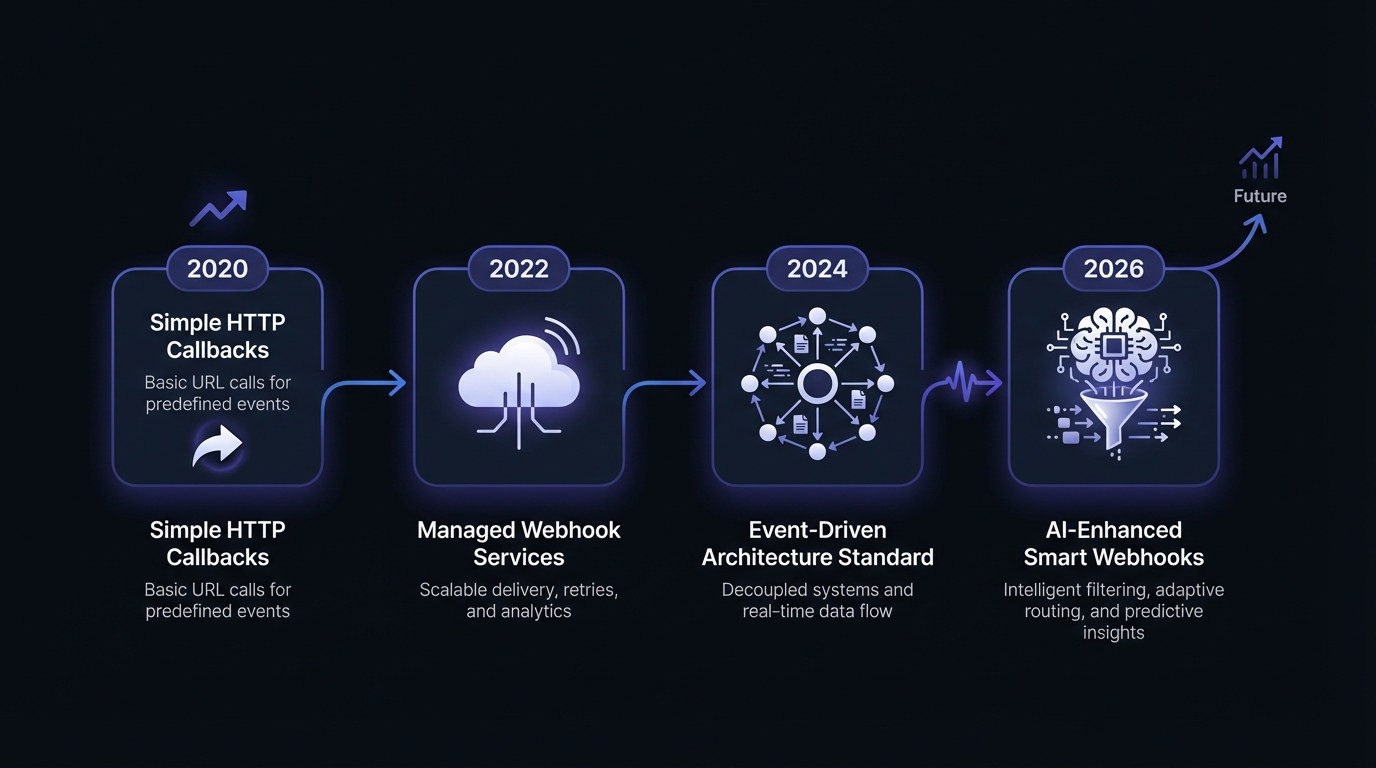
Event-driven architecture (EDA) adoption has become mainstream—85% of organizations now use it, up from 60% in 2023. This is a fundamental shift from monolithic request-response patterns to loosely coupled, event-based systems where webhooks are the primary communication mechanism.
Drivers: microservices maturity (reliable inter-service communication), third-party demands (B2B apps integrate 15-20 services), customer expectations (real-time updates). For startups, webhook infrastructure is now foundational—no longer optional for enterprise readiness. See webhooks for startups for essential considerations.
Webhook-as-a-Service: Market Coming of Age
The API management market reaches $15 billion by 2027 (25% annual growth). Webhook-as-a-service is the fastest-growing segment because building production-grade webhook infrastructure is deceptively complex. Beyond simple HTTP POSTs, you need: exponential backoff retries, dead letter queues, rate limiting, payload signing, monitoring, and multi-region redundancy.
Many startups have burned months on custom systems only to face reliability issues at scale. The build versus buy decision has shifted toward managed solutions for nearly all organizations. This mirrors authentication (Auth0, Okta), payments (Stripe), and communications (Twilio)—webhook delivery is commodity infrastructure better purchased than built.
AI and Machine Learning: The New Webhook Frontier
One of the most exciting developments in 2026 is the explosion of AI/ML-related webhook use cases. As artificial intelligence moves from experimental to production workloads, webhooks have become the connective tissue for AI-powered systems.
Model training callbacks: ML pipelines are asynchronous—training jobs run for hours, inference takes time. Webhooks notify when training completes, fine-tuning finishes, batch results are ready, or performance degrades. Platforms like Replicate, Modal, and custom ML use them heavily.
AI agent communication: Autonomous agents need reliable, secure ways to communicate across systems. A sales agent monitoring email, updating CRM, and triggering sequences requires webhooks to propagate events reliably. These workflows demand higher volumes and lower latency than traditional use cases.
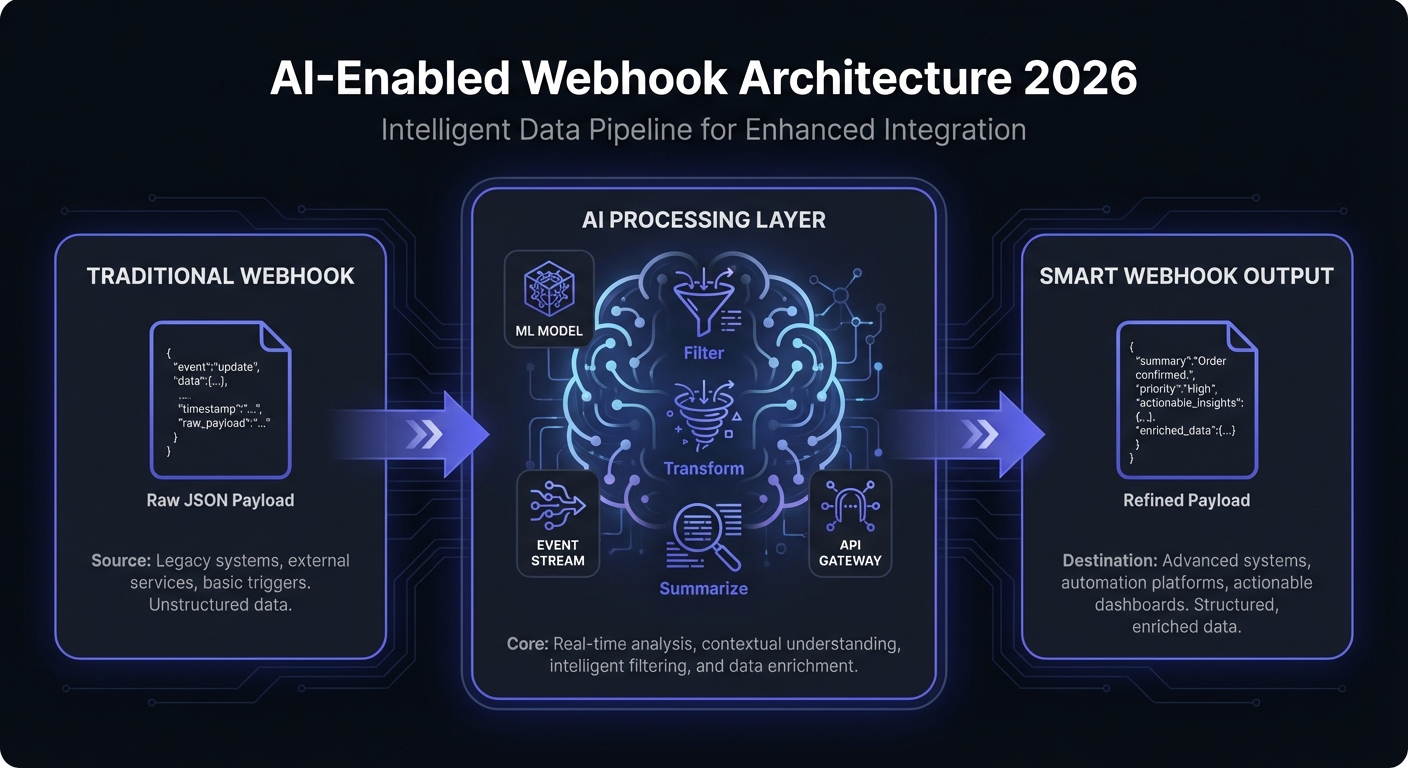
AI-enhanced payloads: Instead of "here's everything that changed," platforms now offer filtered, transformed, and AI-summarized webhook payloads. This reduces noise, lowers processing costs, and enables smarter downstream automation. Expect intelligent filtering to become standard by late 2026.
AI-to-AI integrations: The pattern where AI coordinates directly with other AI systems goes mainstream. Humans move from "in the loop" to "on the loop"—supervising rather than mediating every interaction. Webhooks provide the reliable transport layer for these autonomous workflows.
Performance implications: AI workloads have larger payloads (model outputs, embeddings), stricter latency requirements, and severe consequences for failed delivery. Providers innovate with payload compression, priority queuing, and sub-second delivery guarantees.
Real-Time Requirements: The New Normal
Users expect instant feedback. Implications for webhook architecture:
Sub-second delivery: Payment confirmations, inventory updates, and security alerts must arrive in hundreds of milliseconds—not seconds.
Global distribution: Edge computing and distributed infrastructure are now essential, not optional.
Persistent connections: Some use cases demand WebSocket alternatives for highest-frequency, lowest-latency scenarios.
Model Context Protocol: The New Integration Standard
MCP (Model Context Protocol) becomes table stakes in 2026. Five years ago, having an API was novel—that is MCP today. With the Agentic AI Foundation formalizing it under the Linux Foundation, this is now the universal standard for AI-to-system communication.
If your SaaS doesn't have an MCP server, you are invisible to AI assistants. Webhooks and MCP complement each other: MCP enables AI agents to discover and interact with your system, while webhooks deliver real-time events to those agents. The tooling ecosystem around MCP (client libraries, testing utilities, debugging tools) explodes in 2026.
Event Gateways: The Infrastructure Layer
Event gateways transition from optional to foundational infrastructure. Instead of building webhook dispatchers from scratch, organizations push messages to event gateways that handle:
- Message filtering: Prevent receivers from processing irrelevant messages, reducing serverless invocation costs
- Intelligent routing: Direct messages to appropriate destinations without custom code
- Payload transformation: Convert formats between incompatible systems automatically
- Third-party orchestration: Simplify integration workflows across multiple external applications
The pattern: consume when possible, build when necessary. Event gateways centralize visibility, encourage message reuse, and discourage redundant schema creation.
Security and Compliance: Rising Stakes
Webhooks carry sensitive data (financial transactions, healthcare, personal info) requiring intensified security:
Mutual TLS: Organizations require mTLS beyond HTTPS to verify both sender and receiver.
Payload encryption: HMAC signatures are baseline; advanced implementations add full payload encryption.
Compliance: SOC 2, HIPAA, GDPR compliance are standard for providers serving enterprise customers. Regulatory deadlines are firm—healthcare FHIR APIs have January 2026 mandates, financial services require FAPI 2.0 compliance.
Zero Trust: Every API interaction is validated, authenticated, and monitored in real time. Security moves shift-left into CI/CD pipelines with automated policy enforcement.
Audit logging: Detailed logs of webhook attempts (request/response) are necessary for debugging and compliance.
The Tools Landscape: Your Options in 2026
Organizations evaluating webhook infrastructure today have three primary paths—but a fourth option is emerging.
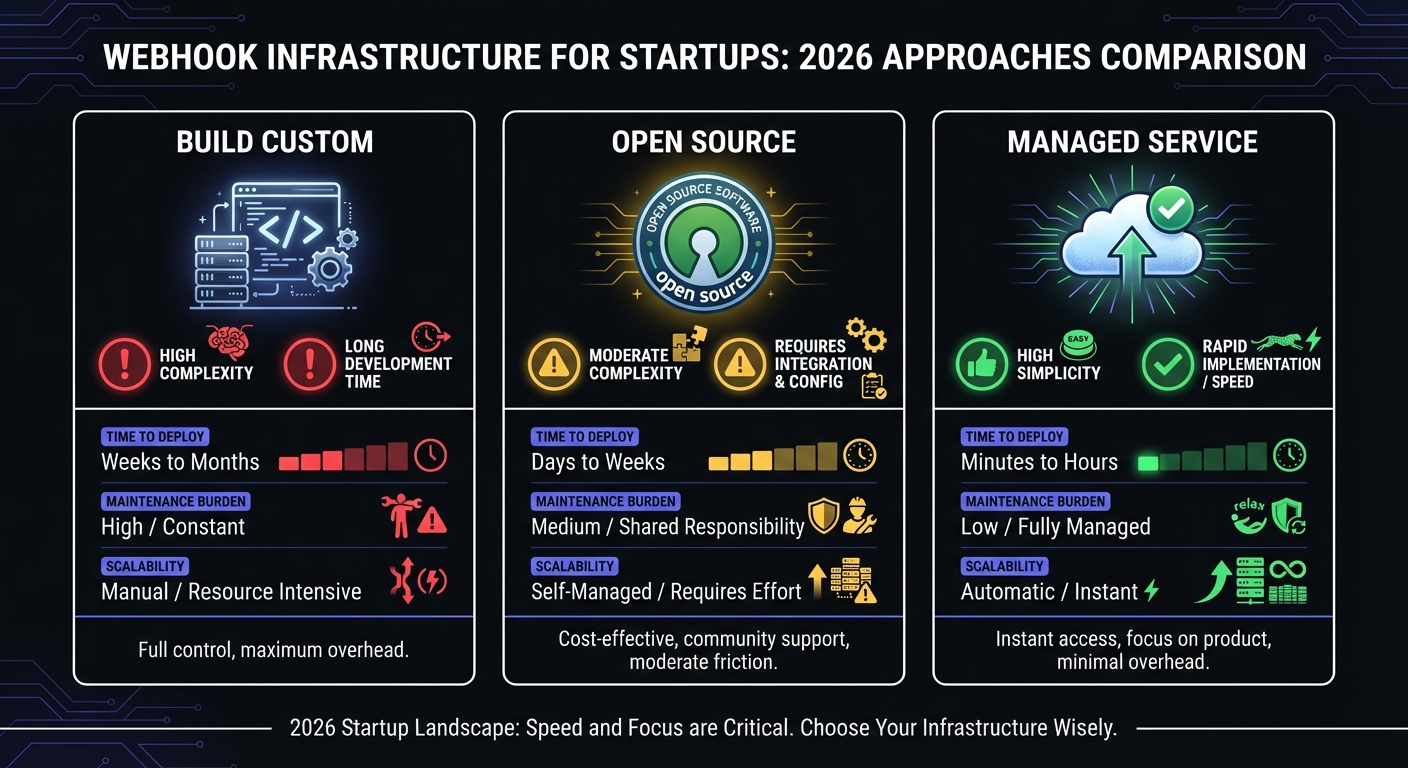
Build yourself: Viable for large teams with specific needs, but total cost of ownership (maintenance, on-call, opportunity cost) is hard to justify. Research shows 40% of AI-generated code contains vulnerabilities—"integration debt" from 2025's rapid development becomes a 2026 cleanup problem.
Open source: Convoy, Svix, hookdeck offer control and customization. Requires DevOps capacity.
Managed services: Fastest-growing. Hook Mesh handles infrastructure entirely—best for startups and SMBs prioritizing product over infrastructure.
AI agent orchestration: The old build-vs-buy decision gains a third option: have an AI agent handle integrations dynamically. However, mission-critical, high-volume, audit-required integrations remain too important for non-deterministic approaches. Complex integrations that AI cannot handle dynamically become MORE valuable, not less.
Predictions: Where Webhooks Are Heading
Standardization accelerates: CloudEvents specification and AsyncAPI gain broader adoption, reducing payload fragmentation and enabling seamless cross-platform integration. GraphQL subscriptions and gRPC streaming complement traditional webhooks for specific use cases.
AI-native APIs emerge: 30%+ of new API demand comes from AI and LLM-based tools. APIs designed for autonomous AI agent interaction—with enriched metadata and self-healing capabilities—become competitive differentiators.
Intelligent routing: Infrastructure automatically retries based on error patterns, transforms payloads between formats, and routes based on content. Observing what you repeatedly ask AI to do, then hardening those patterns into deterministic integrations becomes the standard workflow.
Observability integration: Webhook delivery becomes a first-class citizen with distributed tracing from source through processing. Modern teams want end-to-end visibility: logs, traces, and metrics tied together rather than isolated dashboards. See webhook observability, logging, and metrics.
Event streaming convergence: Webhooks and event streaming (Kafka, Pulsar) blur with unified interfaces for push and pull consumption. Hybrid approaches combining real-time webhook delivery with event replay capabilities become standard for enterprise applications.
Edge and serverless dominant: API logic runs as close as possible to end users. AWS Lambda and Azure Functions triggered by webhooks replace dedicated web servers for most event processing workloads.
What This Means for Startups
Your webhook infrastructure directly impacts your ability to serve enterprise customers, integrate with AI, and meet reliability expectations. The build-versus-buy decision is clear: unless webhook delivery is your core product, buy. Prioritize reliability guarantees, global performance, security certifications, clean APIs, and scalability. See webhook provider evaluation checklist.
Key considerations for 2026:
- MCP readiness: Ensure your product can integrate with AI assistants through MCP servers
- AI payload handling: Support larger payloads (model outputs, embeddings) with stricter latency requirements
- Compliance timelines: Healthcare, financial services, and EU markets have firm regulatory deadlines
- Integration debt: Audit 2025's rapidly-built integrations before they create 2026's reliability problems
Organizations that thrive treat webhook infrastructure as strategic. The webhook ecosystem evolves rapidly—getting it right from the start matters.
Related Posts
What Are Webhooks? A Complete Guide for Developers
Learn what webhooks are, how they work, and why they're essential for modern applications. This comprehensive guide covers webhook basics, real-world use cases, code examples, and best practices for startup developers.
Build vs Buy: Webhook Infrastructure Decision Guide
A practical guide for engineering teams deciding whether to build webhook delivery infrastructure from scratch or use a managed service. Covers engineering costs, timelines, and when each approach makes sense.
Webhooks for Startups: A Practical Guide
A comprehensive guide for startup founders and engineers on implementing webhooks - when to add them, what to build first, and how to scale without over-engineering.
Webhook Observability: Logging, Metrics, and Tracing
A comprehensive technical guide to implementing observability for webhook systems. Learn about structured logging, key metrics to track, distributed tracing with OpenTelemetry, and alerting best practices.
Choosing a Webhook Provider: A Checklist for Startup CTOs
A comprehensive evaluation checklist for technical leaders choosing a webhook provider. Covers reliability, security, developer experience, pricing, and the red flags to avoid.