5 Webhook Mistakes Early-Stage Startups Make
Learn the most common webhook mistakes that plague early-stage startups—from missing retry logic to over-engineering—and how to avoid them before they cost you customers.

5 Webhook Mistakes Early-Stage Startups Make
You shipped webhooks in a weekend. Your first customer integrated. Everything worked—until it didn't.
Three months later, you're debugging why a payment didn't process, data is out of sync, or customers are churning. Webhooks seem simple: send an HTTP POST on events, done. But the gap between working and production-ready systems is where startups lose customers and accumulate years of technical debt.
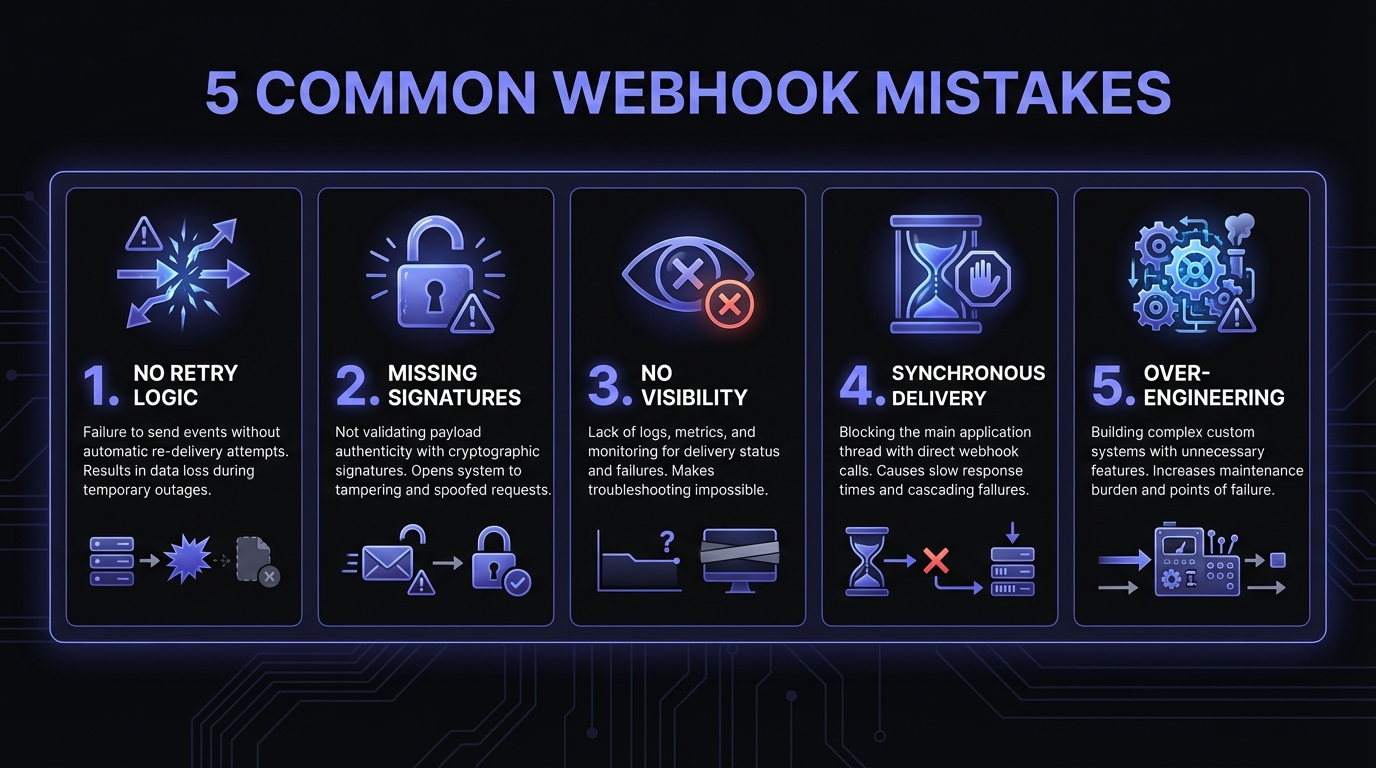
Here are the five webhook mistakes we see early-stage startups make repeatedly—and how to fix them before they cost you. For a comprehensive guide to getting webhooks right from the start, see our webhooks for startups guide.
Mistake 1: No Retry Logic (Or Bad Retry Logic)
What Goes Wrong
A single failed webhook without retries means lost data forever. Bad retry logic is worse: startups often hammer failing endpoints every second, overwhelming infrastructure and customer servers.
// The wrong way: No retries, or aggressive retries
async function sendWebhook(url, payload) {
  const response = await fetch(url, {
    method: 'POST',
    body: JSON.stringify(payload)
  });

  // If this fails, the event is gone forever
  if (!response.ok) {
    console.error('Webhook failed');
  }
}

// Also wrong: Retry spam
async function sendWebhookWithBadRetries(url, payload) {
  for (let i = 0; i < 10; i++) {
    const response = await fetch(url, { method: 'POST', body: JSON.stringify(payload) });
    if (response.ok) return;
    // Retrying immediately with no backoff
  }
}
Real Consequences
A fintech startup lost a $50K enterprise deal because a single webhook carrying a critical transaction notification failed during a brief AWS outage. No retry meant no notification. The customer's reconciliation broke, and trust was permanently damaged.
How to Fix It
Implement exponential backoff with jitter. Start with short delays, increase progressively, and add randomness to prevent thundering herd problems. See webhook retry strategies for complete patterns.
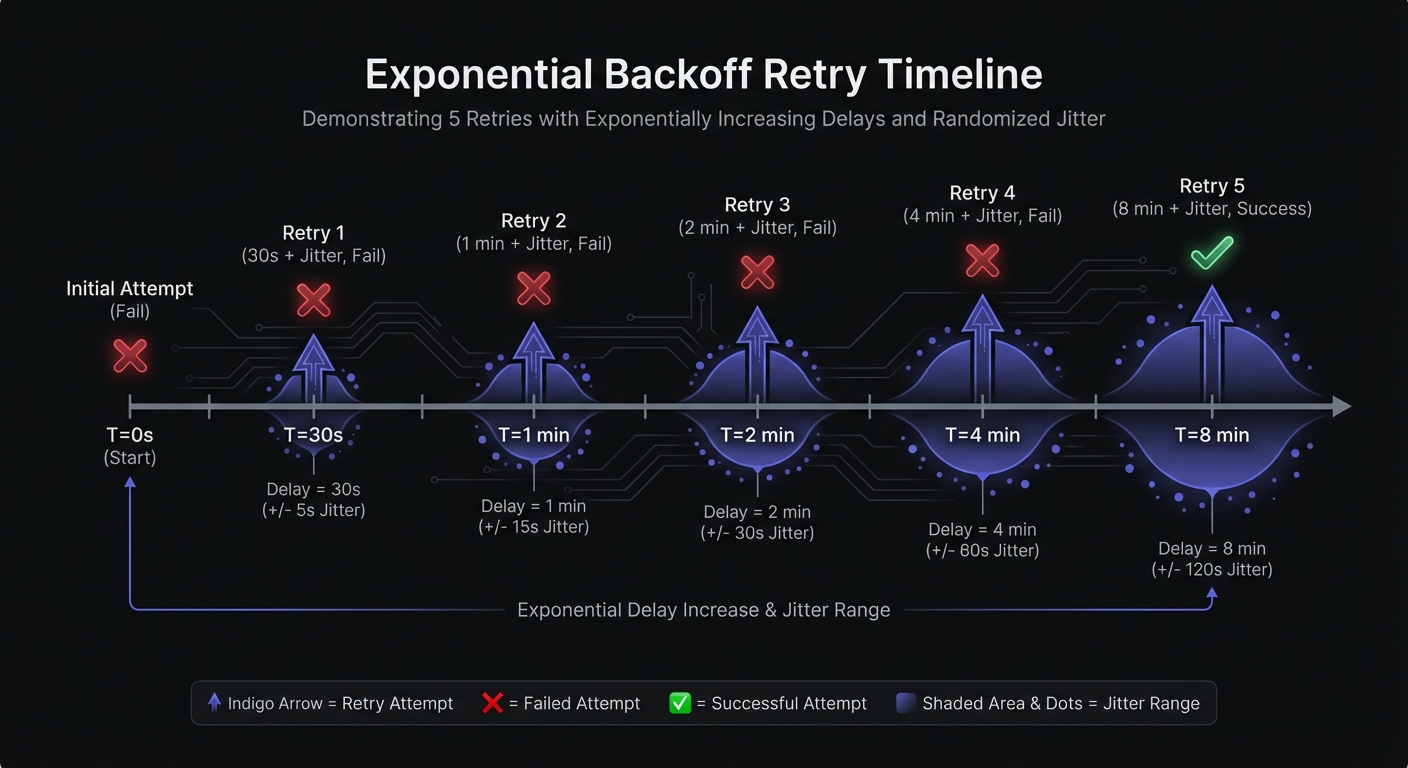
// The right way: Exponential backoff with jitter
async function sendWebhookWithRetry(url, payload, attempt = 0) {
  const maxAttempts = 5;

  try {
    const response = await fetch(url, {
      method: 'POST',
      body: JSON.stringify(payload),
      signal: AbortSignal.timeout(30000)
    });

    if (!response.ok && attempt < maxAttempts) {
      const delay = Math.min(1000 * Math.pow(2, attempt), 32000);
      const jitter = delay * 0.2 * Math.random();
      await sleep(delay + jitter);
      return sendWebhookWithRetry(url, payload, attempt + 1);
    }

    return response;
  } catch (error) {
    if (attempt < maxAttempts) {
      const delay = Math.min(1000 * Math.pow(2, attempt), 32000);
      await sleep(delay);
      return sendWebhookWithRetry(url, payload, attempt + 1);
    }
    throw error;
  }
}
Mistake 2: Missing Signature Verification
What Goes Wrong
Without signature verification, anyone can send fake events to your customer's webhook endpoint. Malicious actors actively exploit this.
// The wrong way: No verification
app.post('/webhook', (req, res) => {
  const event = req.body;
  // Blindly trusting the payload
  processPayment(event.data);
  res.sendStatus(200);
});
Real Consequences
An e-commerce platform without webhook signatures had attackers send fake "payment completed" events to merchant endpoints. Merchants shipped products for payments that never happened. The platform faced chargebacks, angry merchants, and a PR nightmare.
How to Fix It
Sign every webhook with HMAC-SHA256 using a shared secret and include a timestamp to prevent replay attacks. See HMAC-SHA256 webhook signatures for implementation.
// The right way: HMAC signature verification
const crypto = require('crypto');

function signWebhook(payload, secret, timestamp) {
  const signedPayload = `${timestamp}.${JSON.stringify(payload)}`;
  return crypto.createHmac('sha256', secret)
    .update(signedPayload)
    .digest('hex');
}

// Sending side
const timestamp = Date.now();
const signature = signWebhook(payload, customerSecret, timestamp);

fetch(url, {
  method: 'POST',
  headers: {
    'X-Webhook-Signature': signature,
    'X-Webhook-Timestamp': timestamp
  },
  body: JSON.stringify(payload)
});

// Receiving side (your customer's code)
app.post('/webhook', (req, res) => {
  const signature = req.headers['x-webhook-signature'];
  const timestamp = req.headers['x-webhook-timestamp'];

  // Reject old timestamps (prevent replay attacks)
  if (Date.now() - timestamp > 300000) {
    return res.sendStatus(401);
  }

  const expectedSig = signWebhook(req.body, secret, timestamp);
  if (!crypto.timingSafeEqual(Buffer.from(signature), Buffer.from(expectedSig))) {
    return res.sendStatus(401);
  }

  processEvent(req.body);
  res.sendStatus(200);
});
Mistake 3: No Customer Visibility
What Goes Wrong
Customers have no idea why webhooks fail. No visibility into delivery attempts, response codes, or payloads means every failure becomes a support ticket requiring manual log investigation.
Real Consequences
A SaaS startup spent 40% of their engineering support time debugging webhook issues because customers had zero visibility. Response times stretched to hours. Customer satisfaction tanked. Engineers burned out investigating problems that customers could have self-served.
How to Fix It
Build a webhook logs dashboard exposing:
- Timestamp of each delivery attempt
- HTTP status code received
- Response body (truncated)
- Request payload sent
- Next scheduled retry
Let customers retry failed webhooks manually. Customers should never ask "did you send it?"—they should see it themselves.
Mistake 4: Synchronous Delivery Blocking Requests
What Goes Wrong
Synchronous webhook delivery in your API request path means response time depends on the customer's server. Slow or down endpoints slow or timeout your entire API.
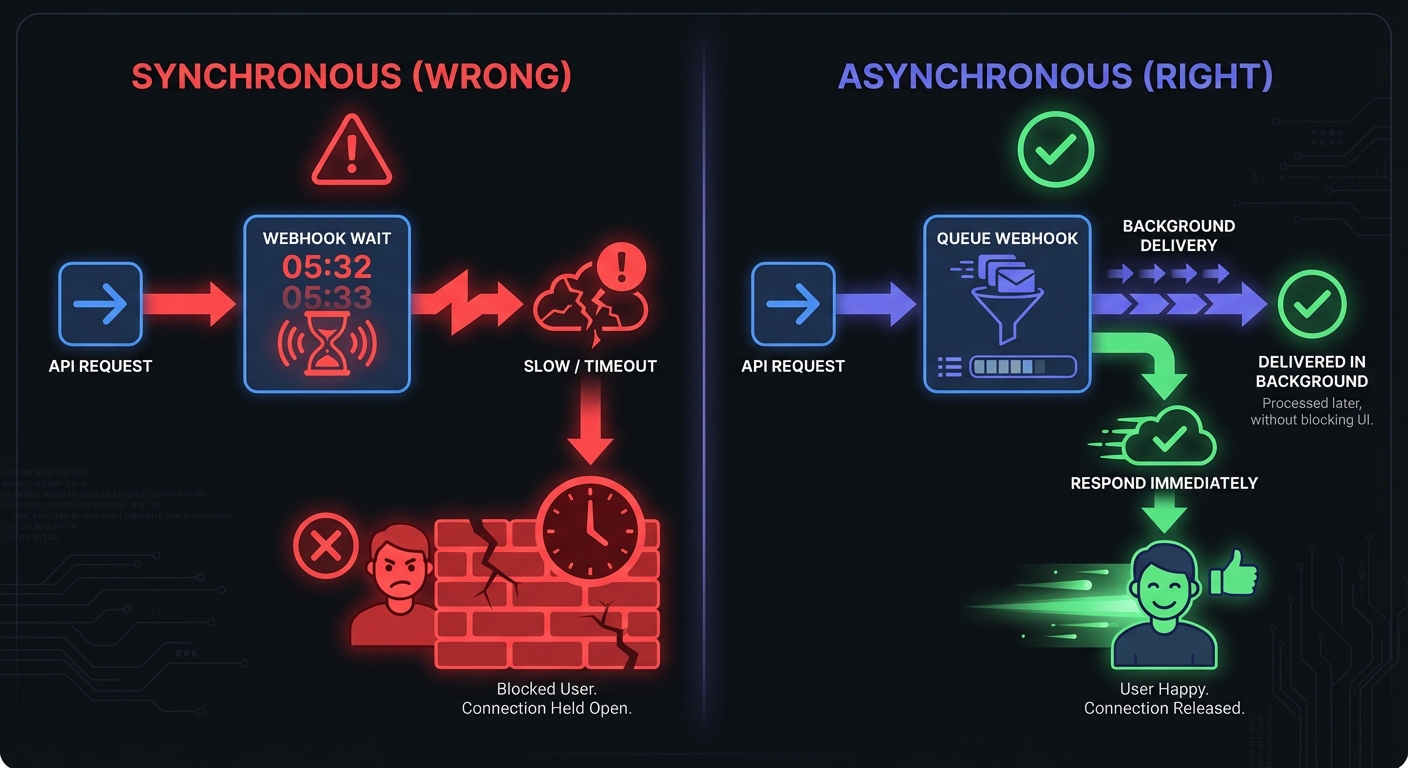
// The wrong way: Synchronous delivery in the request path
app.post('/api/orders', async (req, res) => {
  const order = await createOrder(req.body);

  // This blocks your response on external servers
  await sendWebhook(customer.webhookUrl, { event: 'order.created', data: order });

  res.json(order); // User waits for webhook to complete
});
Real Consequences
A marketplace sent webhooks synchronously. One customer's endpoint went down, API response times spiked from 200ms to 30 seconds. Other customers experienced degraded performance, cascading into partial outage.
How to Fix It
Queue webhooks for asynchronous delivery. Your API responds immediately while webhooks are processed in the background. This decouples your availability from your customers' infrastructure.
// The right way: Async delivery via queue
app.post('/api/orders', async (req, res) => {
  const order = await createOrder(req.body);

  // Queue webhook for background delivery
  await webhookQueue.add({
    url: customer.webhookUrl,
    event: 'order.created',
    data: order
  });

  res.json(order); // Responds immediately
});

// Separate worker processes the queue
webhookQueue.process(async (job) => {
  await sendWebhookWithRetry(job.data.url, job.data);
});
Mistake 5: Over-Engineering Too Early
What Goes Wrong
Some startups over-engineer. They spend months on Kafka, Redis clusters, custom retry algorithms, and complex monitoring before having 10 customers—optimizing for scale they don't have while neglecting features customers need.
Real Consequences
A developer tools startup spent three months building an "enterprise-grade" webhook pipeline. They used Kafka, wrote custom delivery workers, and built elaborate monitoring. Meanwhile, competitors shipped simpler solutions and captured market share. When they finally launched, they discovered customers just wanted reliable delivery and a logs dashboard—not architectural elegance. Our MVP webhook architecture guide shows you exactly what to build first and what to defer.
How to Fix It
Start simple. Use a managed queue service. Implement basic retries and logging. Focus on customer experience: Can they see their webhooks? Debug failures? Trust delivery?
You don't need Kafka on day one. You need webhooks that work and customers who can see that they work.
Bonus Mistakes: What Competitors Miss
Beyond the five core mistakes, experienced webhook operators consistently flag these additional pitfalls:
Ignoring Idempotency
Webhooks get delivered multiple times—network hiccups, retries, race conditions. If processing the same event twice produces different results, you've built a time bomb.
// Wrong: Not idempotent
app.post('/webhook', async (req, res) => {
  await addCredit(req.body.userId, req.body.amount); // Doubles credit on retry
  res.sendStatus(200);
});

// Right: Idempotent with event ID tracking
app.post('/webhook', async (req, res) => {
  const eventId = req.body.event_id;

  // Check if already processed
  const exists = await db.query('SELECT 1 FROM processed_events WHERE id = $1', [eventId]);
  if (exists.rows.length > 0) {
    return res.sendStatus(200); // Acknowledge but skip processing
  }

  await db.query('INSERT INTO processed_events (id) VALUES ($1)', [eventId]);
  await addCredit(req.body.userId, req.body.amount);
  res.sendStatus(200);
});
Every webhook handler must be idempotent. Period. See our idempotency guide for complete patterns.
Not Handling Rate Limits
When a customer's endpoint returns 429 (Too Many Requests), respect the Retry-After header. Ignoring it creates a thundering herd that makes the problem worse.
async function sendWebhookWithRateLimiting(url, payload, attempt = 0) {
  const response = await fetch(url, {
    method: 'POST',
    body: JSON.stringify(payload)
  });

  if (response.status === 429) {
    const retryAfter = response.headers.get('Retry-After') || 60;
    await sleep(parseInt(retryAfter) * 1000);
    return sendWebhookWithRateLimiting(url, payload, attempt);
  }

  return response;
}
No Timeout Configuration
Webhook handlers that take too long trigger retries while still processing. Most providers timeout after 5-30 seconds. Configure timeouts on both send and receive sides:
// Sending side: Abort after 30 seconds
const response = await fetch(url, {
  method: 'POST',
  body: JSON.stringify(payload),
  signal: AbortSignal.timeout(30000)
});

// Receiving side: Return 200 immediately, process async
app.post('/webhook', async (req, res) => {
  res.sendStatus(200); // Acknowledge receipt immediately

  // Process in background to avoid timeout
  setImmediate(() => processWebhook(req.body));
});
Sending All Events to Everyone
Broadcasting every event type to every endpoint wastes bandwidth, increases costs, and annoys customers. Let customers subscribe to specific event types:
// Store customer preferences
const subscriptions = {
  customer_123: ['order.created', 'order.fulfilled'],
  customer_456: ['payment.completed']
};

async function shouldSendWebhook(customerId, eventType) {
  return subscriptions[customerId]?.includes(eventType) ?? false;
}
The Path Forward
Building webhooks is a distraction from your core product. The build vs buy decision is where startups save the most time.
Hook Mesh handles exponential backoff retries, signature verification, delivery logs, async processing, idempotency tracking, and rate limit compliance. You can ship webhooks in a weekend, but production-ready systems take months of iteration. The startups that win recognize which problems to solve themselves—and which to outsource.
Related Posts
Webhooks for Startups: A Practical Guide
A comprehensive guide for startup founders and engineers on implementing webhooks - when to add them, what to build first, and how to scale without over-engineering.
MVP Webhook Architecture: Start Simple, Scale Later
A practical guide for startups building their first webhook system. Learn what you need on day one versus later, avoid common over-engineering mistakes, and understand when to build versus buy.
How to Scope Your Webhook MVP (Without Over-Engineering)
A practical guide for product managers and engineers on scoping a webhook MVP. Learn what features to include, what to defer, how to prioritize events, and avoid common scope creep traps that derail webhook projects.
Webhook Security Best Practices: The Complete Guide
Learn how to secure your webhook implementations with HMAC signature verification, replay attack prevention, SSRF mitigation, and more. Includes code examples in Node.js and Python.
Webhook Idempotency: Why It Matters and How to Implement It
A comprehensive technical guide to implementing idempotency for webhooks. Learn about idempotency keys, deduplication strategies, and implementation patterns with Node.js and Python code examples.