Securing Webhook Endpoints: A Checklist for Production
A comprehensive, actionable security checklist for production webhook endpoints. Covers transport security, authentication, input validation, rate limiting, logging, and error handling with priority levels and code examples.
Securing Webhook Endpoints: A Checklist for Production
Webhook endpoints are publicly accessible URLs that accept POST requests from external services. Without proper security controls, they become attack vectors for data injection, denial of service, and unauthorized access.
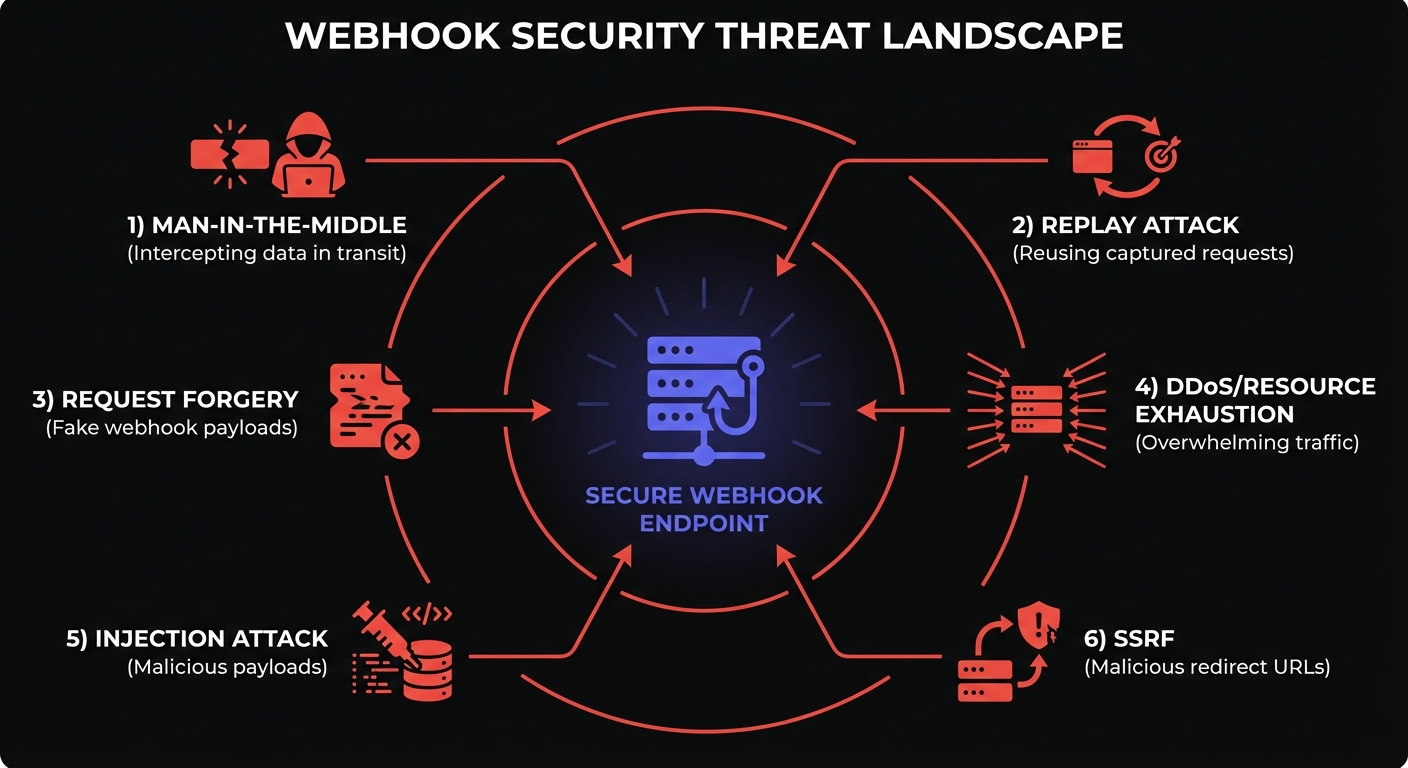
This checklist covers every security consideration for production webhook endpoints, organized by priority level. Use it as a pre-launch audit or reference when hardening existing implementations. For in-depth explanations, see our webhook security best practices guide.
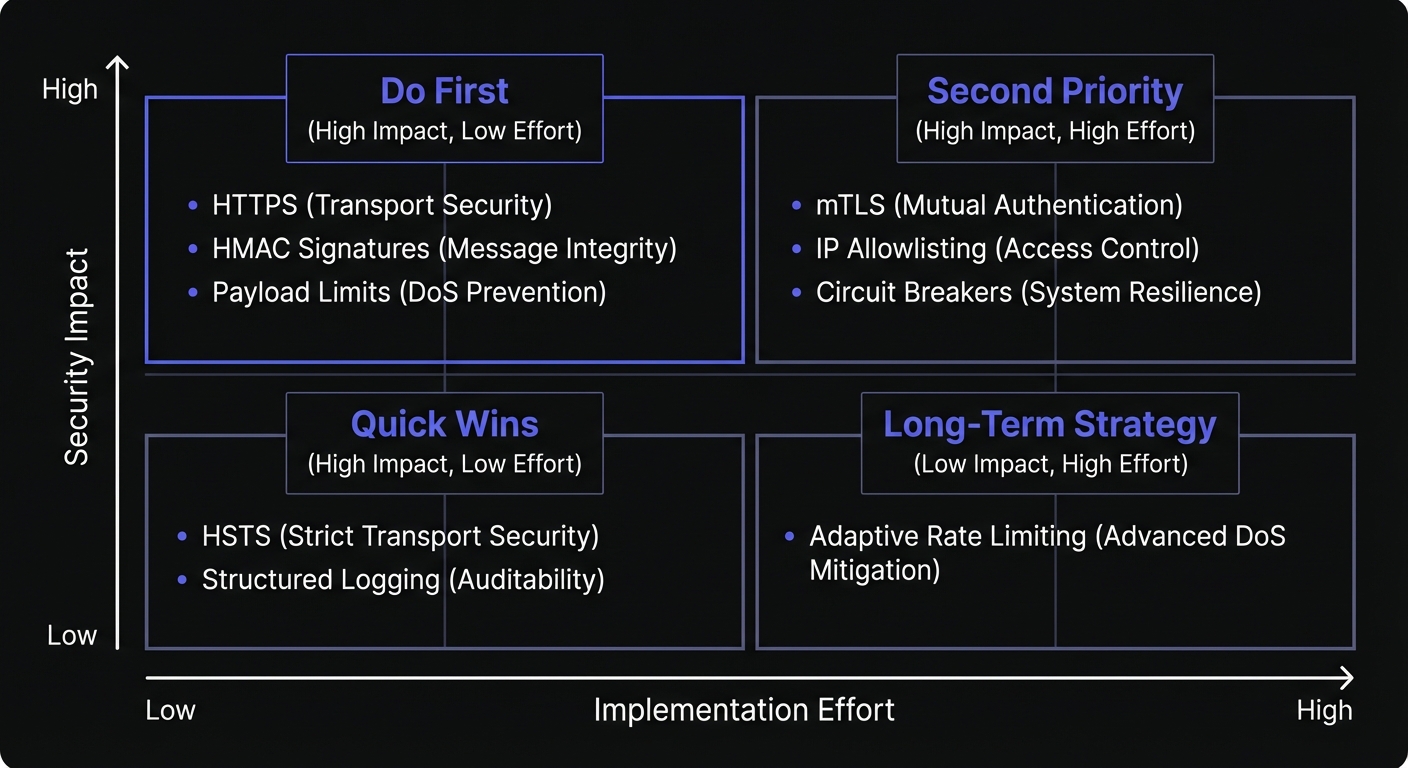
Each item is categorized by priority:
- Must Have: Non-negotiable for production
- Should Have: Important hardening before handling sensitive data
- Nice to Have: Defense-in-depth measures
Transport Security
Your webhook endpoint's security depends on the connection delivering the payload.
Must Have
Enforce HTTPS exclusively
Reject HTTP requests entirely rather than redirecting them. HTTP traffic can be intercepted and modified by anyone on the network path.
# Nginx: Reject HTTP connections entirely
server {
    listen 80;
    server_name webhooks.yourapp.com;
    return 444;  # Close connection without response
}
Require TLS 1.2 or higher
Disable older TLS versions (1.0, 1.1) and SSL. TLS 1.0 and 1.1 are vulnerable to BEAST, POODLE, and other attacks.
Should Have
Use valid, non-expired certificates - Invalid certificates prevent legitimate webhook delivery and signal infrastructure neglect.
Enable HSTS - HTTP Strict Transport Security prevents protocol downgrade attacks.
Authentication and Verification
Authentication confirms webhook requests come from the claimed source and haven't been tampered with.
Must Have
Verify HMAC signatures on every request
Implement HMAC-SHA256 signature verification. Reject any request with a missing or invalid signature before processing the payload. See HMAC-SHA256 webhook signatures for implementation details.
const crypto = require('crypto');

function verifySignature(payload, signature, secret) {
  const expected = crypto
    .createHmac('sha256', secret)
    .update(payload, 'utf8')
    .digest('hex');

  return crypto.timingSafeEqual(
    Buffer.from(signature, 'hex'),
    Buffer.from(expected, 'hex')
  );
}

app.post('/webhooks', express.raw({ type: 'application/json' }), (req, res) => {
  const signature = req.headers['x-webhook-signature'];

  if (!verifySignature(req.body.toString(), signature, WEBHOOK_SECRET)) {
    return res.status(401).json({ error: 'Invalid signature' });
  }
  // Process verified webhook...
});
Use timing-safe comparison for signatures
Never use === to compare signatures. Use constant-time comparison functions. Standard comparison leaks timing information, allowing attackers to discover signatures character by character.
Store secrets securely
Keep webhook secrets in environment variables or a secrets manager. Never commit them to source control. See webhook authentication methods compared. Exposed secrets allow attackers to forge valid signatures.
Use dedicated secret management platforms for production:
- HashiCorp Vault: Self-hosted or cloud, with automatic rotation
- AWS Secrets Manager: Native AWS integration, automatic rotation
- Azure Key Vault: Azure ecosystem, HSM-backed
- Google Secret Manager: GCP integration, versioned secrets
# AWS Secrets Manager example
aws secretsmanager get-secret-value \
  --secret-id webhook/production/hmac-secret \
  --query SecretString --output text
Should Have
Validate timestamps to prevent replay attacks
Reject requests with timestamps older than 5 minutes to limit the window for replay attacks.
def verify_timestamp(timestamp_header, tolerance_seconds=300):
    request_time = int(timestamp_header)
    current_time = int(time.time())
    if abs(current_time - request_time) > tolerance_seconds:
        raise ValueError('Request timestamp outside acceptable window')
Implement idempotency tracking - Store processed event IDs and reject duplicates to handle retries safely. See debugging webhooks in production for strategies when idempotency issues arise.
Nice to Have
Configure IP allowlisting - Restrict your endpoint to accept requests only from known provider IP ranges.
Input Validation
Never trust incoming data. Validate and sanitize webhook payloads before processing. If building delivery systems, review SSRF attack prevention for malicious destination URLs.
Must Have
Enforce payload size limits
Reject payloads exceeding a reasonable limit (1MB typical). Oversized payloads can exhaust memory, cause denial of service, or exploit parsing vulnerabilities.
app.use('/webhooks', express.json({ limit: '1mb' }));Validate JSON structure before processing
Validate payloads against an expected schema before acting on them. Malformed payloads can crash applications or exploit parser vulnerabilities.
const Ajv = require('ajv');
const ajv = new Ajv();

const webhookSchema = {
  type: 'object',
  required: ['event', 'data', 'timestamp'],
  properties: {
    event: { type: 'string', pattern: '^[a-z]+\\.[a-z]+$' },
    data: { type: 'object' },
    timestamp: { type: 'integer' }
  },
  additionalProperties: false
};

const validate = ajv.compile(webhookSchema);
Should Have
Validate event types against an allowlist - Only process event types your application explicitly handles.
Sanitize data before database operations - Use parameterized queries. Never interpolate webhook data directly into queries.
Nice to Have
Validate nested object depth - Limit nesting depth to prevent stack overflows or complexity attacks.
Defense-in-Depth Strategy
No single security control is sufficient. Layer multiple defenses so that if one fails, others prevent compromise.
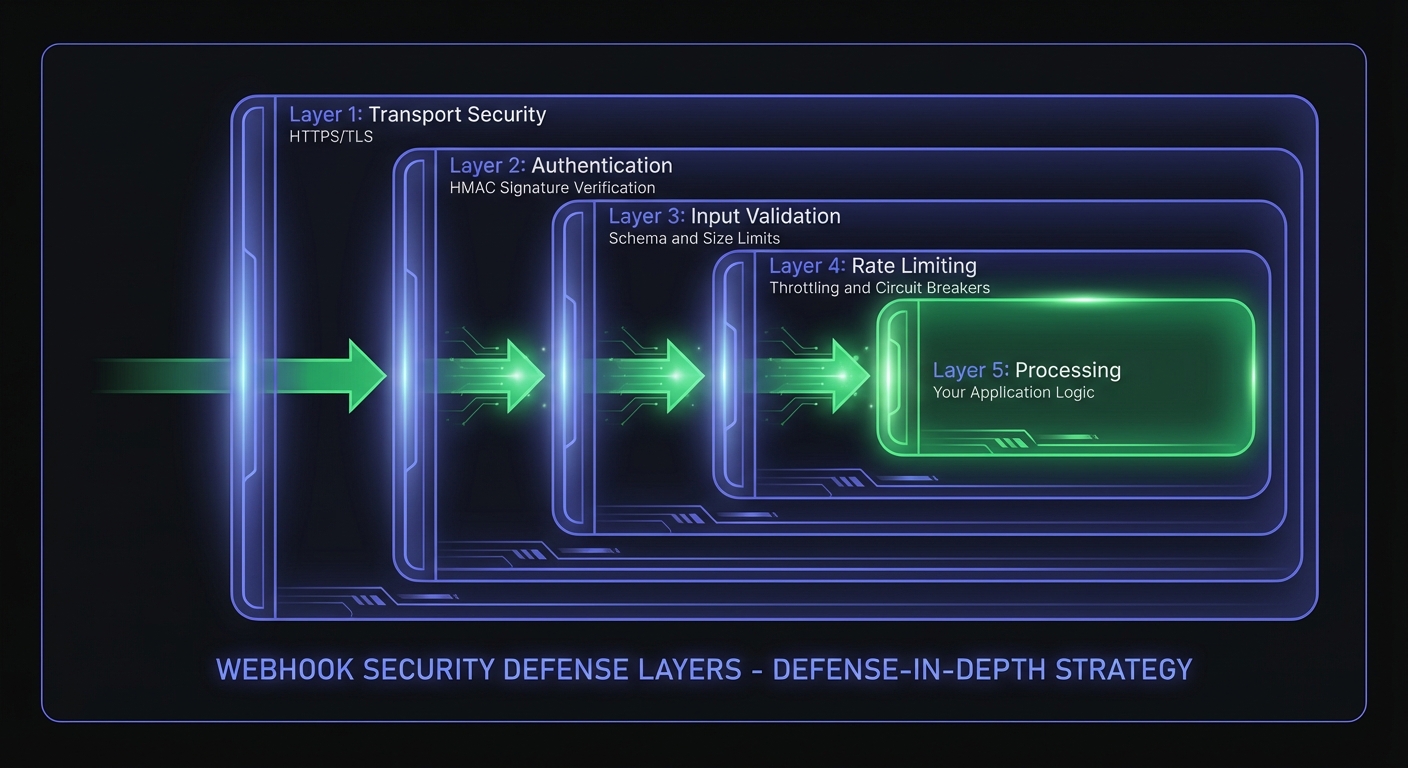
Each layer addresses different threat vectors:
| Layer | Protects Against | Failure Impact |
|---|---|---|
| Transport (HTTPS/TLS) | Eavesdropping, MITM | Data exposure |
| Authentication (HMAC) | Forgery, spoofing | Malicious data injection |
| Input Validation | Injection, malformed data | Application crashes, SQLi |
| Rate Limiting | DDoS, resource exhaustion | Service unavailability |
| Processing | Logic flaws, mishandling | Business logic errors |
Rate Limiting and Abuse Prevention
Protect webhook endpoints from malicious or accidental abuse.
Must Have
Implement rate limiting
Limit requests per time window to prevent denial of service. Without rate limiting, attackers or misbehaving providers can overwhelm your endpoint.
const rateLimit = require('express-rate-limit');

const webhookLimiter = rateLimit({
  windowMs: 60 * 1000,
  max: 100,
  message: { error: 'Rate limit exceeded' },
});

app.use('/webhooks', webhookLimiter);
Should Have
Implement circuit breakers - Prevent cascade failures when downstream services are unavailable.
Set request timeouts - Terminate long-running handlers to prevent resource exhaustion.
Nice to Have
Implement adaptive rate limiting - Adjust limits based on behavior patterns to allow higher throughput for well-behaved sources.
Async Processing and Queues
Process webhooks asynchronously to handle high volumes without blocking delivery confirmations.
Must Have
Return 200 immediately, process later
Webhook providers expect responses within 5-30 seconds. Process payloads asynchronously using a message queue.
const { Queue } = require('bullmq');
const webhookQueue = new Queue('webhooks');

app.post('/webhooks', async (req, res) => {
  // Verify signature first (sync)
  if (!verifySignature(req.body, req.headers['x-webhook-signature'])) {
    return res.status(401).json({ error: 'Invalid signature' });
  }

  // Queue for async processing
  await webhookQueue.add('process', {
    payload: req.body,
    receivedAt: Date.now(),
  });

  // Respond immediately
  res.status(200).json({ received: true });
});
Should Have
Implement dead letter queues - Failed processing attempts should move to a dead letter queue after max retries for investigation.
Set processing timeouts - Kill handlers that exceed reasonable processing time to prevent resource leaks.
Track processing metrics - Monitor queue depth, processing latency, and failure rates.
Logging and Monitoring
Comprehensive logging enables security analysis and incident response.
Must Have
Log all webhook attempts - Record timestamp, source IP, event type, and outcome for every request. Logs are essential for detecting attacks and demonstrating compliance.
Log signature verification failures - Track failed authentication with enough detail to identify attack patterns.
Should Have
Set up alerts for anomalies - Configure alerts for traffic spikes, authentication failure increases, or unexpected request origins.
Implement structured logging - Use JSON logs with consistent fields for automated analysis.
Nice to Have
Retain logs for compliance periods - Keep logs for 90 days to 7 years depending on your compliance framework.
CI/CD Pipeline Security
Webhooks triggering CI/CD pipelines present supply chain attack vectors. A compromised webhook can inject malicious code into builds or deploy unauthorized changes.
Must Have
Restrict webhook triggers by branch/repository - Only allow webhooks from specific branches (e.g., main, release/*) to trigger production deployments.
Validate webhook source before pipeline execution - Verify signatures and source before any code execution.
# GitHub Actions example - verify webhook before running
jobs:
  deploy:
    if: github.event_name == 'push' && github.ref == 'refs/heads/main'
    runs-on: ubuntu-latest
    steps:
      - name: Verify deployment source
        run: |
          if [[ "${{ github.actor }}" != "dependabot[bot]" ]]; then
            echo "Deployment triggered by: ${{ github.actor }}"
          fi
Should Have
Require approval workflows for sensitive operations - Human approval before production deployments.
Audit webhook-triggered deployments - Log every deployment triggered by webhooks with full traceability.
Isolate webhook processing from build environments - Webhook handlers should not have access to build secrets.
Error Handling
Poor error handling leaks information to attackers.
Must Have
Return generic error messages
Never expose internal details. Use generic messages like "Invalid request." Detailed errors help attackers understand your implementation.
// Bad: Leaks implementation details
res.status(400).json({
  error: 'PostgreSQL constraint violation: duplicate key in users table'
});

// Good: Generic response
res.status(400).json({ error: 'Request could not be processed' });
Log detailed errors internally - Keep full error details for debugging without exposing them to clients.
Should Have
Return appropriate HTTP status codes - Use 401 for auth failures, 400 for validation errors, 429 for rate limiting.
Implement graceful degradation - Continue processing when non-critical components fail.
Subscription Lifecycle Management
Manage webhook subscriptions to limit exposure from inactive or abandoned endpoints.
Should Have
Set subscription expiration dates - Require periodic re-registration to prevent indefinite access.
// Example subscription with expiration
const subscription = {
  endpointUrl: 'https://customer.com/webhooks',
  events: ['payment.completed', 'payment.failed'],
  secret: generateSecret(),
  createdAt: new Date(),
  expiresAt: new Date(Date.now() + 90 * 24 * 60 * 60 * 1000), // 90 days
};

// Check expiration before delivery
if (new Date() > subscription.expiresAt) {
  await disableSubscription(subscription.id);
  await notifySubscriptionExpired(subscription);
  return;
}
Verify endpoint ownership - Send a verification request that requires acknowledgment before activating subscriptions.
Support secret rotation with zero downtime - Accept multiple active secrets during rotation periods.
Nice to Have
Auto-disable failing endpoints - Disable subscriptions after consecutive delivery failures (e.g., 5 failures over 24 hours).
Notify subscribers before expiration - Send reminders 14, 7, and 1 day before subscription expires.
Printable Checklist
PRODUCTION WEBHOOK SECURITY CHECKLIST

TRANSPORT SECURITY
[ ] HTTPS enforced exclusively (Must Have)
[ ] TLS 1.2+ required (Must Have)
[ ] Valid SSL certificate (Should Have)
[ ] HSTS enabled (Should Have)

AUTHENTICATION
[ ] HMAC signature verification (Must Have)
[ ] Timing-safe comparison (Must Have)
[ ] Secrets stored securely (Must Have)
[ ] Secret management platform configured (Must Have)
[ ] Timestamp validation (Should Have)
[ ] Idempotency tracking (Should Have)
[ ] IP allowlisting (Nice to Have)

INPUT VALIDATION
[ ] Payload size limits (Must Have)
[ ] Schema validation (Must Have)
[ ] Event type allowlist (Should Have)
[ ] Sanitized database operations (Should Have)
[ ] Nested depth limits (Nice to Have)

DEFENSE-IN-DEPTH
[ ] Multiple security layers implemented (Must Have)
[ ] Each layer independently verified (Should Have)
[ ] Failure modes documented (Should Have)

RATE LIMITING
[ ] Request rate limiting (Must Have)
[ ] Circuit breakers (Should Have)
[ ] Request timeouts (Should Have)
[ ] Adaptive limiting (Nice to Have)

ASYNC PROCESSING
[ ] Immediate 200 response (Must Have)
[ ] Message queue for processing (Must Have)
[ ] Dead letter queue configured (Should Have)
[ ] Processing timeouts set (Should Have)

CI/CD PIPELINE SECURITY
[ ] Branch/repository restrictions (Must Have)
[ ] Source verification before execution (Must Have)
[ ] Approval workflows for production (Should Have)
[ ] Webhook-triggered deployments audited (Should Have)

LOGGING & MONITORING
[ ] All attempts logged (Must Have)
[ ] Auth failures tracked (Must Have)
[ ] Anomaly alerts (Should Have)
[ ] Structured logging (Should Have)
[ ] Compliant retention (Nice to Have)

ERROR HANDLING
[ ] Generic client messages (Must Have)
[ ] Detailed internal logging (Must Have)
[ ] Appropriate status codes (Should Have)
[ ] Graceful degradation (Should Have)

SUBSCRIPTION LIFECYCLE
[ ] Subscription expiration dates (Should Have)
[ ] Endpoint ownership verification (Should Have)
[ ] Zero-downtime secret rotation (Should Have)
[ ] Auto-disable failing endpoints (Nice to Have)
Let Hook Mesh Handle the Heavy Lifting
Implementing this entire checklist takes significant engineering effort. Hook Mesh handles many of these automatically:
- Automatic HMAC signatures with timestamp inclusion
- Built-in replay protection with event deduplication
- Rate limiting and circuit breakers for your infrastructure
- Async processing with managed message queues
- Dead letter queues with automatic retry policies
- Comprehensive delivery logs with searchable history
- HTTPS-only delivery with TLS 1.2+ enforced
- Subscription lifecycle management with expiration handling
- SOC 2 Type II certified infrastructure
Get started with Hook Mesh to check half this list off automatically. For more, explore our complete webhook security guide.
Related Posts
Webhook Security Best Practices: The Complete Guide
Learn how to secure your webhook implementations with HMAC signature verification, replay attack prevention, SSRF mitigation, and more. Includes code examples in Node.js and Python.
HMAC-SHA256 Webhook Signatures: Implementation Guide
Learn how to implement secure webhook signature verification using HMAC-SHA256. Complete guide with code examples for signing and verifying webhook payloads in Node.js and Python.
SSRF Attacks via Webhooks: Protection Strategies
Learn how Server-Side Request Forgery (SSRF) attacks exploit webhook systems, discover real-world attack scenarios targeting cloud metadata and internal services, and implement proven protection strategies to secure your infrastructure.
Webhook Authentication: HMAC vs JWT vs mTLS Compared
A comprehensive comparison of webhook authentication methods including HMAC-SHA256, JWT, mTLS, Basic Auth, and API Keys. Learn when to use each method, with code examples and security recommendations.
Debugging Webhooks in Production: A Systematic Approach
Learn how to debug webhook issues in production with a systematic approach covering signature failures, timeouts, parsing errors, and more. Includes practical tools, real examples, and step-by-step checklists.