The Complete Guide to Webhook Security
A comprehensive resource covering webhook authentication, signature verification, attack prevention, and production security best practices. Your authoritative hub for securing webhook integrations.
The Complete Guide to Webhook Security
Webhooks power the real-time web—but an insecure endpoint is an open door for attackers. This comprehensive guide covers authentication, signature verification, attack prevention, and production best practices to help you build secure webhook receivers.
Table of Contents
- Why Webhook Security Matters
- Common Webhook Attack Scenarios
- Authentication Methods
- Signature Verification
- Attack Prevention
- Infrastructure Security
- Platform-Specific Security
- Security Monitoring
- Compliance Considerations
- Production Security Checklist
- Conclusion
Why Webhook Security Matters
Webhooks expose a public endpoint—attackers can send forged requests, inject payloads, or replay legitimate requests. A compromised payment webhook could result in fraudulent order fulfillment. An insecure deployment webhook could allow attackers to inject code into production. Security is not optional.
Webhook security follows well-established patterns. By implementing proper authentication, verifying signatures, and following defensive coding practices, you can build secure webhook receivers.
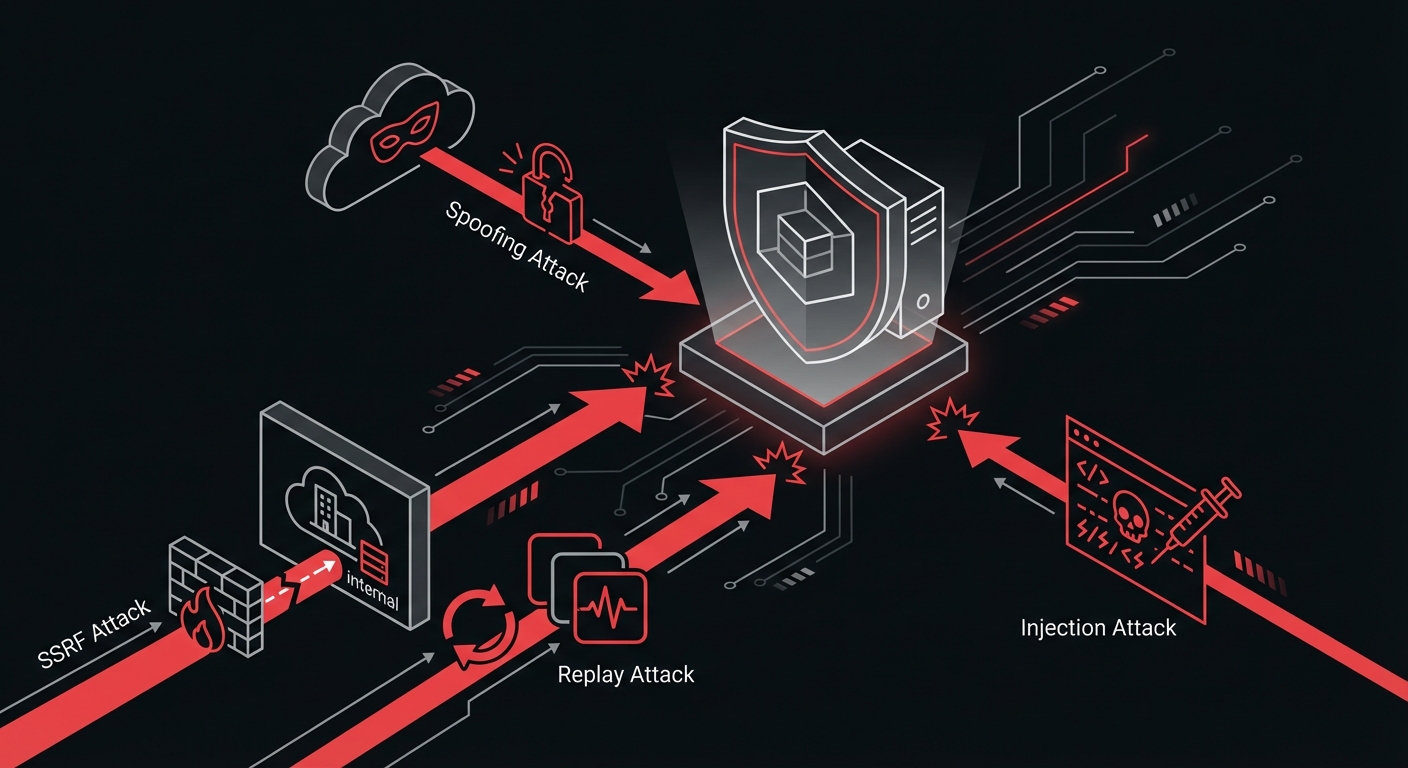
Common Webhook Attack Scenarios
These attack patterns represent actual threats that security researchers and malicious actors actively exploit.
Cloud Metadata Theft via SSRF
When webhook systems allow user-configured destination URLs, attackers can target internal infrastructure. A classic attack involves pointing a webhook URL at http://169.254.169.254/latest/meta-data/, the AWS instance metadata service. If your webhook delivery system runs in AWS and makes requests to user-supplied URLs without validation, an attacker can extract IAM credentials, instance identity documents, and other sensitive cloud metadata. Similar attacks work against GCP (metadata.google.internal), Azure, and other cloud providers. One successful metadata theft can provide attackers with credentials to pivot deeper into your infrastructure.
CI/CD Pipeline Injection
Deployment webhooks from platforms like GitHub, GitLab, and Bitbucket trigger automated pipelines that build and deploy code. If an attacker can forge or manipulate these webhooks, they can inject malicious code into your build process. Consider a scenario where your deployment system trusts any POST request to /webhooks/deploy without signature verification—an attacker could trigger deployments of arbitrary branches or tags, potentially deploying backdoored code to production. Even with signature verification, insufficient validation of the payload contents (such as branch names or commit SHAs) can allow attacks.
Payment Fraud via Replay Attacks
Payment webhooks from providers like Stripe notify your system when charges succeed, subscriptions renew, or refunds process. If you lack replay protection, an attacker who captures a legitimate charge.succeeded webhook can replay it repeatedly. Each replay might trigger order fulfillment, credit provisioning, or subscription activation. The signatures remain valid because the original webhook was legitimate—only timestamp validation and idempotency keys prevent this attack. Without these controls, a single $50 payment could result in thousands of dollars in fraudulent fulfillment.
Account Takeover Through Identity Webhook Spoofing
Identity providers like Auth0, Clerk, and Okta send webhooks for user lifecycle events: account creation, password changes, email verification, and session revocation. If an attacker can forge a user.created webhook or a password.changed event, they could potentially create administrative accounts or hijack existing user sessions. Identity webhooks require the strictest verification because they directly impact authentication and authorization decisions throughout your application.
Data Exfiltration Using Legitimate Webhook Services
Sophisticated attackers use webhook systems for data exfiltration by setting up legitimate webhook receivers (using services like webhook.site, RequestBin, or their own infrastructure) as destination URLs. If your system sends webhooks containing sensitive data to user-configurable endpoints, attackers can configure their malicious endpoint and wait for data to flow to them. This attack is particularly insidious because the webhook delivery itself is "working correctly"—the security failure is in allowing sensitive data to be sent to untrusted destinations.
Authentication Methods
Ensure incoming requests originate from the expected sender. Several authentication methods exist, each with distinct trade-offs:
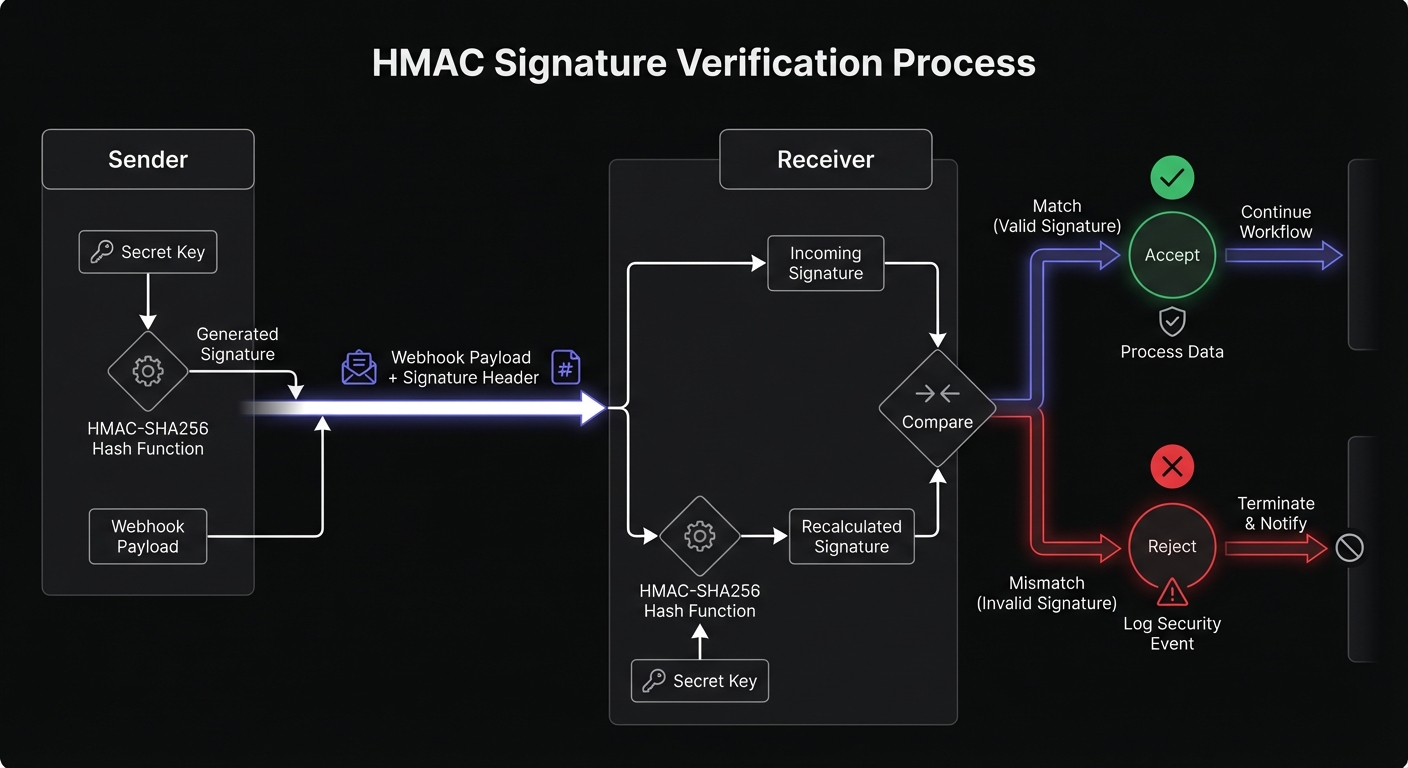
HMAC (Hash-based Message Authentication Code) is the de facto standard. Providers like Stripe, GitHub, and Shopify use HMAC signatures to prove request authenticity. The sender computes a cryptographic hash of the request body using a shared secret, and your server verifies this hash before processing. HMAC is simple to implement, doesn't require certificate management, and provides strong security guarantees.
JWT (JSON Web Tokens) offer an alternative approach where the sender includes a signed token containing claims about the request. JWTs work well when you need to include metadata in the authentication payload or when integrating with systems that already use JWT-based auth. mTLS (mutual TLS) provides the strongest authentication by requiring both parties to present certificates, but adds significant operational complexity. Basic Authentication remains an option for internal systems or as a secondary layer, though it should never be your only protection.
For a detailed comparison of these methods with implementation examples and security analysis, see our guide on Webhook Authentication Methods Compared. If you're implementing HMAC signatures (which we recommend for most use cases), our deep dive on HMAC-SHA256 Webhook Signatures covers the cryptographic details and common implementation pitfalls.
Signature Verification
Proper signature verification is critical—many implementations fail due to subtle details. You must use the raw request body exactly as received (before any parsing or transformation), perform constant-time string comparison to prevent timing attacks, and verify the timestamp to prevent replays.
Each programming language has different idioms for these operations. We've created language-specific guides with complete, production-ready implementations.
Language-Specific Implementation Guides
Node.js developers should start with Receiving and Verifying Webhooks in Node.js. This guide covers Express and other frameworks, handling raw body parsing, and integrating with popular webhook providers. We address common issues like body-parser middleware interfering with signature verification.
Python developers will find everything needed in Receiving and Verifying Webhooks in Python. Whether you're using Flask, Django, or FastAPI, this guide shows how to correctly access raw request bodies and implement secure verification using Python's cryptographic libraries.
Go developers can reference Receiving and Verifying Webhooks in Go. Go's standard library provides excellent primitives for webhook handling, and this guide demonstrates idiomatic patterns for building secure, high-performance webhook receivers.
Attack Prevention
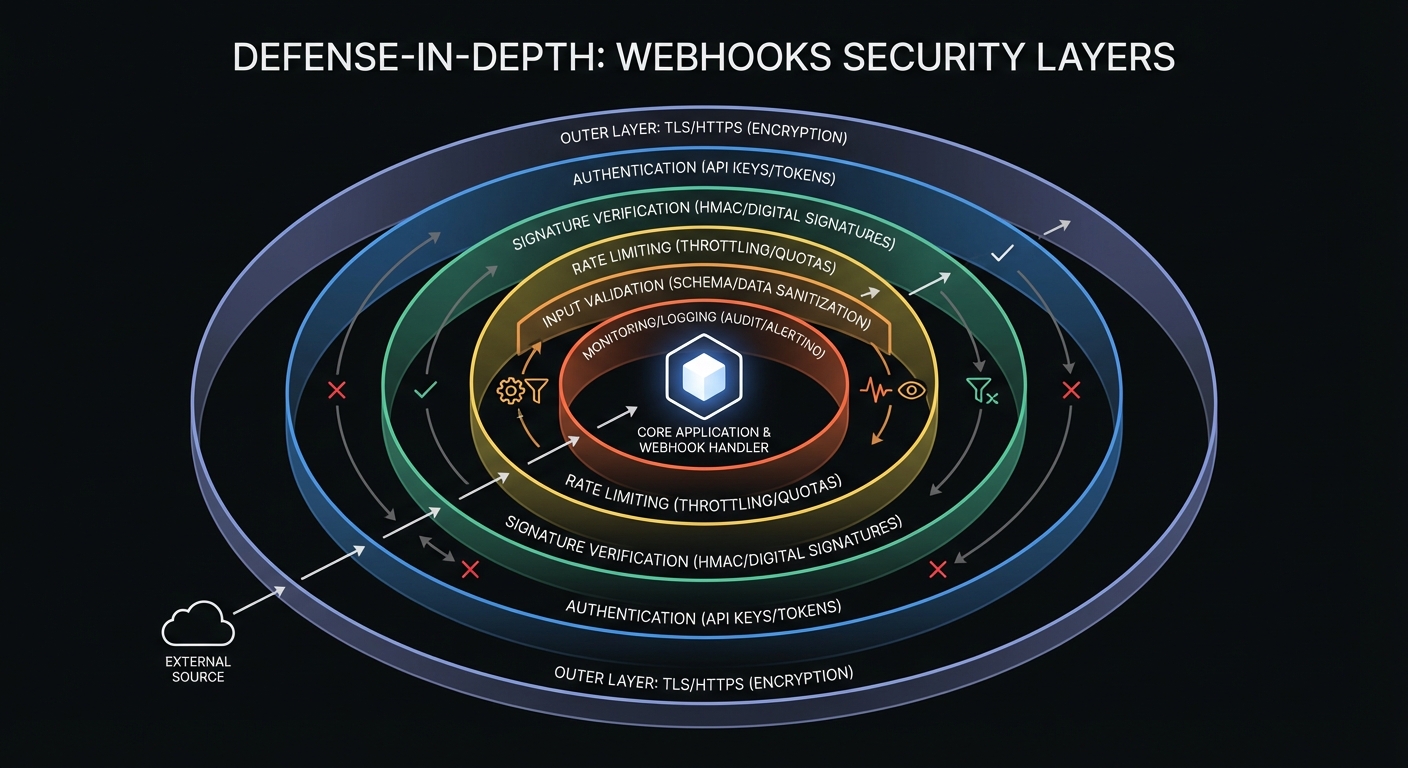
Authentication and signature verification protect against forged requests, but webhooks face additional attack vectors that require specific countermeasures. Understanding these threats helps you build defense in depth.
SSRF Protection
Server-Side Request Forgery (SSRF) attacks exploit webhook systems that make outbound requests based on user-supplied URLs. If your application sends webhooks to URLs provided by users, attackers can potentially force your servers to make requests to internal services, cloud metadata endpoints, or other sensitive resources. This attack vector has led to major breaches at companies of all sizes.
Protecting against SSRF requires validating and sanitizing destination URLs, blocking requests to private IP ranges and localhost, implementing allowlists where possible, and using dedicated egress proxies. Our comprehensive guide on SSRF Attacks in Webhooks and How to Protect Against Them covers detection, prevention, and incident response.
Replay Attack Prevention
Replay attacks occur when an attacker captures a legitimate webhook request and retransmits it later. Even with valid signatures, replayed requests can cause duplicate charges, repeated notifications, or other unintended side effects. Prevention relies on timestamp validation and idempotency.
Most webhook providers include a timestamp in the signed payload. Your verification logic should reject requests where the timestamp differs from current time by more than a few minutes. Additionally, implementing idempotent request handling using unique event identifiers prevents duplicate processing even if a replay slips through. Both our signature verification guides and platform-specific guides cover replay prevention in detail.
Input Validation Beyond Signatures
A valid signature proves the request came from the expected sender, but it doesn't guarantee the payload is safe to process. Attackers who compromise a webhook provider account or discover signing key leaks can send malicious payloads with valid signatures. Defense in depth requires validating webhook payloads before acting on them.
Injection attack prevention is critical when webhook data flows into databases, templates, or shell commands. Treat all webhook payload fields as untrusted input. Use parameterized queries when storing data, sanitize any values used in HTML rendering, and never pass webhook data directly to system commands. A webhook payload containing "; rm -rf /" in a customer name field should not be able to cause damage.
HTTP method restrictions provide a simple but effective control. Webhook endpoints should only accept POST requests. Reject GET, PUT, DELETE, and other methods at the earliest possible point—ideally at your load balancer or API gateway. This prevents certain classes of CSRF attacks and reduces your attack surface.
Payload size limits protect against denial-of-service attacks where attackers send massive payloads to exhaust memory or processing resources. Configure your web server and application framework to reject requests exceeding a reasonable size limit (typically 1-10 MB for webhooks). Most legitimate webhook payloads are under 100 KB.
Schema validation ensures payloads conform to expected structures. Define and enforce JSON schemas for each webhook event type you accept. Reject payloads with unexpected fields, wrong data types, or missing required values. This catches both attacks and integration bugs early.
Infrastructure Security
Proper network segmentation, egress controls, and resource management create additional layers of protection.
Egress Proxy Pattern
For webhook systems that deliver to user-configured URLs, an egress proxy is essential. Rather than allowing webhook workers to make direct outbound connections, route all requests through a dedicated proxy that enforces security policies. Stripe's open-source Smokescreen proxy exemplifies this pattern—it validates destination URLs, blocks private IP ranges, and provides centralized logging of all outbound requests.
An egress proxy allows you to implement URL allowlists and blocklists at the network level, resolve DNS and validate the resulting IPs before connecting, log all outbound requests for security monitoring, and rate limit requests to specific destinations. This architecture ensures that even if application-level validation has bugs, the proxy provides a safety net.
Webhook Worker Isolation
Webhook processing workers should run in isolated network segments with minimal access to internal resources. If a webhook handler vulnerability is exploited, network segmentation limits the blast radius. Place webhook workers in a dedicated subnet that can reach the internet (through the egress proxy) but cannot access databases, internal APIs, or other sensitive systems directly.
Consider using separate compute environments for webhook processing. Container orchestration platforms like Kubernetes make it straightforward to run webhook workers in isolated pods with restricted network policies. The workers should communicate with your core application only through well-defined APIs, never through shared database access.
DNS Resolution Validation
DNS rebinding attacks can bypass SSRF protections that only check IP addresses at request time. An attacker configures a DNS record with a short TTL that initially resolves to a public IP but switches to an internal IP (like 169.254.169.254) between your validation check and the actual HTTP request.
Defend against DNS rebinding by resolving hostnames and validating the IP address immediately before making the connection, using a DNS resolver that ignores TTL values below a safe threshold, and caching DNS results during a request to prevent mid-request changes. Some egress proxies handle this automatically, but verify your proxy's behavior against known DNS rebinding techniques.
Rate Limiting at Infrastructure Level
Application-level rate limiting protects against abuse, but infrastructure-level rate limiting stops attacks before they consume application resources. Implement rate limits at multiple layers: your CDN or DDoS protection service, load balancer, API gateway, and application. Each layer catches different attack patterns.
For incoming webhooks, rate limit by source IP, by authenticated sender identity, and by endpoint. For outgoing webhooks, rate limit by destination domain to prevent attackers from using your system as a DDoS amplifier. Consider both request rate (requests per second) and request volume (total requests per time window).
Resource Timeouts for DDoS Mitigation
Webhook endpoints are attractive DDoS targets because they must accept external connections. Attackers can send slowloris attacks (extremely slow request bodies), massive payloads, or simply high volumes of requests. Configure aggressive timeouts at every level.
Set connection timeouts (time to establish TCP connection), read timeouts (time to receive the complete request), and processing timeouts (maximum time your handler can execute). For outbound webhooks, set connect and response timeouts to prevent slow recipients from consuming worker threads. A reasonable configuration might allow 5 seconds to connect, 30 seconds to receive a complete response, and 60 seconds total for retry sequences.
Platform-Specific Security
Major platforms have developed their own webhook security mechanisms. The specific headers, signature algorithms, and verification procedures vary by provider.
Payment Platforms
Stripe uses HMAC-SHA256 signatures with a timestamp-prefixed payload format. Their signature scheme includes replay protection through timestamp validation and supports multiple signing secrets for key rotation. Given that Stripe webhooks often trigger financial operations, getting this right is critical. Our guide on Receiving Stripe Webhooks Reliably covers signature verification, handling their unique payload format, and implementing proper error handling for payment events.
Developer Platforms
GitHub webhooks secure repository events, CI/CD triggers, and organizational notifications. GitHub uses HMAC-SHA256 signatures and provides detailed event payloads that require careful validation. Since GitHub webhooks often trigger deployment pipelines or code operations, security is paramount. See GitHub Webhooks Setup and Security for complete implementation guidance.
Identity Providers
Clerk and similar authentication platforms send webhooks for user lifecycle events—signups, profile updates, and session changes. These platforms often use Svix for webhook delivery, which provides its own signature verification scheme. Properly securing identity webhooks prevents attackers from spoofing user events. Our guide on Clerk Webhooks for User Authentication demonstrates secure integration patterns.
Security Monitoring
What you log and how you analyze it determines whether you'll catch security incidents or discover breaches only during forensic investigations.
SIEM Integration Patterns
Connect webhook logs to a Security Information and Event Management (SIEM) system to correlate events across your infrastructure. A SIEM ingests logs from webhooks, authentication systems, API gateways, and other sources to identify patterns indicating attacks. Configuration varies by SIEM platform, but the general approach involves forwarding structured logs via syslog, HTTP, or cloud-native mechanisms.
For outbound webhooks, send logs including: request timestamp, destination URL, HTTP status code, retry count, and authorization scope. For inbound webhooks, log: request timestamp, event type, source IP, signature verification result, and response status. Send logs to your SIEM as soon as events complete, with structured fields that enable filtering and correlation.
What to Log vs What NOT to Log
Log these metadata fields:
- Timestamp and timezone
- Event type or action
- Request/response status codes
- Source or destination identifiers
- Number of retries
- Processing latency
- Error categories (network error, timeout, validation failure)
- Originating IP address (with note about privacy implications)
Never log these sensitive fields:
- Request or response bodies (they may contain customer data, financial information, or personally identifiable information)
- Authorization headers or signing keys
- Customer email addresses or phone numbers
- API keys or secrets of any kind
- Passwords or session tokens
- Full credit card numbers or other payment card data
Some webhook systems tempt you to log full payloads for debugging. Resist this temptation for production systems. Instead, log enough metadata to reconstruct what happened without exposing sensitive data. If you need to debug a specific webhook delivery, retrieve logs from a secure audit trail system with access controls, not from your general security logs.
Anomaly Detection Strategies
Establish baselines for normal webhook behavior, then alert when activity deviates significantly:
Volume anomalies: If you normally receive 1,000 webhooks per day but suddenly receive 100,000, that's a distributed attack or system misconfiguration. Set alerts for traffic spikes that exceed 10x your baseline.
Error rate anomalies: Track the percentage of webhooks that fail signature verification, exceed size limits, or timeout. If your normal error rate is 0.1% but suddenly jumps to 5%, investigate immediately. Attackers often craft malformed requests that trigger errors.
Source IP anomalies: When receiving webhooks from external services, legitimate sources usually come from stable IP ranges. If webhooks suddenly arrive from a new geographic region or IP range, that's suspicious. Maintain an allowlist of known webhook provider IP ranges when possible.
Destination anomalies: For outbound webhooks, monitor if your system suddenly attempts to deliver to unusual destinations—different domains, geographic regions, or private IP ranges. A sudden surge of webhook attempts to a single destination suggests either an attack or a compromised subscription.
Timing anomalies: Legitimate webhooks for most businesses follow predictable patterns—more during business hours, fewer at night, correlated with user activity. Attacks often arrive uniformly or at unusual times. Detect timing patterns that deviate from normal.
Security Violation Alerting
Configure alerts to trigger immediately when security controls detect violations:
- Signature verification failures: Every failed signature is a potential attack. Alert on multiple failures from the same source within a time window.
- Replay attack attempts: If you detect a request timestamp older than your acceptable window, that's a replay attempt. This often indicates an attacker replaying captured requests.
- Size limit violations: Requests exceeding your configured size limits trigger alerts immediately—this is simple DoS protection.
- Rate limit thresholds: Alert when any source exceeds your configured rate limits, indicating either abuse or misconfiguration.
- Validation failures: Schema validation errors or injection attempts detected by input validation should trigger security alerts.
Alerts should go to your incident response channel (typically Slack, PagerDuty, or an equivalent) with enough context to investigate immediately. Include the timestamp, source information, type of violation, and a link to detailed logs.
Incident Response Checklist
When a security alert fires, follow a structured incident response process:
Immediate (0-5 minutes):
- Acknowledge the alert
- Determine scope: How many webhooks? Which endpoints? Which customers?
- Check if similar alerts are firing across other systems
- Determine if legitimate traffic or actual attack
Short-term (5-30 minutes):
- Collect logs and evidence from the SIEM
- Interview relevant teams (was there a config change, new integration?)
- If attack confirmed, implement temporary mitigation (block source IP, reduce rate limits, disable endpoint)
- Begin forensic analysis to understand attack method
Investigation (hours to days):
- Determine if the attack was successful (did attacker-controlled requests execute?)
- Identify what data might have been exposed
- Check for lateral movement to other systems
- Review webhook logs for reconnaissance activity (scanning for endpoints)
- Determine if signing keys were compromised
- Assess if current architecture allowed the attack or if controls worked as designed
Recovery:
- Rotate any potentially compromised secrets
- Monitor for follow-up attacks (attackers often probe after initial attempts)
- Implement additional controls to prevent the specific attack method
- Document what happened and how to detect it in the future
- Share findings with relevant teams and update runbooks
Compliance Considerations
Regulatory requirements mandate specific webhook security controls and documentation. Understanding which regulations apply helps you implement appropriate controls and prepare for audits.
PCI DSS Requirements for Payment Webhooks
If your webhook system handles payment events from Stripe, Square, or other payment processors, you likely fall under PCI DSS (Payment Card Industry Data Security Standard). Even if you never directly handle credit card data, receiving payment webhooks creates security obligations.
Key PCI DSS requirements:
- Requirement 1: Maintain a firewall configuration to protect cardholder data. Your webhook endpoint should be behind a WAF and API gateway with rate limiting.
- Requirement 2: Do not use vendor defaults. Change default secrets and signing keys, don't deploy with example keys.
- Requirement 3: Protect stored cardholder data. Never store full card numbers in webhook logs or replay data.
- Requirement 4: Encrypt transmission of cardholder data across public networks. Always use HTTPS, never HTTP.
- Requirement 6: Develop and maintain secure systems. Regularly review webhook code for vulnerabilities, implement security testing in CI/CD.
- Requirement 10: Track and monitor access to network resources and cardholder data. Log all webhook events with immutable audit trails.
PCI DSS compliance is not optional if you process payments—it's a contractual requirement of your payment processor agreement. Many small businesses under-invest in webhook security, then face processor penalties when audits reveal weaknesses.
HIPAA Considerations for Health Data
If your webhooks transmit protected health information (PHI), HIPAA compliance is mandatory. This includes not just medical records but billing information, insurance details, or any data that could identify a patient.
Key HIPAA requirements:
- Encryption in transit: All webhook transmission must use TLS 1.2 or higher.
- Access controls: Your webhook endpoints must authenticate callers and verify they have authorization to send health data.
- Audit controls: Maintain immutable logs of all webhook access for 6 years minimum.
- Breach notification: If a webhook security incident exposes PHI, you must notify affected individuals within 60 days.
HIPAA also requires a Business Associate Agreement (BAA) with any third parties that handle PHI. If you use a webhook delivery service like Hook Mesh, the provider must sign a BAA protecting health data.
SOC 2 Control Mapping
When customers request SOC 2 Type II compliance or audits, they're evaluating whether your organization has security controls over systems and data. Webhook systems fall into this scrutiny because they handle data in motion.
SOC 2 trust service criteria relevant to webhooks:
- CC6.1 (Logical Access): Verify webhook sender identity through signature verification.
- CC6.2 (Prior to issuing user IDs): Implement rate limiting and IP allowlists to prevent unauthorized access.
- CC7.2 (System monitoring): Log all webhook events and monitor for unauthorized access attempts.
- CC7.4 (Unavoidability of actions): Ensure audit logs cannot be modified after creation (use immutable logging).
- A1.3 (Encryption): Verify that webhooks are encrypted in transit (TLS).
SOC 2 audits require providing evidence of controls. For webhooks, this means documenting your signature verification implementation, showing logs of webhook processing, and demonstrating monitoring systems. Many companies discover webhook security gaps during SOC 2 audits when these questions are first asked formally.
Audit Trail Requirements
Regulatory frameworks consistently require immutable audit trails that capture who did what when. For webhooks, audit trails should document:
For inbound webhooks:
- When the webhook was received (timestamp)
- Which event type it represented
- Source system and source IP
- Whether signature verification succeeded or failed
- Whether validation passed or failed
- What action was taken based on the webhook
- Who (which system, process ID, or user) processed it
For outbound webhooks:
- When the webhook was created and why
- Destination URL and destination system
- Event payload summary (without sensitive data)
- Signature used for signing
- Delivery attempts and results
- Any errors or failures
- Retry history
Audit trails must be stored separately from operational logs, with access controls limiting who can view or modify them. Most cloud providers offer immutable blob storage or specialized audit logging services for this purpose. The requirement to maintain complete, tamper-proof audit trails for 1-7 years (depending on regulation) drives infrastructure decisions for many enterprises.
Production Security Checklist
Moving from development to production requires systematic validation of your webhook security implementation. A structured checklist ensures nothing falls through the cracks.
Essential Security Controls
Before deploying to production, verify that you've implemented the following: signature verification on every endpoint, timestamp validation to prevent replay attacks, constant-time signature comparison, proper error handling that doesn't leak information, rate limiting to prevent abuse, and logging for security monitoring. Each of these controls addresses specific attack vectors.
Operational Security Practices
Operational practices matter equally. Production webhook security requires processes that persist beyond initial deployment.
Secret Rotation with Zero Downtime: Webhook secrets need periodic rotation to limit the damage from key compromise, but rotating keys shouldn't interrupt service. The proven pattern involves supporting multiple active signing keys simultaneously. When rotating, generate a new key and deploy it as "preferred" but keep the previous key active for verification. Your webhook receiver accepts signatures from either key for a transition period (typically 24-48 hours). This allows senders to gradually migrate to the new key without service disruption. After the transition period, disable the old key. Document this process and practice it during low-traffic hours before an actual emergency forces rotation.
Subscription Lifecycle Management: Webhook subscriptions often lack expiration dates, creating maintenance burden and security risk. Implement subscription expiration dates—webhooks older than 1-2 years without activity get automatically disabled. Require subscription re-authorization periodically (annually is typical). Provide a dashboard showing subscription age and last activity, helping customers identify stale integrations. When a webhook hasn't succeeded in 30 days, automatically reduce retry frequency and alert the subscriber to investigate.
Secret Storage in Vaults: Never store webhook secrets in environment variables, configuration files, or database fields that aren't encrypted. Use a dedicated secret management system: HashiCorp Vault, AWS Secrets Manager, Azure Key Vault, or GCP Secret Manager. These systems provide encryption at rest, audit trails of access, automatic secret rotation, and integration with your deployment pipeline. Your application should retrieve secrets from the vault at startup or periodically refresh them, never caching decrypted secrets for longer than necessary.
IP Allowlist Maintenance: If you maintain an allowlist of webhook provider IPs, build processes to keep it updated. Webhook providers occasionally change their IP ranges with little notice. Subscribe to their status pages or notification systems, monitor for unexplained webhook failures (which might indicate IP changes), and establish a quarterly audit schedule to verify your allowlist against the provider's current documentation. Automate this where possible—some providers publish IP ranges in machine-readable formats. An outdated allowlist is invisible until it causes service disruption.
Access Controls for Webhook Configuration: Restrict who can create, modify, or delete webhook subscriptions. Typical RBAC (Role-Based Access Control) patterns assign webhook configuration permissions to team leads or infrastructure teams, not individual engineers. Changes to production webhook configuration should go through change management procedures. Log all configuration changes with who made the change, when, and what changed—this audit trail is crucial for understanding security incidents.
Comprehensive Resources
For a complete pre-launch validation process, work through our Webhook Security Checklist for Production. This checklist covers everything from basic signature verification to advanced concerns like geographic restrictions and anomaly detection.
For ongoing security maintenance and deeper architectural guidance, our Webhook Security Best Practices guide provides strategic recommendations for building and operating secure webhook systems at scale.
Conclusion
Webhook security is not optional—it's a fundamental requirement for any production integration. By implementing proper authentication, verifying signatures correctly, defending against common attacks, and following platform-specific requirements, you can build secure webhook receivers.
Start with the basics: choose an authentication method, implement signature verification using the language-specific guide for your stack, and work through the production checklist. As your system matures, revisit the advanced topics around attack prevention and operational security.
Ready to secure your webhooks? Hook Mesh provides built-in signature verification, replay protection, and security monitoring for all your webhook integrations. Start your free trial and implement production-grade webhook security in minutes, not days.
Related Resources
- Webhook Authentication Methods Compared
- HMAC-SHA256 Webhook Signatures
- Receiving and Verifying Webhooks in Node.js
- Receiving and Verifying Webhooks in Python
- Receiving and Verifying Webhooks in Go
- SSRF Attacks in Webhooks and Protection
- Receiving Stripe Webhooks Reliably
- GitHub Webhooks Setup and Security
- Clerk Webhooks for User Authentication
- Webhook Security Checklist for Production
- Webhook Security Best Practices