The True Cost of Building Webhooks In-House
A detailed breakdown of what it really costs to build, maintain, and scale webhook infrastructure internally. Engineering time, infrastructure expenses, hidden costs, and opportunity cost compared to using a managed service.

The True Cost of Building Webhooks In-House
"How hard can webhooks be? They're just HTTP POST requests."
Every engineering team that builds webhook infrastructure starts with this thought. Six months later, they're maintaining thousands of lines of code, debugging silent delivery failures, and explaining integrations that broke at 2 AM.
Segment's team learned this hard way. Their "simple" system became Centrifuge—a 9-month rearchitecture after discovering traditional queues couldn't handle their scale. GitHub's webhook infrastructure caused multiple outages, one permanently losing 200,000 payloads.
This post breaks down the true cost: not just engineering time, but hidden expenses that accumulate over years.
The Visible Costs: Engineering Time and Infrastructure
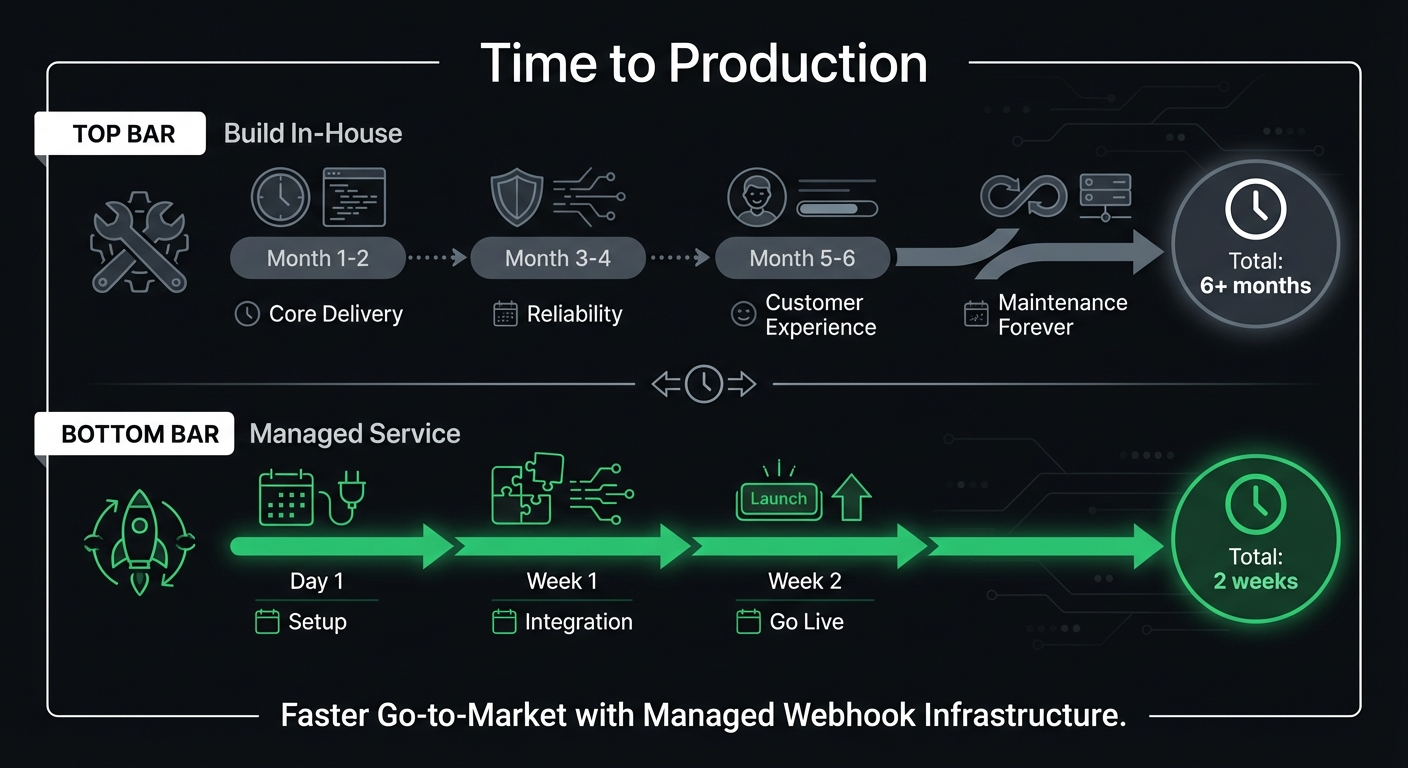
Engineering Time: 3-6 Months for an MVP
Month 1-2: Core Delivery
- HTTP client with configurable timeouts
- Queue system for async processing
- Basic retry logic with exponential backoff
- Payload signing (HMAC-SHA256)
- Database schema for events and delivery attempts
Month 3-4: Reliability
- Dead letter queues for failed deliveries
- Circuit breakers for failing endpoints
- Idempotency handling
- Rate limiting (both inbound and per-endpoint)
- Monitoring and alerting
Month 5-6: Customer Experience
- Delivery logs and debugging UI
- Endpoint management interface
- Manual retry functionality
- API documentation
- SDK for at least one language
At $180,000-220,000/year fully-loaded (salary + benefits + equity + overhead):
| Timeline | Engineering Cost |
|---|---|
| 3 months | $45,000 - $55,000 |
| 6 months | $90,000 - $110,000 |
Most teams underestimate by 2-3x.
Infrastructure Costs: $500-2,000+/Month
Webhook infrastructure requires several components, each with ongoing costs:
| Component | Purpose | Monthly Cost |
|---|---|---|
| Message queue (SQS/RabbitMQ/Redis) | Async processing, retries | $50-200 |
| Database (PostgreSQL/MySQL) | Event storage, delivery logs | $100-400 |
| Application servers | Delivery workers | $100-500 |
| Monitoring (Datadog/New Relic) | Observability | $100-300 |
| Log storage | Debugging, compliance | $50-200 |
| Load balancer | Traffic distribution | $20-50 |
Monthly infrastructure: $500-2,000 (scales with volume: $1,000-2,000 at 1M webhooks/month, $3,000-5,000+ at 10M)
Infrastructure Components You Must Build
Building reliable webhook infrastructure requires these interconnected systems:
| Component | Purpose | Build Complexity |
|---|---|---|
| API Gateway | Protocol conversion, rate limiting | Medium |
| Message Broker | Async processing, delivery queuing | High |
| Retry System | Exponential backoff, failure handling | High (custom) |
| Rate Limiter | Per-endpoint throttling | Medium |
| Logging Pipeline | ELK Stack or cloud aggregation | Medium |
| Consumer Pool | Stateless, horizontally-scalable workers | High |
A retry system is not an off-the-shelf component—it requires custom development with configurable delays, jitter, and failure categorization. Most teams underestimate this complexity by 2-3x.
The Hidden Costs: What Nobody Tells You
The visible costs are just the beginning. Here's where the real expense accumulates.
Edge Cases That Become Your Problem
Webhook delivery encounters countless edge cases:
- Endpoints that hang (30+ seconds, blocking workers)
- Redirect loops (301 to itself, queue backups)
- SSL certificate errors (expired, self-signed, incorrect chains)
- IPv6-only endpoints (silent failures if you only support IPv4)
- Payload size limits (compression or chunking needed)
- Character encoding issues (UTF-8 mangling with special characters)
Each requires 2-4 engineering hours for investigation, implementation, testing, and documentation. New ones appear monthly.
On-Call and Incident Response
Webhook infrastructure fails at the worst times. When it does, you need someone available to respond.
Common incidents:
- Queue backlog during traffic spikes (Black Friday, product launches)
- Downstream provider outages causing retry storms
- Database connection exhaustion
- Memory leaks in delivery workers
Cost of on-call: 4-10 hours per incident for response, postmortems (2-4 hours), and customer communication (1-2 hours). At 1-2 incidents/month, that's 10-20 engineering hours of reactive work monthly—time not spent on product.
Customer Support Load
"Where's my webhook?"
This question consumes more support time than expected. When webhooks fail, customers open tickets, your team investigates logs, discovers 500 errors, explains retry logic, and replays payloads.
Support burden: 5-10 webhook tickets/week, 15-30 minutes per ticket, 1-4 hours engineering/week on escalations. That's $500-1,500/month in engineering time alone.
Documentation and SDKs
Without documentation, support tickets increase 3-5x, integration failures spike, and customers blame broken webhooks.
Documentation & SDKs: For three SDKs (JavaScript, Python, Go): 6-8 weeks initial development plus 10+ hours/month ongoing maintenance.
Opportunity Cost: The Biggest Hidden Expense
Every hour on webhook infrastructure is an hour not spent on core product. If your runway is 18 months and you spend 6 months on webhooks, you've spent 33% of your time on infrastructure instead of differentiation.
For most startups, opportunity cost exceeds all other costs combined.
The Hockey-Stick Cost Curve
DIY webhook infrastructure often exhibits a "hockey-stick" cost curve that catches teams off guard. What starts as a "simple" queue and retry system morphs into a distributed system of Lambda functions, SQS queues, and custom monitoring dashboards. According to industry analysis, managed services can deliver a 48% reduction in 5-year operating costs compared to custom-built solutions.
Hidden cost drivers that compound over time:
- Retry charges: Failed deliveries consume queue resources
- Payload size growth: Compression or storage scaling required
- Security overhead: Authentication, audit trails, compliance checks
- Monitoring fees: Log aggregation costs scale with volume
These hidden costs can add 15-40% to initial infrastructure estimates.
Year-Over-Year Cost Comparison
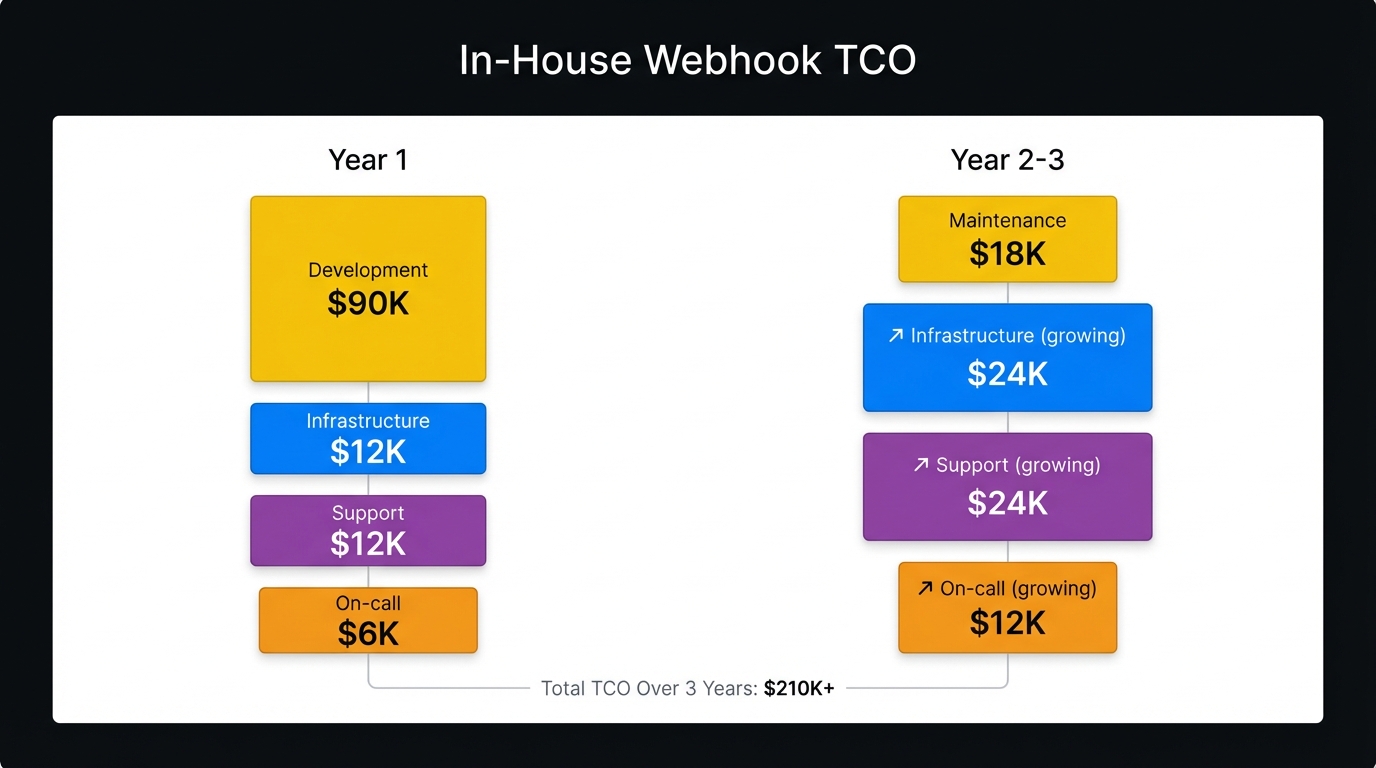
Building In-House
| Cost Category | Year 1 | Year 2 | Year 3 |
|---|---|---|---|
| Initial development | $90,000 | - | - |
| Infrastructure | $12,000 | $18,000 | $24,000 |
| Maintenance (20% of dev time) | - | $18,000 | $18,000 |
| Support engineering | $12,000 | $15,000 | $18,000 |
| On-call/incidents | $6,000 | $8,000 | $10,000 |
| Annual Total | $120,000 | $59,000 | $70,000 |
| Cumulative | $120,000 | $179,000 | $249,000 |
Using Hook Mesh
| Cost Category | Year 1 | Year 2 | Year 3 |
|---|---|---|---|
| Integration time (1 week) | $4,500 | - | - |
| Growth plan ($99/mo) | $1,188 | $1,188 | $1,188 |
| Annual Total | $5,688 | $1,188 | $1,188 |
| Cumulative | $5,688 | $6,876 | $8,064 |
Three-year savings: $240,000+ (even at half the fully-loaded rate, managed services win by 10-20x)
When Building In-House Might Make Sense
- Webhooks are your core product - you need in-house expertise
- Extreme scale - billions of events daily with custom performance
- Regulatory constraints - compliance no vendor meets
- Dedicated platform team - 50+ engineers with infrastructure specialists
For most seed-to-Series-B startups, none apply. Competitive advantage is your product, not webhook infrastructure. See build vs buy decision for comprehensive comparison.
The Hybrid Approach
The most pragmatic pattern for growing companies: use Webhook-as-a-Service as the delivery backbone and build bespoke business logic on top.
When hybrid makes sense:
- You need custom payload transformations
- Specific compliance requirements demand certain data handling
- High event volumes where per-event pricing becomes prohibitive
Self-hosted solutions become optimal when you have infrastructure expertise, strict data residency requirements, or volumes exceeding 10M+ events where you pay for compute and storage rather than per-event fees.
The Build vs. Buy Decision Framework
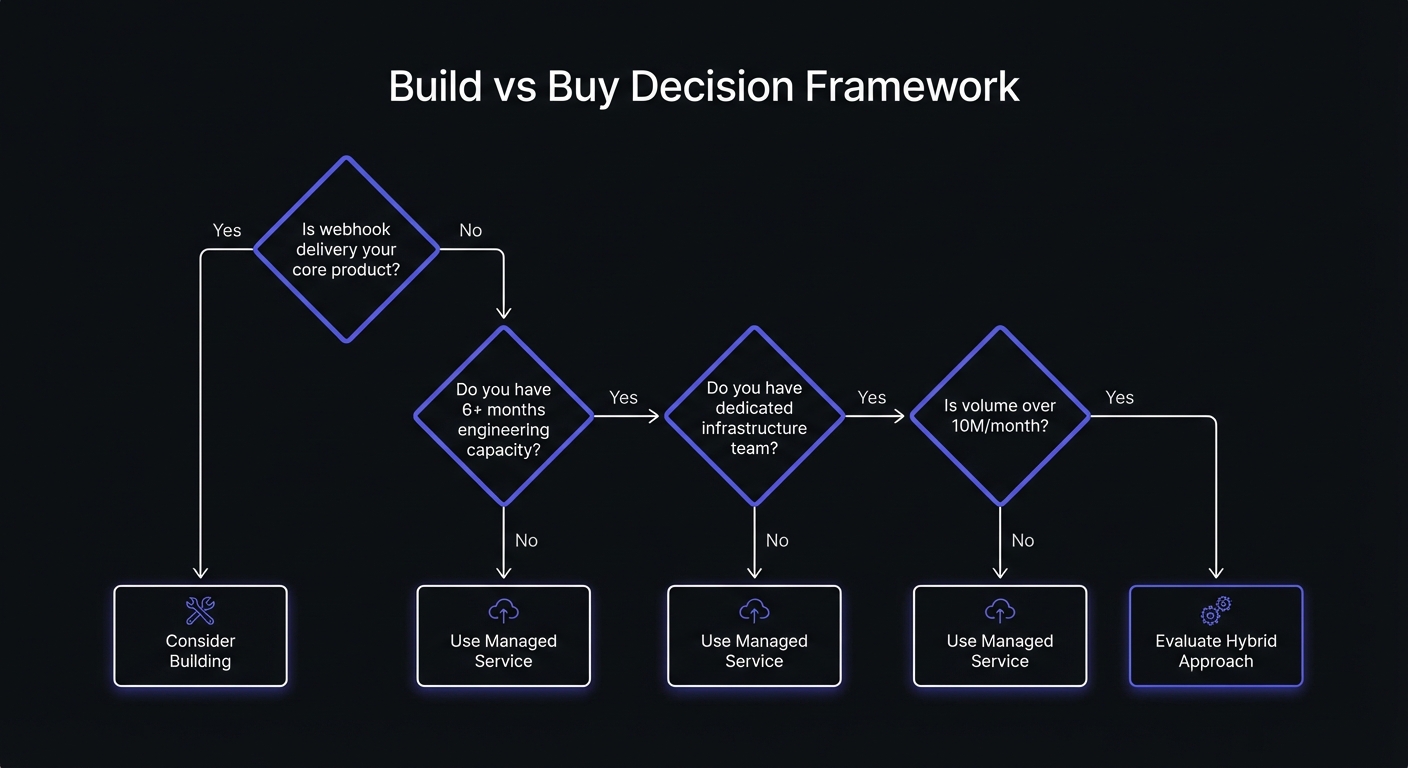
Do you have 3-6 months of engineering bandwidth? No → don't build.
Is webhook delivery a core competency? No → don't build.
Do you have 24/7 on-call infrastructure? No → don't build.
Are you prepared to maintain this 5+ years? No → don't build.
Is your volume over 10M webhooks/month? No → don't build.
The TCO Calculation
Understanding true webhook infrastructure costs requires modeling both direct and indirect expenses:
Direct Costs:
- Computational resources (queue processing, delivery workers)
- Storage (event logs, retry queues, audit trails)
- Network egress (especially at scale)
Indirect Costs (often exceed direct):
- Development time for implementation and maintenance
- Operational overhead for monitoring and troubleshooting
- Business impact when webhook failures affect customers
- Knowledge drain when the solution builder leaves
One Svix customer noted: "To be at feature parity with what we can do using [a managed service] today would take us at least a year."
Making the Switch
Typical migration path:
- Set up Hook Mesh account and configure event types (1 hour)
- Update application to send events to Hook Mesh (1 day)
- Migrate endpoints via API (1 day)
- Run parallel delivery for validation (1 week)
- Deprecate internal system
Most teams complete migration in 1-2 weeks while maintaining full delivery continuity.
Conclusion
Building in-house costs $150,000-250,000 over three years. A managed service costs under $10,000. More importantly, those engineering months could ship features that differentiate your product. The question isn't whether you can build—the question is whether that's the best use of your limited resources.
The companies that win ship the best products, not the best internal infrastructure.
Hook Mesh provides reliable webhook delivery starting at $0/month. Start free and ship webhooks in minutes instead of months.
Related Posts
Build vs Buy: Webhook Infrastructure Decision Guide
A practical guide for engineering teams deciding whether to build webhook delivery infrastructure from scratch or use a managed service. Covers engineering costs, timelines, and when each approach makes sense.
Choosing a Webhook Provider: A Checklist for Startup CTOs
A comprehensive evaluation checklist for technical leaders choosing a webhook provider. Covers reliability, security, developer experience, pricing, and the red flags to avoid.
Webhook Pricing Explained: What Startups Need to Know
A transparent guide to webhook service pricing models. Learn about per-message fees, tiered subscriptions, hidden costs, and how to estimate your true webhook infrastructure spend.
From 0 to 10K Webhooks: Scaling Your First Implementation
A practical guide for startups on how to scale webhooks from your first implementation to handling 10,000+ events per hour. Learn what breaks at each growth phase and how to fix it before your customers notice.
Webhooks for Startups: From MVP to Scale
The definitive guide for startup founders and engineers on implementing webhooks - from your first integration to handling millions of events. Learn when to add webhooks, how to scope your MVP, avoid common pitfalls, and scale confidently.