Webhooks for Startups: From MVP to Scale
The definitive guide for startup founders and engineers on implementing webhooks - from your first integration to handling millions of events. Learn when to add webhooks, how to scope your MVP, avoid common pitfalls, and scale confidently.
Webhooks for Startups: From MVP to Scale
When it comes to webhooks, early decisions either accelerate growth or create years of technical debt. This guide covers the complete journey: when to add webhooks, MVP scoping, common mistakes, build vs buy decisions, and scaling patterns.
Table of Contents
- Why Webhooks Matter for Startups
- When to Add Webhooks
- Scoping Your MVP
- Common Mistakes to Avoid
- Build vs Buy Decision
- Choosing a Provider
- Scaling Your Implementation
- Getting Started
Why Webhooks Matter for Startups
Webhooks are table stakes for modern SaaS. Without them, customers must poll your API (expensive) or manually move data (unacceptable for serious buyers).
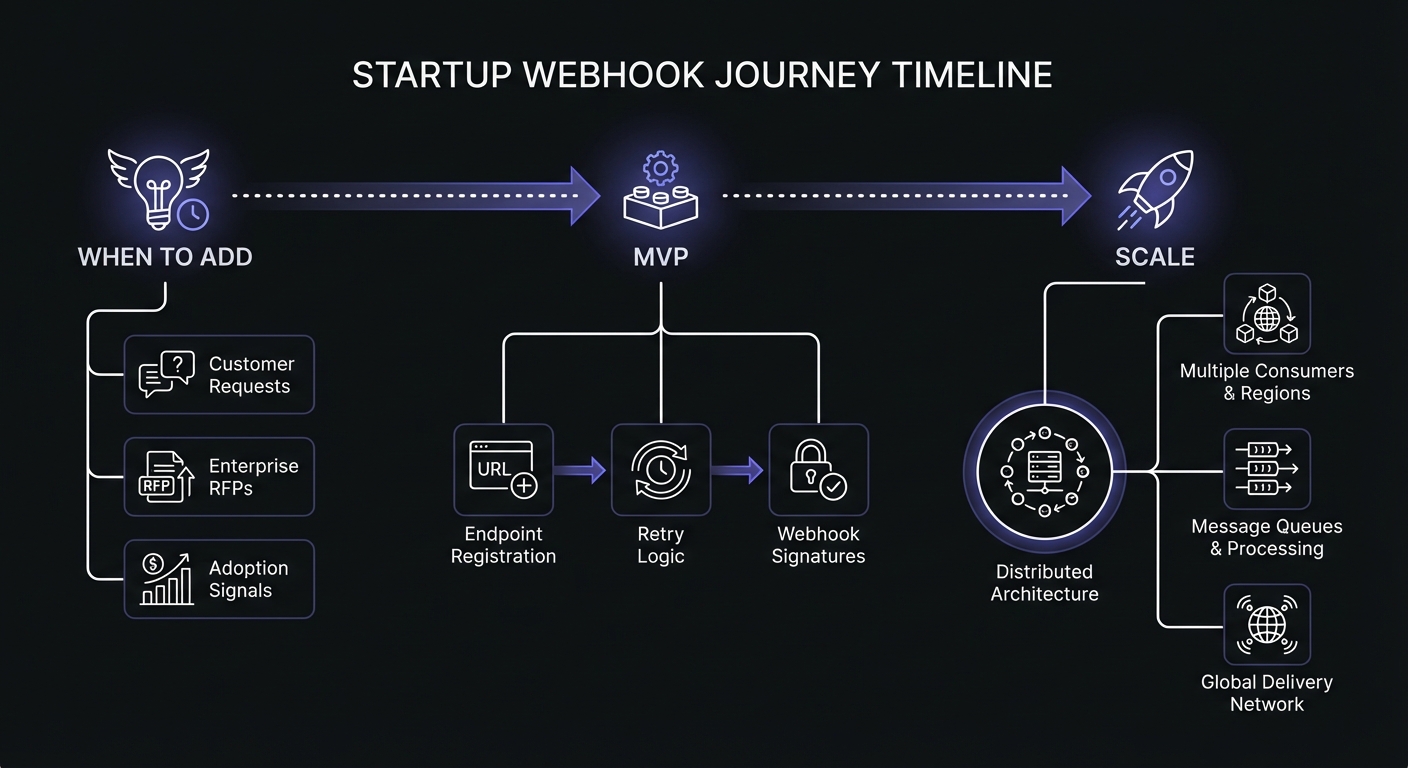
For startups, webhooks unlock partner integrations without engineering overhead, enable enterprise deals, and embed your product into customer workflows - increasing switching costs and reducing churn. The challenge is timing: add them too early or too late, and you've wasted resources or lost deals.
When to Add Webhooks
Add webhooks too early (before product-market fit) and you waste engineering time. Too late and you lose deals. The right time is when multiple customers request them, enterprise prospects require them, or customers build workarounds to extract data.
Timing Signals
- When 3+ prospects ask about webhook support - One request is noise, three is a pattern. Track these in your CRM and review monthly.
- When customers export data manually more than weekly - If customers are downloading CSVs or copying data between systems regularly, they're working around your lack of real-time integration.
- When integration requirements appear in 20%+ of enterprise RFPs - Enterprise buyers have checklists. If webhooks keep showing up, you're losing deals without them.
- When a strategic partnership depends on data sync - Partners won't wait for you to build polling infrastructure. Webhooks are often table stakes for distribution deals.
- When your support team handles "how do I get notified when X happens" tickets - These are webhook feature requests in disguise.
Ask customers what they need: data warehouse sync, Zapier workflows, or custom integrations? Their answers shape your event schema and MVP priorities.
Related articles:
Scoping Your MVP
Avoid building a complete system from day one. Identify the 2-3 webhook events that unlock the most value - typically core lifecycle events (created, updated, deleted). Each webhook type you add is a forever commitment, so resist exposing every internal event.
Your MVP needs: endpoint registration, reliable delivery with retries, and signature verification. Skip filtering, transformations, and analytics for v1. Ship quickly so you learn what customers actually need versus what you assumed.
Related articles:
Common Mistakes to Avoid
Critical: Treat webhook delivery as asynchronous, not synchronous with your main app. A slow customer endpoint otherwise degrades your entire application - or causes cascading failures during spikes.
Other pitfalls: inadequate retry logic (customers expect graceful handling of downtime), weak or missing payload signatures (security-conscious customers reject unsigned webhooks), and poor documentation (developers left guessing about schemas). Each damages support burden and platform trust.
Related articles:
Build vs Buy Decision
Building webhooks typically takes 6-12 months and 3-5 developers. You'll need queuing, retry logic, health monitoring, logs, a customer dashboard, and ongoing maintenance (0.5-1 FTE). Total engineering cost outweighs the control you gain.
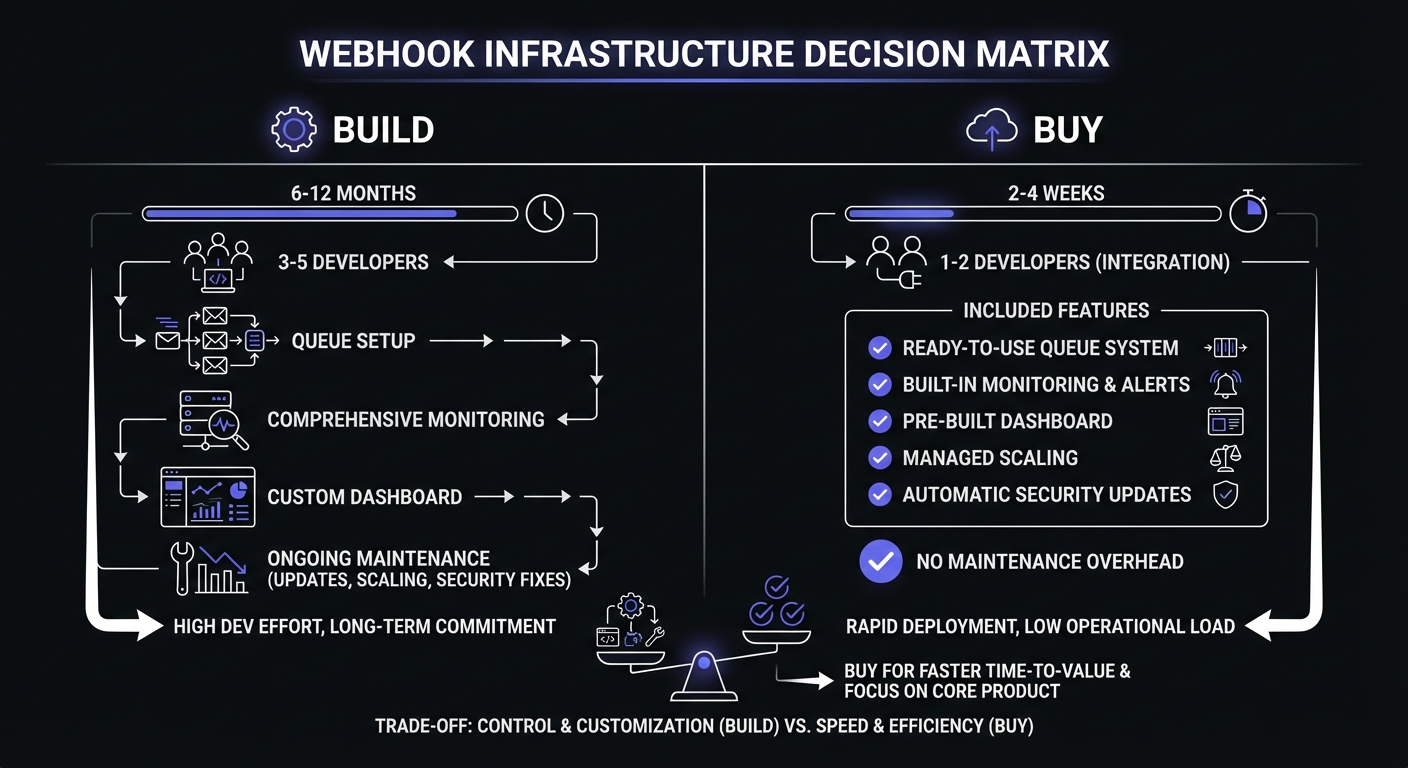
Using a provider takes 2-4 weeks with 1-2 developers. You lose some control but get a battle-tested system with edge cases handled. For most startups, buying wins: engineers are your scarcest resource. Exception: webhooks are genuinely core to your differentiation (rare).
Case Study: A Fintech Startup's Journey
A Series A fintech startup spent 4 months building webhook infrastructure before realizing they needed to rebuild for scale. Their initial implementation worked for their first 50 customers, but started showing cracks as they onboarded enterprise clients with stricter reliability requirements. After switching to a managed provider, they shipped enterprise-grade webhooks in 2 weeks - and their engineering team went back to building features that actually differentiated their product.
Decision Framework
Build if:
- Webhooks are core to your product's value proposition
- You have 3+ months of runway to invest in infrastructure
- You have experienced engineers with distributed systems background
- You're selling software as your product (developer tools, infrastructure)
Buy if:
- Webhooks enable integrations but aren't your core differentiator
- You need to ship webhook functionality in 2-4 weeks
- Your engineering bandwidth is constrained or focused elsewhere
- You're pursuing enterprise deals with strict reliability requirements
Full Infrastructure Costs
| Component | Build (Self) | Buy (Managed) |
|---|---|---|
| Message Queue | Set up, maintain, scale Redis/RabbitMQ/SQS | Included |
| Monitoring & Alerting | Integrate Datadog/Prometheus, build dashboards | Included |
| Dead Letter Handling | Build DLQ, manual inspection tools | Included with UI |
| Retry Logic | Implement exponential backoff, jitter, circuit breakers | Included |
| Customer Dashboard | Build from scratch (often 2-4 weeks alone) | Included |
| Documentation | Write and maintain API docs | Included |
| On-call Support | Your engineers, 24/7 | Provider's team |
The dashboard alone is often underestimated - customers expect to see delivery status, retry attempts, and payload inspection. This is table stakes for enterprise sales.
Related articles:
Choosing a Provider
Core delivery and retries are table stakes. Differentiators: developer experience, customer dashboards, pricing models, and support quality.
Test products before deciding. Build a POC, evaluate API design and docs, and check pricing scaling carefully. A cheap provider at low volumes can become prohibitively expensive as you grow.
Related articles:
- Choosing a Webhook Provider: The Complete Checklist
- Webhook Pricing Explained: What You're Really Paying For
- Hook Mesh vs Svix: A Detailed Comparison
- Hook Mesh vs Hookdeck: Which Is Right for You?
Scaling Your Implementation
What works at 100 customers breaks at 10,000. You'll hit challenges with delivery throughput, flaky customer endpoints, traffic spikes, and demands for logs, replay, and filtering. Your architecture must evolve from "works for early adopters" to "handles enterprise requirements."
Phased Architecture Evolution
Plan for these three phases as your customer base grows:
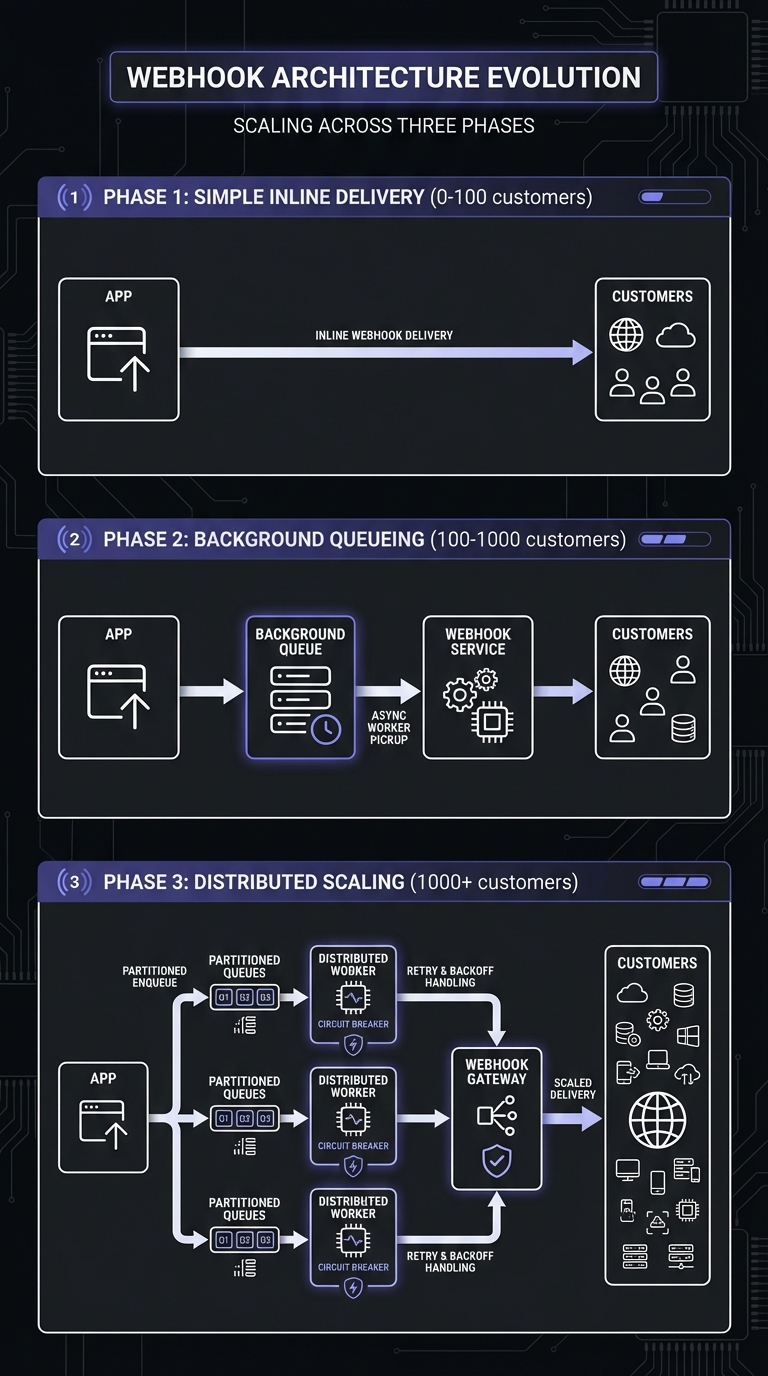
Phase 1: 0-100 customers (Synchronous)
- Webhook delivery happens inline with your main application
- Simple retry logic (3 attempts with fixed delays)
- Basic logging to your application database
- Works fine for low volume, but delivery failures can slow down user requests
- Typical latency: 100-500ms added to user actions that trigger webhooks
Phase 2: 100-1,000 customers (Dedicated Service)
- Move webhook delivery to a background job queue (Redis, SQS, or similar)
- Dedicated webhook service separate from your main application
- Exponential backoff with jitter for retries
- Endpoint health tracking to identify problematic destinations
- Customer-facing delivery logs become necessary at this scale
- Main application no longer blocked by webhook delivery
Phase 3: 1,000+ customers (Distributed System)
- Horizontal scaling across multiple delivery workers
- Distributed queue with partitioning by customer or endpoint
- Circuit breakers to protect against cascading failures from bad endpoints
- Per-customer rate limiting to prevent noisy neighbors
- Real-time observability dashboards
- Automated alerting on delivery degradation
- This is where most teams realize they should have bought instead of built
Scale requires moving synchronous to asynchronous delivery, adapting retries to endpoint behavior, adding observability, and building customer-facing debugging tools. Plan this evolution early.
Related articles:
Getting Started
Start simple, ship quickly, and iterate. A basic implementation collecting feedback beats a comprehensive roadmap item.
Build one webhook event for your most-requested integration. Add delivery with retries, signature verification, and clear docs. Live within a sprint; expand based on usage.
With Hook Mesh, go from zero to production in hours, not weeks. Our SDKs handle reliable delivery, retries, and signatures - leaving your team to build your product.
Related articles:
Start Your Webhook Journey with Hook Mesh
Building webhooks doesn't have to be a months-long infrastructure project. Hook Mesh was built specifically for startups like yours - teams that need reliable, scalable webhook delivery without the overhead of building and maintaining it in-house.
Why startups choose Hook Mesh:
- Ship in hours, not weeks: Our SDKs and intuitive API get you to production fast
- Startup-friendly pricing: Pay for what you use, with generous free tiers for early-stage companies
- Scale without worry: The same infrastructure handles your first customer and your ten-thousandth
- Customer-facing dashboard: Give your customers the visibility they expect from day one
- World-class reliability: 99.99% uptime SLA backed by infrastructure that's processed billions of events
Your engineering team should be building your product, not reinventing webhook infrastructure. Let us handle the webhooks while you focus on what makes your startup unique.
Get Started Free | Talk to Our Startup Team
This guide is part of Hook Mesh's Startup Resource Center. We're founders and engineers who've built webhook systems at scale, and we're committed to helping the next generation of startups avoid the mistakes we made. Have questions? Reach out - we love talking webhooks.